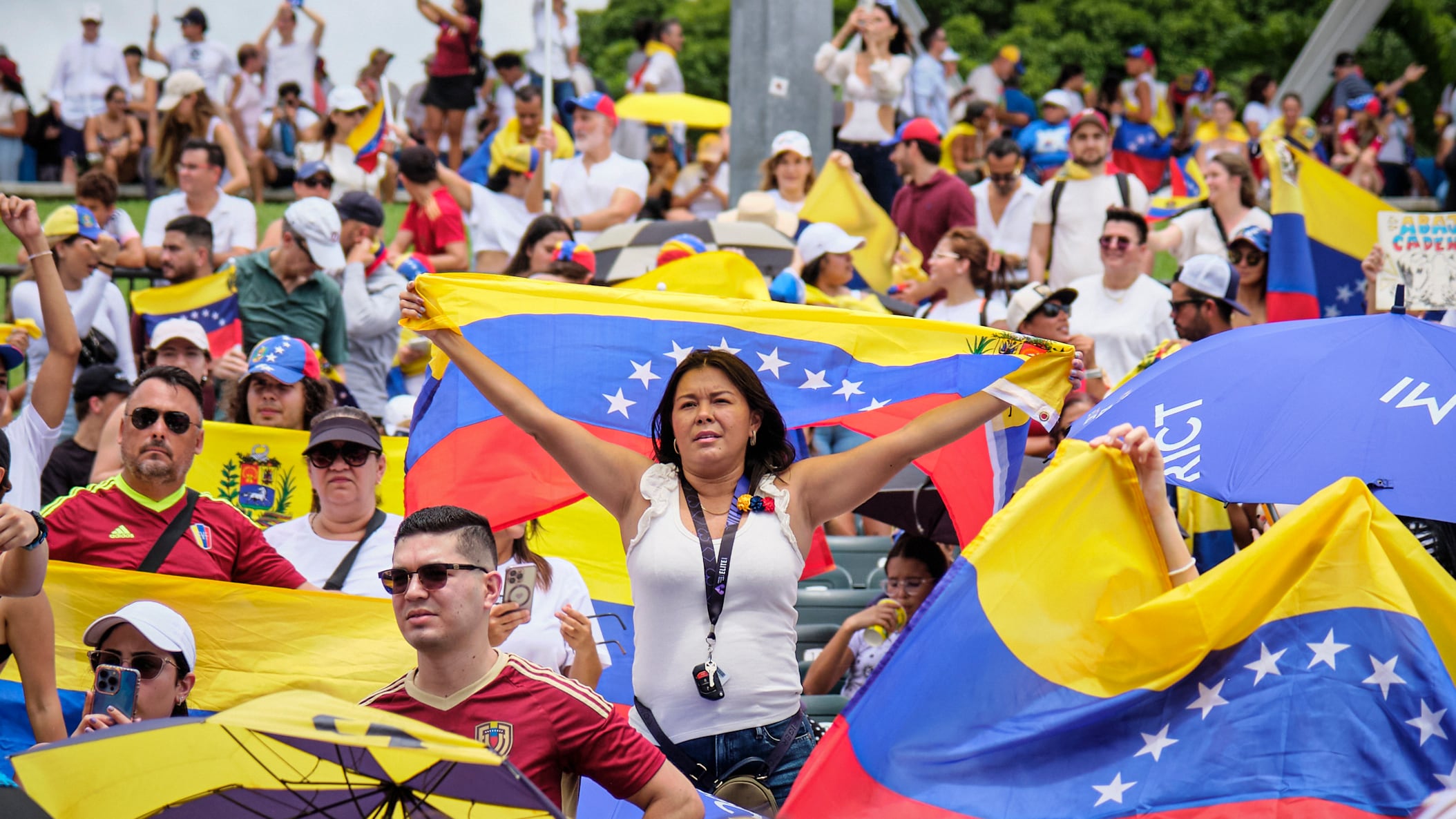
After Maduro’s arrest and with the immigration restrictions imposed by Trump, going back to Venezuela is becoming a real possibility for some. However, doubts remains as the Chavista regime continues to hold power
In South Florida, home to most members of the Venezuelan diaspora in the United States, a question that recently seemed unthinkable is now being asked: “What if we go back?”
The capture of Nicolás Maduro on January 3, 2026, has shaken not only Venezuelan politics, but also the daily lives of thousands of migrants from that country who have embraced the United States as their permanent home. Now, almost a month after the fall of Maduro, for the first time in a long time, the idea of returning is beginning to feel like a real possibility, albeit one that’s still fraught with uncertainty.
Edgar Simón Rodríguez has been in the United States for seven years. He arrived after “fleeing the Chavista regime” — referring to the ruling United Socialist Party of Venezuela (PSUV) — and has since worked actively in the Venezuelan opposition from exile. He’s the organizing coordinator for Vente Venezuela in the United States, the political party led by María Corina Machado. He didn’t sleep a wink on the morning of January 3.
“I was notified at 2 a.m. or 3 a.m. that they were bombing Caracas. I made myself coffee because I knew I wasn’t going to sleep anymore,” he recalls. In the middle of the night, he met with part of the political team. The news of Maduro’s capture was, for him, “a fundamental step” that marks the beginning of a transition, which is “still fragile, but inevitable.”
“Maduro’s arrest is a key step. It marks the beginning of a process that must end in the complete liberation of the country,” he affirms. However, he speaks cautiously. He knows that the transition will be complex and that the “repressive apparatus of Chavismo” remains active. That’s why, even though his desire is to return to his home country, he hasn’t set a date yet.
“I would return without hesitation if the regime falls completely and the repressive agencies are dismantled. I’m not thinking about [political] positions; I’m thinking about a project to reinstitutionalize the country,” he explains.
Jorge Andrés Galicia, a 30-year-old Venezuelan lawyer, who has been in exile since 2018, shares a similar reflection. He lives in Miami and arrived in the United States alone, fleeing political persecution. For him, January 3 was a mixture of anguish, faith and hope.
“I received calls from my mother and my girlfriend, saying that they could hear bombings and planes flying over Caracas. I turned on the news and started praying to God,” he recounts. When he saw Donald Trump’s announcement confirming Maduro’s capture, he found it hard to believe. “When I confirmed it was true, I felt that we were finally witnessing an act of justice in our lives.”
Galicia also wants to return, but not at any cost. “As long as people don’t feel safe and there aren’t real changes on the ground, I won’t return. Venezuela still isn’t a free country,” he says.
Despite feeling hopeful, both Simón and Galicia agree on a key point: so long as the Chavistas remain part of the power structure, Venezuela won’t be free.
The U.S. is still committed to collaborating with the government of Delcy Rodríguez, who became the interim president of the South American country following Maduro’s capture. Last week, U.S. Secretary of State Marco Rubio described the relationship between the U.S. and Rodríguez as “respectful and productive,” after warning that Washington is prepared to use force again in Venezuela if the acting president doesn’t cooperate sufficiently.
The United States’ plan for Venezuela — which could be a process that takes years, according to the Trump administration — is divided into three phases: the first will focus on restoring the country’s infrastructure, including the oil sector; the second, on bolstering economic activity; and, finally, the third will involve a transition to democratic elections.
On Thursday, January 29, Venezuela’s National Assembly unanimously approved a new hydrocarbons law, thus opening the oil sector to privatization — a crucial initial step toward reform.
“We understand that there are phases in a transition, but we’re concerned that it’s slowing down. It involves human lives, political prisoners and families who are waiting,” says Simón, who has already stated that he won’t return until “the change is complete.”
For his part, Galicia maintains that “until the Chavista regime is completely removed from institutions, Venezuela won’t have a genuine democracy. I wouldn’t return before then,” he affirms, also ruling out any possibility of moving for the time being.
Despite the climate of expectation, finding Venezuelans with concrete plans to return to their country isn’t easy. Many prefer not to give their names to EL PAÍS: the fear of reprisals still weighs heavily, even outside the country.
At the Miami airport, Carlos (whose name has been changed) waits for his flight to Santo Domingo, the capital of the Dominican Republic. From there, he will travel on to Venezuela. He carries a backpack, a small suitcase and a folder with documents.
“I was an engineer in Venezuela,” he says in a low voice. “Here, [in the U.S.], I’ve done everything: Uber, plumbing, electrical work… whatever pops up.”
The decision to leave hasn’t been easy. “It makes me very sad to leave the United States, because this country gave me an opportunity. But I no longer feel safe. I feel like I’m being persecuted,” he explains, while confessing that “what’s happening in Venezuela” has been the deciding factor in making this decision.
But that wasn’t all: U.S. President Donald Trump’s immigration policies also pushed him to leave. He was living legally in the U.S. with Temporary Protected Status (TPS), which the White House canceled. That’s why, he admits, he has “nothing left to do” in this country.
“That day, January 3rd, I saw a glimmer of hope. I thought, ‘If not now, when?’”
In Venezuela, he hopes to work on infrastructure reconstruction projects. He doesn’t know how much he’ll earn or what the adjustment will be like, but he says that he “feels at peace” with his decision.
Francisco, a 35-year-old man who also doesn’t want to be identified by his real name, shares that same feeling. He arrived in the U.S. five years ago and became a father for the first time a few months ago. Even so, he plans to leave the country in May.
“This is no longer the country that welcomed me. I’m grateful for everything, but I no longer feel safe,” he explains.
Francisco — who acknowledges that “if nothing had happened in Venezuela” he probably would have stayed in the United States without documents — speaks of fear and uncertainty. But he also admits to feeling “a sense of nostalgia that never went away.”
The debate about returning isn’t just an emotional one. It’s starting to be reflected in the South Florida real estate market. Gisela Rojas, from Venezuela, says that she experiences it “daily” as head of the real estate company The Caissa Group.
“There’s definitely an increase in inquiries,” she explains. “Clients who bought years ago are now calling to sell or, at least, to find out how much their house is worth today, because they’re considering leaving,” she describes, emphasizing that “this isn’t just a passing phenomenon.”
“For the first time in years, the idea of returning [to Venezuela] is no longer just a wish,” she adds. “For many, it’s starting to become a plan.”
Sign up for our weekly newsletter to get more English-language news coverage from EL PAÍS USA Edition
¿Quieres añadir otro usuario a tu suscripción?
Si continúas leyendo en este dispositivo, no se podrá leer en el otro.
¿Por qué estás viendo esto?
Si quieres compartir tu cuenta, cambia tu suscripción a la modalidad Premium, así podrás añadir otro usuario. Cada uno accederá con su propia cuenta de email, lo que os permitirá personalizar vuestra experiencia en EL PAÍS.
¿Tienes una suscripción de empresa? Accede aquí para contratar más cuentas.
En el caso de no saber quién está usando tu cuenta, te recomendamos cambiar tu contraseña aquí.
Si decides continuar compartiendo tu cuenta, este mensaje se mostrará en tu dispositivo y en el de la otra persona que está usando tu cuenta de forma indefinida, afectando a tu experiencia de lectura. Puedes consultar aquí los términos y condiciones de la suscripción digital.
Comments
No comments yet.
Log in to leave a comment.