February 8, 2026e-Paper
The View From India Looking at World Affairs from the Indian perspective.
First Day First Show News and reviews from the world of cinema and streaming.
Today's Cache Your download of the top 5 technology stories of the day.
Science For All The weekly newsletter from science writers takes the jargon out of science and puts the fun in!
Data Point Decoding the headlines with facts, figures, and numbers
Health Matters Ramya Kannan writes to you on getting to good health, and staying there
The Hindu On Books Books of the week, reviews, excerpts, new titles and features.
February 8, 2026e-Paper
Published - February 09, 2026 01:10 am IST
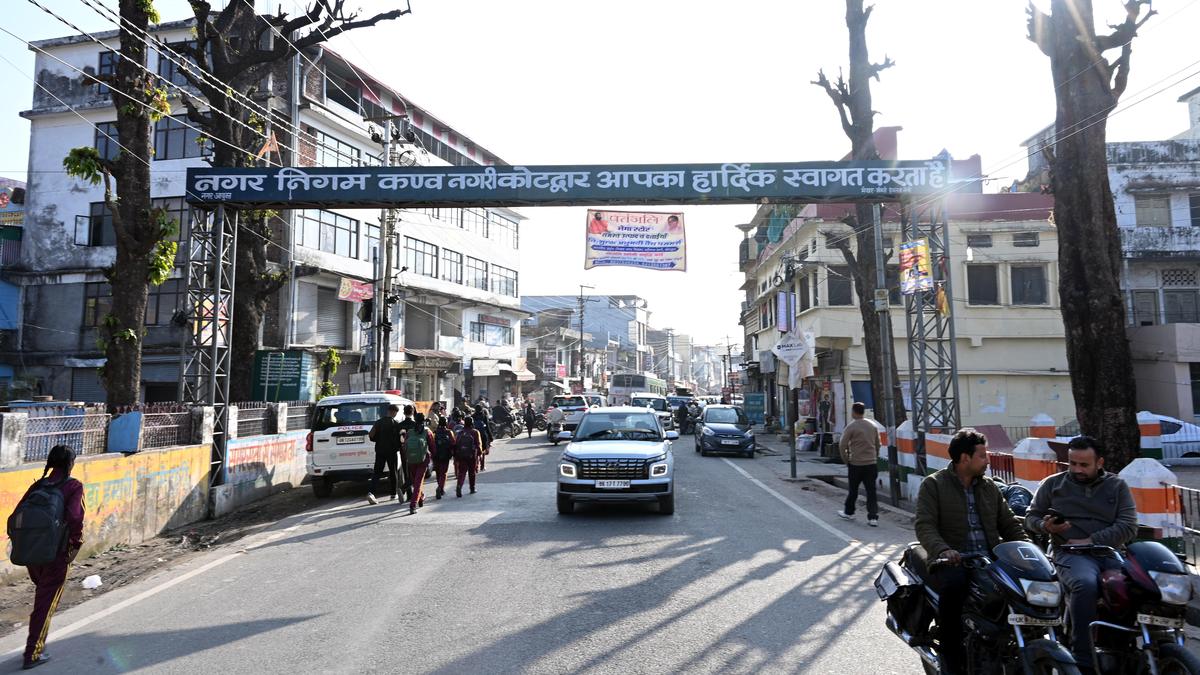
At the entrance to Kanva Nagri Kotdwar town, renamed in 2021. | Photo Credit: Tayyab Hussain
On Republic Day, patriotic songs blared on loudspeakers and the tricolour fluttered across Kotdwar, a town known as the gateway to the Garhwal hills in Uttarakhand. The atmosphere was upbeat, celebratory, and nationalistic. This did not last.
In a market near Jhanda Chowk, a crowd gathered outside a shop. Voices rose and anger thickened the air. Mobile phone videos — later widely circulated on social media — captured a group of young men coercing a garment seller into removing the word Baba from his shop name. The shop, called Baba School Dress and Matching Centre, itself had existed longer than the men confronting its owner had lived. As the elderly trader trembled and struggled to speak under the bullying, a man, much taller than the youths, stepped forward to challenge the harassment. When asked to identify himself, he replied, “My name is Mohammad Deepak.”
In the days that followed, Deepak Kumar, who tacked on the name ‘Mohammad’ to his name to make a point, would face an FIR for intimidation, rioting, and breach of peace. People would avoid coming to the gym he owns out of fear of the police deployed outside, and his daughter, wife, and mother would suffer threats from those associated with right-wing groups.
“My 5-year-old daughter has a high fever. My wife and mother cry heavily after hearing the life threats. We have suffered so much when I did nothing wrong,” says Deepak. His eyes grow wet.
Deepak is one of the few Uttarakhand residents who have stood against hate and have spoken up for those they believe are being wronged.
A January 2026 report by the Association for Protection of Civil Rights (APCR), which provides free legal aid to the marginalised, throws light on the changing social landscape of Uttarakhand. Titled Excluded, Targeted, & Displaced: Communal Narratives and Violence in Uttarakhand, the report documents a rise in communal violence, forced displacement, and systematic exclusion experienced by Muslim residents across the State since 2021.
The Bharatiya Janata Party (BJP) has been in power in the hill State since 2017. Hours before the protestors gathered outside Deepak’s gym, the Chief Minister, Pushkar Singh Dhami, was in Kotdwar for the inauguration of a bird festival. In his speech, he said that any tampering with the State’s rich cultural heritage and values would not be acceptable. “Whether it is a case of encroachment or related to land jihad or love jihad… we have acted firmly,” he said.
Down the highway that leads to Kotdwar, are giant posters of a Virat Hindu Sammelan, a gathering of Hindus to discuss culture. It has the line “Ek Hindu ko mai jagaun; eK Hindu ko aap jagao,” (I will awaken one Hindu; you awaken another), the poster reads.
The main affected
Wakeel Ahmed, 71, the man at the heart of the controversy, says it never occurred to him that the word ‘Baba’ could be claimed by one religion alone. “They told me that Kotdwar is the land of Baba Siddhabali, a form of the Hindu god Hanuman, and therefore I, as a Muslim, cannot use that name for my shop,” Ahmed said to the media later. Since the incident, he has begun spending more time indoors, wary of the tension outside, avoiding the press and the curious. He refuses to rename the shop that has been part of the town for decades.
The FIR against Deepak was filed based on a complaint from members of the Vishwa Hindu Parishad (VHP). He sits desolately in front of a giant poster of lord Hanuman in his gym in Kotdwar’s Jhanda Chowk. At the roundabout, a 65-foot tricolour rises into the sky. He looks at the almost-empty client-entry chart.
Five days after the incident, and a day after India observed Gandhi’s 78th death anniversary, a group of about 150-200 allegedly gathered outside his gym and raised slogans of Jai Shree Ram while shouting that they would teach Deepak a lesson. Videos of this gathering, too, were widely circulated on social media.
“They have deployed police outside my gym now, but no one paid heed to my complaint when I told police about calls being made by “kuch dal” (some organisations) to harm my family. They said they’d come to Kotdwar to teach me a lesson,” he says, asking where the police were when the group of men gathered outside his gym. Later, police had filed an FIR on unnamed men.
Deepak Kumar (left) with Vijay Rawat at his gym in Kotdwar. | Photo Credit: Tayyab Hussain
Vijay Rawat, Deepak’s co-accused in the police FIR, stands composed. He says he was with Deepak both in body and spirit. Since then, his father has been tense. “He calls me several times a day, just to check on me. My family agrees that I did the right thing, but their concerns are also real,” he says. The concerns he speaks about are the stress of getting involved with a criminal case, threats from right-wing groups, and the ostracisation in a small community.
Nandkishore, who runs a grocery shop in Jhanda Chauk, has known Deepak for at least a decade. He also knows those who threatened Ahmed. He does not want to take sides. “I just want peace in my town,” he says.
Saurabh Nautiyal, a BJP councillor, who was seen in the angry mob that gathered outside Deepak’s gym, says, “Why can’t they name their shops so we know their religion? If they are doing nothing wrong, why are they hiding behind Hindu names?”
Just a few metres away from Deepak’s gym, a signboard welcomes visitors to Kotdwar — a town that has recently been rechristened Kanv Nagri Kotdwar, named after a rishi. In March 2025, the Uttarakhand government renamed 18 places and localities that previously had names associated with the Muslim community, saying this was done “to respect public sentiments”.
Suryakant Dhasmana, Congress vice president, claims that with elections due in 2027, the BJP has nothing to show for itself. “The only way they have to win is to create fear, and tell Hindus that Muslims are a threat. Legislations like the Uniform Civil Code, the minority education bill that aimed to abolish the Madrasa board, and the anti-conversion law — all these are only aimed at polarising and dividing.”
Voice against division
Less than nine months before the incident in Kotdwar, another voice rose against communal division in Uttarakhand — this time in Nainital, the city of lakes and one of North India’s most visited hill stations.
In April 2025, the town was shaken by communal unrest following the arrest of a 72-year-old man, Usman, accused of molesting a minor girl from the majority community. Police acted swiftly, taking the accused into custody. Right-wing groups, joined by local residents, launched protests that soon turned violent. Shops owned by Muslims were vandalised, workers assaulted, and stones hurled at a religious structure.
As tension engulfed Nainital during peak tourist season, a 30-year-old woman, Shaila Negi, stepped forward — alone — to confront a swelling mob that was approaching shops. She questioned the logic of collective punishment, asking why an entire community was being targeted for the alleged actions of one individual.
“Sabko kyun maar rahe ho…” (Why are you beating everyone), her voice is heard asking in a video that later went viral. The daughter of an office-bearer of the local traders’ association, Shaila chose not to lower the shutters of her shop despite calls for a bandh aimed at protesting against Muslims. Keeping her shop open became an act of resistance in a town gripped by fear.
The backlash was swift and vicious. “Some of the comments on the viral videos said I should be raped and thrown into the lake,” Shaila says. “Others abused me or said I should be killed for betraying my community. What wrong did I do by asking the mob to stop the violence?”
Watching the nationwide support now pouring in for Deepak brings her a quiet sense of relief. “I had to fight all alone,” she says. “No one stood by me except my family.”
Quiet solidarity in Purola
Beyond the viral videos and fleeting moments that briefly capture national attention, Uttarakhand holds quieter stories of solidarity — acts of courage that went largely undocumented. One such story belongs to 83-year-old Dharam Singh Negi, the oldest practising lawyer in Purola, a small town in Uttarkashi district that serves as a gateway to the pilgrimage sites of Gangotri and Yamunotri.
In the summer of 2023, Purola was gripped by communal tension after a minor girl was allegedly abducted by two youths — one Hindu and the other Muslim. Local residents apprehended the accused men, who were subsequently arrested and sent to jail. But the arrests failed to stem the rising hostility.
Editorial | Mounting tensions: On the threat to social harmony in Uttarakhand
Several right-wing organisations, including the Bajrang Dal, Vishwa Hindu Parishad, and Bhairav Sena, launched protests targeting the minority community, issuing calls for social and economic boycotts.
What followed was an atmosphere of intimidation. X marks appeared outside Muslim homes. Residents were warned against buying goods from the community’s traders, and landlords were pressured to evict tenants from the community. As fear spread, several minority families were forced to leave Purola.
As law and order slipped out of control, the octogenarian lawyer refused to yield to the tide of hatred. “Some fringe elements pasted a poster outside my house, ordering my Muslim tenants to vacate within a day,” Negi recalls. “I was furious. I confronted them and asked how they could demand that someone living on my property leave without my consent.” The men shouted slogans and issued threats, but Negi says he remained unmoved.
Negi’s refusal to comply — a firm, public stand — resonated across Purola. Word spread quickly, and emboldened by his defiance, and several other landlords decided not to evict their Muslim tenants.
Bale Khan, Negi’s tenant, who has been living in the house for decades, says he remembers many milestones in this home. He also remembers a time when Uttarakhand’s Hindu neighbours guarded Muslim shops during Namaz and Muslim families cooking food for Hindu volunteers during the floods.
“During floods and landslides, religion dissolves into urgency. No one asks the religion of a hand that pulls strangers from the debris,” Khan, who runs a garment shop says.
Published - February 09, 2026 01:10 am IST
Spotlight / Uttarakhand
Copyright© 2026, THG PUBLISHING PVT LTD. or its affiliated companies. All rights reserved.
Terms & conditions | Institutional Subscriber
Comments have to be in English, and in full sentences. They cannot be abusive or personal. Please abide by our community guidelines for posting your comments.
We have migrated to a new commenting platform. If you are already a registered user of The Hindu and logged in, you may continue to engage with our articles. If you do not have an account please register and login to post comments. Users can access their older comments by logging into their accounts on Vuukle.
Comments
No comments yet.
Log in to leave a comment.