South Korea is highly dependent on the US for security and exports, says Pusan National University’s Robert Kelly.
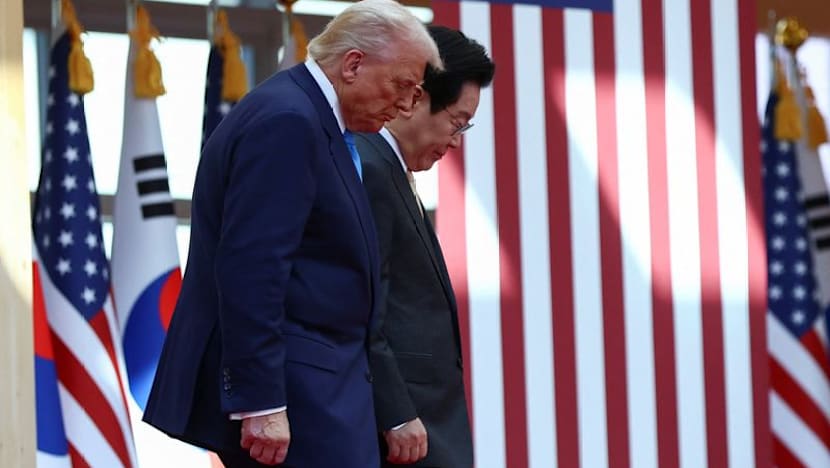
U.S. President Donald Trump meets with South Korean President Lee Jae Myung on the sidelines of the Asia-Pacific Economic Cooperation (APEC) leaders' summit in Gyeongju, South Korea, October 29, 2025. REUTERS/Evelyn Hockstein
This audio is generated by an AI tool.
In a move that caught officials in Seoul by surprise, Mr Trump said on Jan 26 he would raise tariffs on motor vehicles and other South Korean imports to 25 per cent, citing delays in implementing a trade deal agreed last year. The deal included a commitment from Seoul to invest US$350 billion, with US$150 billion earmarked specifically for the US shipbuilding sector.
That investment has not happened yet, nor has it been approved by the South Korean legislature. This delay is a natural part of the democratic process, especially given the sheer size of the proposed investment. But Mr Trump has shown little patience for such democratic constraints hence the turn to tariffs as leverage.
Mr Trump likely wants this investment package to arrive as rapidly as possible. With the midterm elections scheduled for November and his approval ratings under pressure, this could be marketed as a “win” to his voters.
The announcement has seen Seoul reiterating its commitment to the deal, with officials, including the country’s Trade Minister Yeo Han-koo, saying that Seoul is prepared to move swiftly to follow through on the earlier pledges. Given its dependence on the US for security and exports, South Korea may not have too many options to navigate this renewed pressure from the US.
It is worth noting that the Trump administration does not negotiate via conventional diplomatic channels.
Modern states, particularly mature democracies, have a legal-constitutional process by which international treaties are struck: The foreign ministry negotiates a treaty with a partner state, frequently over a lengthy period; the executive branch leader – the president or prime minister – signs the final text; the elected parliament then ratifies it. Only then is it binding law.
By contrast, Mr Trump and his administration have favoured informal negotiations for “deals” that are often announced publicly with limited detail.
Detailing binding commitments is the reason why treaty negotiations take so long and the resulting text is lengthy. The current US administration’s resistance to such processes creates serious problems for its counterparties, many of whom cannot legally agree to Trump’s demands.
In South Korea’s case, the US’ demand for large financial commitments has, unsurprisingly, stirred concerns.
There is significant worry in Seoul that Mr Trump is leveraging the US alliance with South Korea to extract what economists call a “rent” – a profit derived from political power, rather than market forces. To prevent that, Seoul has pushed for some kind of oversight and profit-sharing framework, which takes time.
Bills linked to the trade deal have been bogged down in South Korea’s National Assembly, where partisan disagreements persisted over whether the arrangement requires formal ratification. The country’s opposition was of the view that parliamentary approval is required for the deal with the US, given how the bills could impose burdens on taxpayers.
But amid mounting tariff pressure, South Korea’s ruling and opposition parties have recently agreed to establish a special committee on the matter. The special committee will have the power to draft a special bill and have it finalised by Mar 9.
In his zero-sum way of viewing trade, Mr Trump sees trade deficits as a defeat for the US.
South Korea has run an aggregate trade surplus for decades, including with the US. As a result, the South Korean central bank is routinely under special surveillance by the US Treasury Department for potential currency manipulation.
That said, a trade surplus is regularly reported in South Korea as victory for the country so there is some room to argue, as Mr Trump usually does, that South Korea is “taking advantage” of the US. Still, most of these trade issues were litigated between the two sides in the negotiations for the US-Korean trade deal first struck in 2007, and subsequently amended in 2010 and 2018.
The real driver of the current US-South Korea trade imbalance is likely South Korea’s low fertility rate and high consumer debt – both of which weigh on consumption. However, the headline trade deficit is likely the only relevant metric to the White House.
Other US trade partners, particularly the European Union (EU), have fought off similar demands. The EU has the market power to resist and does not need US security guarantees as much as South Korea does.
South Korea, by contrast, is a small market struggling with long-term, low fertility-driven decline. With domestic demand too weak to absorb its national products, it desperately needs export markets.
It is also dependent on the US for security, given how it abuts North Korea and China. Without the US alliance, its defence costs would double or triple. Mr Trump has a bully’s sense for the weaknesses of his counterparties, and this means he might leverage South Korea’s market and security dependence to get what he wants.
Robert Kelly is a professor of political science at Pusan National University. He writes a monthly column for CNA, published every second Monday.
Subscribe to CNA’s Morning Brief
An automated curation of our top stories to start your day.
Subscribe to our Chief Editor’s Week in Review
Our chief editor shares analysis and picks of the week's biggest news every Saturday.
Get our pick of top stories and thought-provoking articles in your inbox
Stay updated with notifications for breaking news and our best stories
Join our channel for the top reads for the day on your preferred chat app
Copyright© Mediacorp 2026. Mediacorp Pte Ltd. All rights reserved.
We know it's a hassle to switch browsers but we want your experience with CNA to be fast, secure and the best it can possibly be.
To continue, upgrade to a supported browser or, for the finest experience, download the mobile app.
Upgraded but still having issues? Contact us
Comments
No comments yet.
Log in to leave a comment.