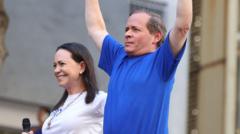
The former vice-president of the National Assembly is among several political prisoners to have been released since the US captured Venezuela's President Nicolas Maduro in January.
"Our entire family will be able to hug again soon," Ramón Guanipa wrote on social media, cautioning: "There are still hundreds of Venezuelans unjustly imprisoned."
Opposition and human rights groups say the government under Maduro had for years used detentions of political prisoners to stamp out dissent and silence critics.
Though the interim government instituted in his absence promised on 8 January that "a significant number" of detainees would be released, this has progressed slowly in the weeks since, with a handful being released at a time.
Foro Penal, which provides assistance to political prisoners in Venezuela, says nearly 400 people have been released.
Its president Alfredo Romero said at least 30 people had been freed on Sunday, including Guanipa. Perkins Rocha, Jesús Armas and Luis Tarbay were also named as having been released.
Since Venezuela's widely disputed presidential election in 2024 - which saw Maduro officially re-elected despite opposition tallies suggesting their candidate had won by a landslide - critics of his regime said legal proceedings against activists, journalists and Maduro's political adversaries increased.
Among them was Guanipa, who went into hiding after being accused of terrorism and treason for challenging the 2024 result.
He was tracked down by Venezuela's security forces and detained in May 2025.
Opposition leader and Nobel Peace Prize winner Machado, who was also in hiding at the time, said her colleague had been "kidnapped" in "an act of state terrorism".
Guanipa is the leader of the centre-right Justice First party. He was elected governor of the Zulia region but barred from taking office after he refused to swear an oath before Maduro's National Constituent Assembly.
With Maduro standing trial on drug trafficking charges in New York, Guanipa's son appeared sceptical a few days after the interim government announced its "goodwill gesture".
Ramón Guanipa told BBC Mundo at the time that he felt "defeated" when his father was not among the first detainees to be released.
"But at the same time, you find another reason to fight," he said. "I'm fighting for them [the interim government] to actually do what they say they're going to do."
Releasing political prisoners was one of US President Donald Trump's demands of the interim government, describing it as "a very important and smart gesture" from Venezuela.
He chose not to install Machado as Venezuela's president after capturing Maduro in a daring raid on Caracas, instead allowing Maduro ally Delcy Rodriguez to take over.
In the weeks since, Rafael Tudares, the son-in-law of Edmundo González, who stood against Maduro in 2024's election after Machado was barred, has been released, as has prominent Venezuelan rights activist Javier Tarazona.
BBC captures celebrations as Belarus frees political prisonersEl Salvador offers Venezuela prisoner swap involving US deporteesRelatives of missing Syrians 'suspended between hope and despair'More from the BBC3 days agoWho is running Venezuela and what are Trump's oil plans?Trump says the US will "run" Venezuela and manage its oil after capturing its president Maduro.
Despite some recent cordiality, the Colombian and American leaders have long traded barbs and accusations.
It is latest in a series of prisoner releases announced by the government amid US pressure for reforms.
The change could pave the way for more foreign investment in the country's oil industry.
Amid rusting oil pumps and rigs, once affluent Venezuelan oil towns place their hope in US investment.
Comments
No comments yet.
Log in to leave a comment.