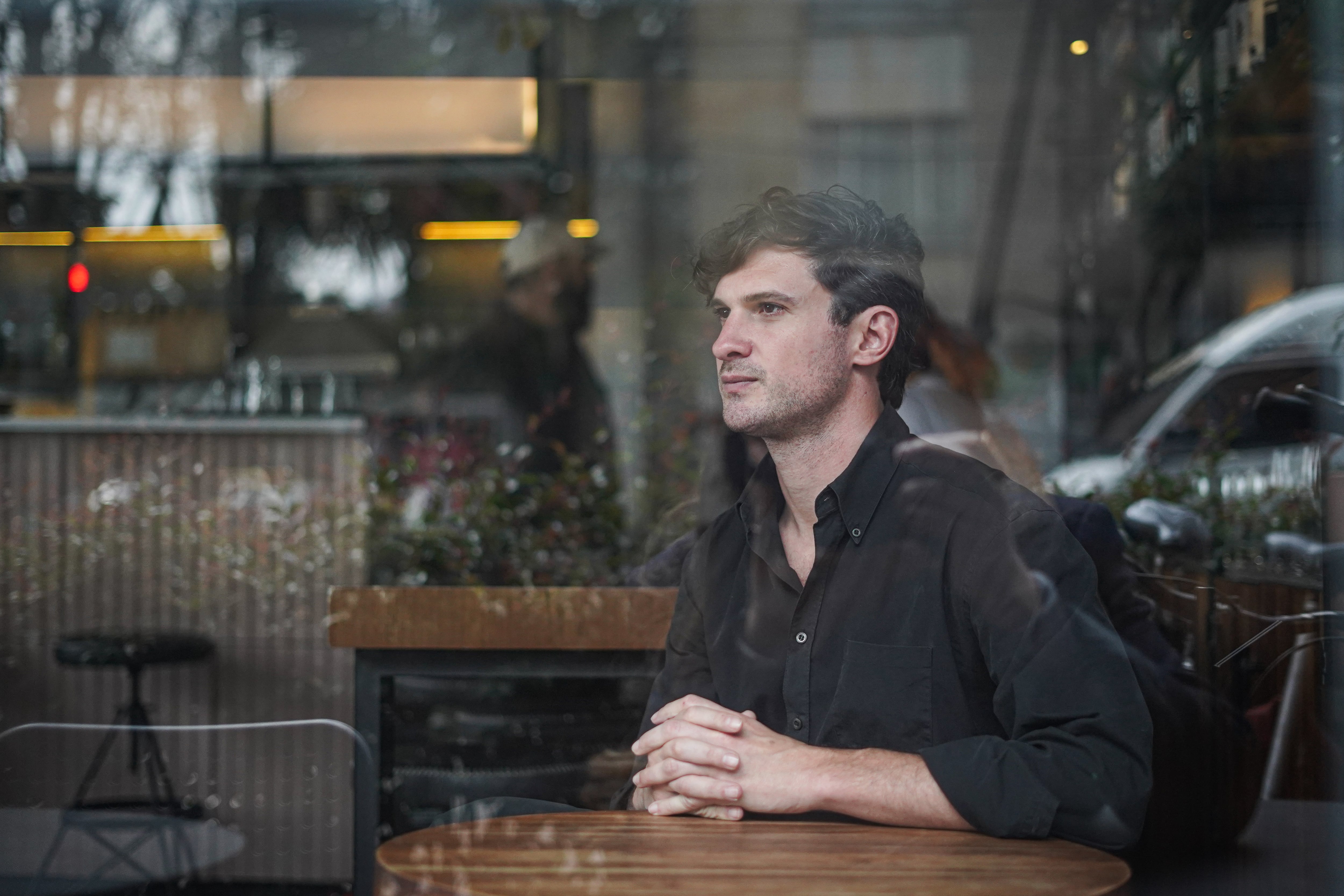
The US analyst is leading a series of summits in Latin America that seek to generate unity around regional sovereignty, in the face of new pressures imposed by the Trump administration
David Adler, 32, defines himself as a radical skeptic. The political scientist and economist was born and raised in Los Angeles. And, since 2020, has been the co-general coordinator of Progressive International, a global movement that emerged during the pandemic to unite different sectors of the left around the world. Its objective is to confront another “international,” one that has been dubbed the “Reactionary International.” The latter has taken shape with the rise of the global far right, spearheaded by U.S. President Donald Trump and his movement.
As multilateralism is forced to reinvent itself amid a global order being reshaped by recklessness and imposed by force under Trump, Adler’s Progressive International organized a conference titled Nuestra América (“Our America”) in Bogotá, Colombia. Held on January 24 and 25, it was named in honor of the 1891 essay by Cuban poet and freedom fighter José Martí.
The Colombian capital hosted the gathering at a historic theater, bringing together more than a dozen left-wing figures from around the world to demand the release of Nicolás Maduro and the defense of regional sovereignty. Among those present were Brazilian activist Thiago Ávila; Clémence Guetté, vice-president of the French National Assembly; and British Member of Parliament Zarah Sultana, of the Labour Party, among others.
“Isolated, we are more vulnerable.” This was a recurring slogan throughout the event, which also included the virtual participation of several U.S. congresspeople from the more progressive wing of the Democratic Party, such as Chuy García, Delia Ramirez and Rashida Tlaib. Faced with the inevitable shadow of the new U.S. international doctrine, attendees promoted financial autonomy, highlighting the need for regional compensation agreements, contingency payment channels and greater trade cooperation within the Global South.
Question. Trump has said that he doesn’t need Latin America. In your opinion, what kind of relationship have the United States and Latin America had? And what should this relationship be like?
Answer. We can use two metaphors: Latin America has been both a laboratory and a beacon. It’s important to emphasize that, for Americans, Latin America has always been a laboratory for our interventions, for our economic paradigms. We saw this with the case of Salvador Allende and the Chicago Boys in Chile. The region has been a laboratory for our international trade paradigm, as happened with the export of corn at the expense of dispossessing peasants.
Conversely, it has been a beacon for the entire world in the fight against this. It’s a region where the concept of solidarity isn’t abstract; it has always played a central role in the struggles for democracy. This is illustrated by institutions like the Union of South American Nations (UNASUR), which transcended left-right ideological lines to build institutions such as the South American Defense Council.
Latin America is on the front lines of the fight against “reactionary international,” and the defense of its democracies and its principle of self-determination will be key.
Q. How do you explain Trump’s second rise to power?
A. There are two interpretations of the arrival of Donald Trump 2.0 and both are correct. The first is that a movement of anger and indignation arose organically among the U.S. people. They felt ignored and marginalized; they suffered a financial crisis that greatly motivated a protest vote in favor of Donald Trump. On the other hand, the other interpretation is inorganic, and this is where the “Reactionary International” comes into play. We saw it in the famous photo of Trump’s inauguration: Elon Musk, Jeff Bezos, the oligarchy. Each of [these oligarchs] contributed to the construction of Trump 2.0.
In both scenarios, we see the oligarchization of the United States. On the one hand, there’s growing inequality. And, on the other, there are billionaires and their contributions to Trump’s campaign.
Q. How would you rate the role of the Democratic opposition after this first year of Trump’s second term?
A. Useless. It’s impossible to understand the United States without understanding that neither the Republican nor the Democratic parties are political parties in the traditional sense. What is the Democratic Party? It’s basically a group of consultants. There’s no grassroots activism. And, since we don’t have a true political party, they’re all like branches in the wind, drifting from one thing to another. They have no principles, because they don’t come organically from a political organization.
Q. How will this impact the midterm elections in November?
A. Let me start by clarifying that we don’t live in a true democracy in the United States. And that’s not just some radical leftist saying that: this is what study after study of how this political system works has shown. It’s one that favors the ultra-rich.
Even so, I recognize that these methods are among the few tools we have to stop this psychopath. It’s essential that we work hard to win the midterms and change the math in the House and Senate to stop some — if not all — of this administration’s absurd and dangerously imperialist maneuvers.
Q. If that doesn’t defeat him, what will be the most effective option to confront Trump? Continuous protests, like those in Minneapolis?
A. Jane McAlevey explained this somewhat in her book, No Shortcuts: Organizing for Power in the New Gilded Age (2016). We can have insurgent candidates, we can have protests that draw millions, but to gain popular power, we have to rebuild social institutions from the ground up.
I grew up in Los Angeles and didn’t even know my own neighbors. We have to rebuild the social fabric. There are already some sparks, like the Democratic Socialists of America (DSA), which is mobilizing and training young people. We can also see a fight for migrant rights, with new organizations coordinating safety nets among families.
However, that’s just the beginning. We’re talking about the most atomized, demobilized and politically cynical society. My conviction is that we must seek lessons by looking to the South. Colombia, Mexico and Brazil have much to teach the United States about renewing its democracy and rebuilding its social fabric.
Q. But Trump has undermined the systems of cooperation and multilateralism — the official channels through which that kind of communication takes place.
A. We’re experiencing a breakdown of the multilateral system. It’s not a transition or a reform; it’s a rupture. It’s up to us to build new mechanisms for multilateralism, whether regional or thematic. The Donroe Doctrine is precisely this logic of divide and conquer. Suddenly, everyone in Latin America wants to play against the United States bilaterally: that’s what Trump wants.
Q. What has global progressivism lacked when it comes to stopping the advance of the most conservative forces?
A. We’ve lacked the political will to rebuild institutions and consolidate internationalism. A conference isn’t enough. We must promote institutions that guarantee our autonomy.
I see the Donroe Doctrine and its success in Trump’s first year as a consequence of a pre-existing fragmentation. During the best years of the second progressive wave, we lacked the boldness to strengthen mechanisms to ensure resilience against any offensive from the North.
The challenge for progressivism is how to confront that advance. Sometimes, that means simple legislation. Sometimes that means straightforward legislative proposals. At the same time, it requires mobilizations in the streets to show that there is a popular force backing the reforms.
Sign up for our weekly newsletter to get more English-language news coverage from EL PAÍS USA Edition
¿Quieres añadir otro usuario a tu suscripción?
Si continúas leyendo en este dispositivo, no se podrá leer en el otro.
¿Por qué estás viendo esto?
Si quieres compartir tu cuenta, cambia tu suscripción a la modalidad Premium, así podrás añadir otro usuario. Cada uno accederá con su propia cuenta de email, lo que os permitirá personalizar vuestra experiencia en EL PAÍS.
¿Tienes una suscripción de empresa? Accede aquí para contratar más cuentas.
En el caso de no saber quién está usando tu cuenta, te recomendamos cambiar tu contraseña aquí.
Si decides continuar compartiendo tu cuenta, este mensaje se mostrará en tu dispositivo y en el de la otra persona que está usando tu cuenta de forma indefinida, afectando a tu experiencia de lectura. Puedes consultar aquí los términos y condiciones de la suscripción digital.
Comments
No comments yet.
Log in to leave a comment.