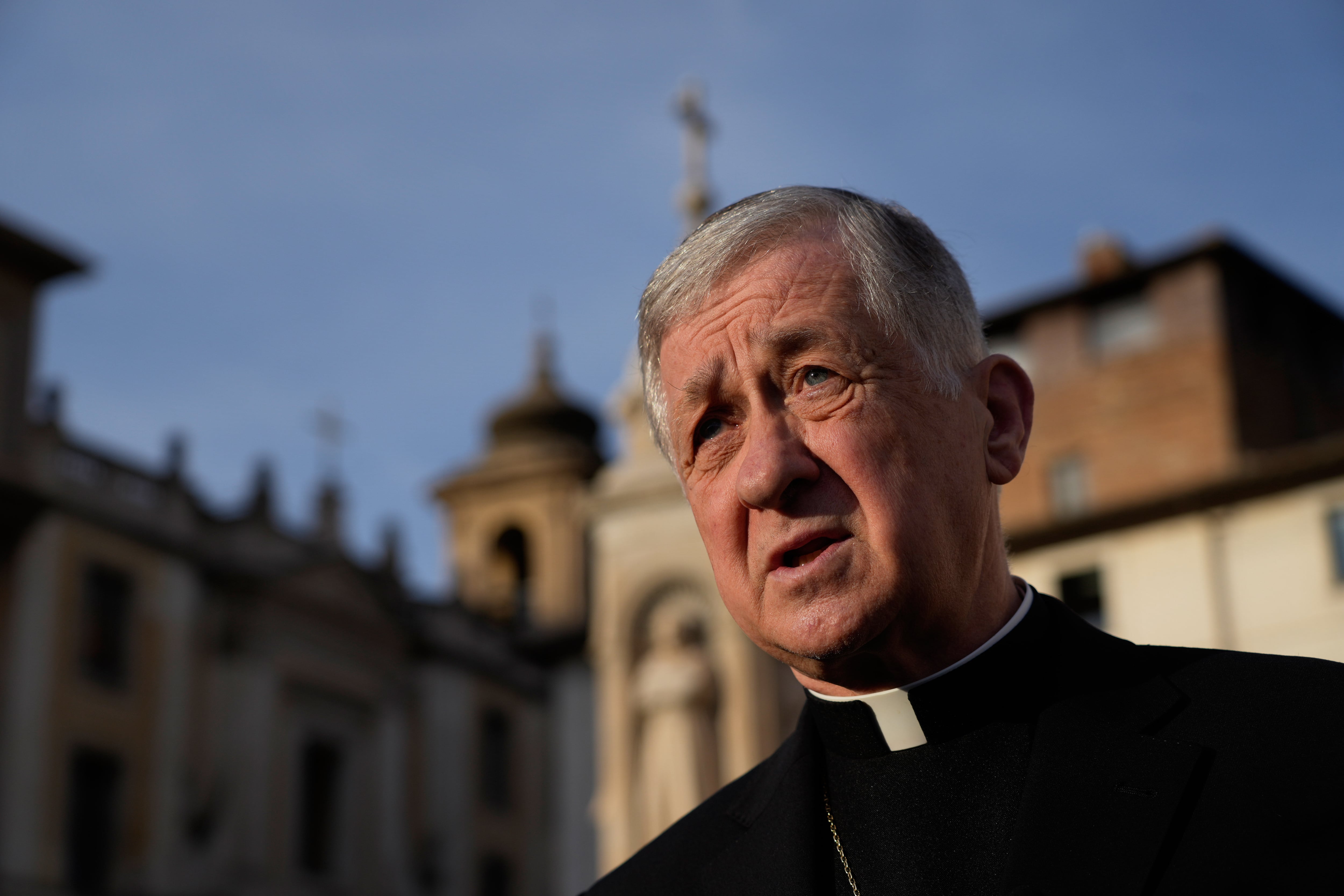
The Catholic prelate criticizes Donald Trump’s anti-immigrant offensive and warns that his foreign policy has jeopardized the United States’ ‘moral role’ in the world
Cardinal Blase Cupich, 76, is one of the leading voices of the progressive sector of the U.S. Catholic Church at a time when the conservative arm, emboldened by the Donald Trump administration, is rapidly gaining ground in a heavily politicized country. Except he doesn’t see himself in that way, nor the church. “I always try to be faithful to what the doctrine of the Church is on social issues, and that is my guide. I don’t want to play the zero-sum game of who’s going to win, the conservatives or progressives,” he says. In an interview with EL PAÍS, he omits mentioning the president by name and instead warns of the “moral implications” of the Republican’s policies. “It’s the Catholic social teachings that can help us in this moment to move forward,” he assures via videoconference.
Last month, the archbishop of Chicago — the birthplace of Pope Leo XIV, the first American pontiff — joined Cardinals Robert McElroy and Joseph Tobin, archbishop of Washington and of Newark, respectively, in penning a strongly worded statement criticizing Trump’s foreign policy. In it, the three highest-ranking heads of Roman Catholic archdioceses in the U.S. cite the cases of Venezuela and Greenland, considering that they “have raised basic questions about the use of military force” and threatened the “sovereign rights of nations.” Although they don’t go into specifics, the January 19 statement was published after the U.S. captured Nicolás Maduro and Trump pressured to take over Greenland.
“Our country’s moral role in confronting evil around the world, sustaining the right to life and human dignity, and supporting religious liberty are all under examination. And the building of just and sustainable peace, so crucial to humanity’s well-being now and in the future, is being reduced to partisan categories that encourage polarization and destructive policies,” the cardinals wrote.
Question. What prompted you to speak out?
Answer. We traveled to Rome to meet with cardinals from around the world, who expressed alarm at how decisions were being made, not just in our country, but around the world, that seemed to, in many ways, step away from the consensus that the world has had since the Second World War on how to handle conflicts. The day after the consistory, Pope Leo gave his address to the diplomatic corps, and that gave us language to be able to address the concerns that we had.
Q. Why did you decide not to name anyone in the statement? Trump was not mentioned.
A. We wanted to provide people, all citizens of the world, and especially in our country, with the language on how to address these issues, because the component of the morality of what was being done seemed to be ignored, and we wanted to highlight that there are other issues involved, other than just satisfying the dominion and domination of one country over another that seemed to be ruling the day and ignoring the rule of law.
Q. Part of the statement reads: “We renounce war as an instrument for narrow national interests and proclaim that military action must be seen only as a last resort in extreme situations, not a normal instrument of national policy.” In the case of Venezuela, many Venezuelans, particularly those in exile in the U.S. and the opposition, celebrated the capture of Nicolás Maduro.
A. What happens is that if you say that ends justify the means, then you begin to open a pathway for how nations can legitimately act in different situations. That needs to be carefully considered, because then one could then say that there are people who might be happy that Russia invaded Ukraine. You can’t go by that measure. The sovereignty of nations is important.
Q. The majority of U.S. Catholics voted for President Trump in 2024. Is your sense that they are in agreement with how he is governing?
A. I don’t have any statistics that can give me an idea about that, except for the fact that there is polling done in which a large group of Americans who did vote for President Trump question the means by which he’s moving forward with his immigration policy. That is important to look at. But we can never, in the church, play the game of asking ourselves whether or not something will be popular. We have to say what’s true, and we have to speak to principles.
Q. The Trump administration often quotes Bible verses to promote or justify its policies, including its mass deportation program.
A. I’m going to let them say what they want. That’s always been the case; there are politicians who like to wrap their policies in scriptural ways. That’s always fraught with danger simply because one could quote one scripture passage in different ways. What you have to look at is not an argument by way of Scripture, but an argument that helps us understand what the moral implications are of a given policy.
Q. In November, the U.S. Conference of Catholic Bishops isssued a Special Message about immigration. It was the first time the conference did that in over 10 years. Why was it important for that statement to be issued?
A. At the center of that issue was the disrespect for human dignity, and that’s why there’s unanimity on the part of the bishops. We have always spoken very strongly about that, whether it’s the child in the womb or the person on death row or the immigrant. For instance, the Bishops Conference also made a statement when there was a cutback in foreign aid, and again, it was because of the violation of human dignity.
Q. Chicago was one of the cities recently targeted by Trump. Thousands of federal agents descended on the city to carry out immigration raids. We know these operations have affected parishes across the country.
A. People are afraid to come out. It brings terror into a city where not just immigrants, but the population, feel as though they’re being terrorized by the ways that these roundups are going. Some of our priests have been stopped because of the color of their skin by these immigration officials, and they’ve been made to show their citizenship and their papers. This is really unheard of. That kind of tactic is really fueling the outrage of people, not only because of the murders that we had in Minneapolis, but also because of our experience here.
Q. In Minneapolis, a number of clergy members were arrested for protesting against ICE and Trump’s policies. What do you believe is the role of the Church at this moment?
A. To offer pastoral care to people who are marginalized and vulnerable. We have to continue to make it a priority. We also have to raise our voice and advocate in a nonviolent way. My major concern is not that we criticize a particular individual in the administration, but that people need to become engaged as citizens in order to have progress. We need to give them the understanding of what’s at stake.
Q. You’ve spoken before about the “broken” U.S. immigration system and the importance of placing responsibility on Congress for it. What changes would you like to see?
A. The major question is how are we going to, in an organized way, allow people to come into this country, but also give them a work visa, like they do in many parts of Europe, where there’s a porous border where people can go back and forth and take care of the needs of their family? Just this week, a judge vacated the order of [Homeland Security] Secretary Noem with regard to the temporary protection status (TPS) of Haitians. These are hard-working people: 20% of the people who are working in health and nursing home facilities in Florida, for instance, are Haitians. We need that workforce.
Q. You are close to Pope Leo, who was born in Chicago. What is your opinion of his first eight months as pontiff? Some say he’s been moving slowly.
A. I would say he hit the ground running. From the very start, it looks like he came out of central casting. He was an individual who made clear that he was going to govern in a way that was collaborative. He’s not afraid to make hard decisions and choose what he says very carefully. He’s going to prove himself this year and will become a major figure in the world.
Q. When he was first elected, many believed he would be a firm voice against Trump. But so far, he has preferred to avoid outright confrontation, something Francis did not shy away from. Why is that?
A. It’s a matter of being precise. He wants to use words in a way that’s going to really move forward the discussion in society. I know that, for instance, there are people in the government who were upset when he used the word “inhumane” to refer to the way that immigration policy was being enforced here. So he’s not afraid to name things the way they are, but he won’t personalize it. Because in the long run, he feels as though the issue is more important than criticizing an individual.
Sign up for our weekly newsletter to get more English-language news coverage from EL PAÍS USA Edition
¿Quieres añadir otro usuario a tu suscripción?
Si continúas leyendo en este dispositivo, no se podrá leer en el otro.
¿Por qué estás viendo esto?
Si quieres compartir tu cuenta, cambia tu suscripción a la modalidad Premium, así podrás añadir otro usuario. Cada uno accederá con su propia cuenta de email, lo que os permitirá personalizar vuestra experiencia en EL PAÍS.
¿Tienes una suscripción de empresa? Accede aquí para contratar más cuentas.
En el caso de no saber quién está usando tu cuenta, te recomendamos cambiar tu contraseña aquí.
Si decides continuar compartiendo tu cuenta, este mensaje se mostrará en tu dispositivo y en el de la otra persona que está usando tu cuenta de forma indefinida, afectando a tu experiencia de lectura. Puedes consultar aquí los términos y condiciones de la suscripción digital.
Comments
No comments yet.
Log in to leave a comment.