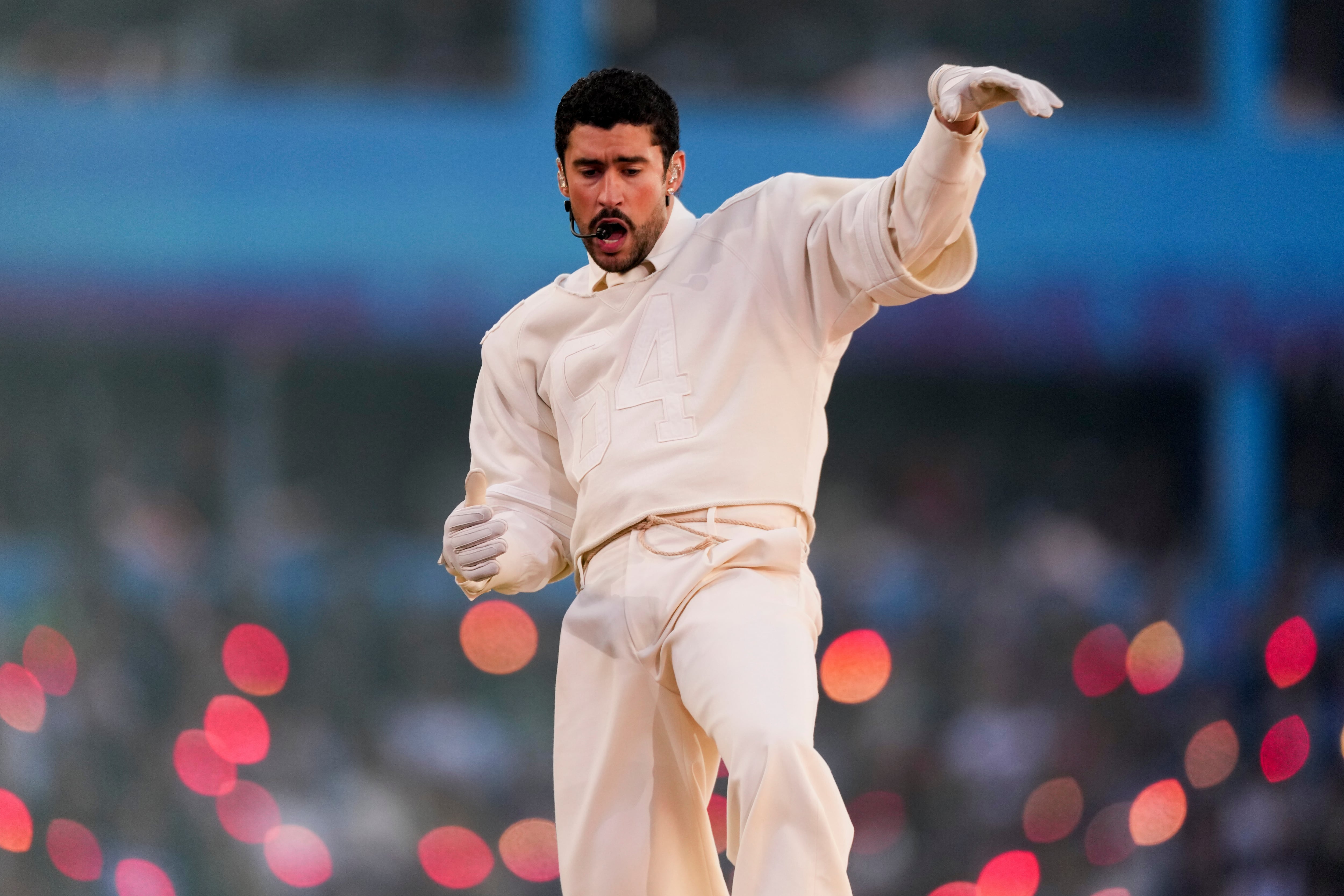
The Puerto Rican artist, with the help of Lady Gaga and Ricky Martin, delivered a brilliant performance in the most anticipated NFL Super Bowl halftime show in recent memory
A fantasy of palm trees, sugar cane, lampposts, domino games, women doing their nails, and corners between Old San Juan and New York—with its market (La Marqueta, like the one in Harlem), its “Casita,” its barbershop, and a liquor store that simply said “Conejo”—served as the backdrop for Bad Bunny’s dazzling confirmation as an icon for Hispanics in the United States and Latin Americans around the world.
The performance, which can only be described as an out-and-out triumph for the Puerto Rican artist, took place on Sunday in Santa Clara, California, during the spectacular Super Bowl halftime show; U.S. President Donald Trump rushed to describe it as “terrible” regardless.
It was actually “el tiempo medio del súper tazón,” a literal translation of Super Bowl halftime, as it was seen in Spanish on the screen at the San Francisco 49ers stadium during the intermission of the NFL final between the Seahawks and the Patriots. The singer showed up dressed to the nines, with an American football that he picked up again at the end of the performance, when, with his song DtMF playing in the background, he exclaimed “We’re still here” and scored a touchdown for the unity of the American continent.
He was surrounded by a dance troupe carrying the flags of all their countries, whose names the singer had just recited angrily, as he raised the flag of his island, Puerto Rico. A message said: “Together we are America.”
Thus ended a dazzling and imaginative recital, which even included a real wedding, and other surprises such as Lady Gaga, accompanied by the Puerto Rican band Los Sobrinos, performing Die with a Smile (with which she won a Grammy alongside Bruno Mars last year) in a salsa style, before joining the star in Baile Inolvidable. Or Ricky Martin, in a gesture of recognition to those who came before him in the musical conquest of America (the country; not the continent), and which also included a medley of early reggaeton hits, including Daddy Yankee’s La Gasolina and Don Omar’s Dale Don Dale.
At that moment, the screens blared a single message in capital letters: “PERREO PERREO,” after a kickoff that included songs like “Tití me preguntó” and “Yo perreo sola.” In the stands, a mostly white audience reacted somewhat coldly to the show, during which the master of ceremonies spoke only in Spanish: “If I’m here today, it’s because I never stopped believing in myself,” he said.
That boy who refused to stop believing in himself, born Benito Antonio Ocasio Martínez, presented a child with one of the two Grammy Awards he won last Sunday. The child’s face resembled Bad Bunny as a child (perhaps because the actor was dressed like the artist in an old photo), but he also reminded viewers of Liam Conejo, the five-year-old boy detained in Minneapolis who has become a symbol of the White House’s brutal immigration policy.
Celebrities such as Karol G, Jessica Alba and Pedro Pascal joined him from a “little house” reminiscent of the historic residence where Bad Bunny held 30 concerts last summer in Puerto Rico.
The singer’s fans had joked throughout the week that a couple of American football teams were tasked with entertaining the crowd on Sunday during the wait for the Benito Bowl, as they called it. The 13 minutes of music that break up a game watched by 130 million people is a global entertainment event in itself, but this time the superlatives fell short. For reasons more political than artistic, it was the most anticipated halftime show in recent times.
Bad Bunny’s biggest statements of the night were his long-awaited tribute to Puerto Rico and his somewhat unexpected defense of America beyond the United States. Also, the gesture of dancing as an act of resistance. And of the Spanish language as a key capable of opening one of the most coveted symbolic spaces in a country whose president has made English official by decree and has launched what aspires to be the “largest deportation” of irregular immigrants in history.
With Bad Bunny, who is not an immigrant but a U.S. citizen, the collision between two visions of the United States in the era of Trumpist tension also took center stage: white, Christian, monolingual America, which fears, as demographers predict, the day when it will cease to be the majority, versus diversity and immigration.
Sign up for our weekly newsletter to get more English-language news coverage from EL PAÍS USA Edition
¿Quieres añadir otro usuario a tu suscripción?
Si continúas leyendo en este dispositivo, no se podrá leer en el otro.
¿Por qué estás viendo esto?
Si quieres compartir tu cuenta, cambia tu suscripción a la modalidad Premium, así podrás añadir otro usuario. Cada uno accederá con su propia cuenta de email, lo que os permitirá personalizar vuestra experiencia en EL PAÍS.
¿Tienes una suscripción de empresa? Accede aquí para contratar más cuentas.
En el caso de no saber quién está usando tu cuenta, te recomendamos cambiar tu contraseña aquí.
Si decides continuar compartiendo tu cuenta, este mensaje se mostrará en tu dispositivo y en el de la otra persona que está usando tu cuenta de forma indefinida, afectando a tu experiencia de lectura. Puedes consultar aquí los términos y condiciones de la suscripción digital.
Comments
No comments yet.
Log in to leave a comment.