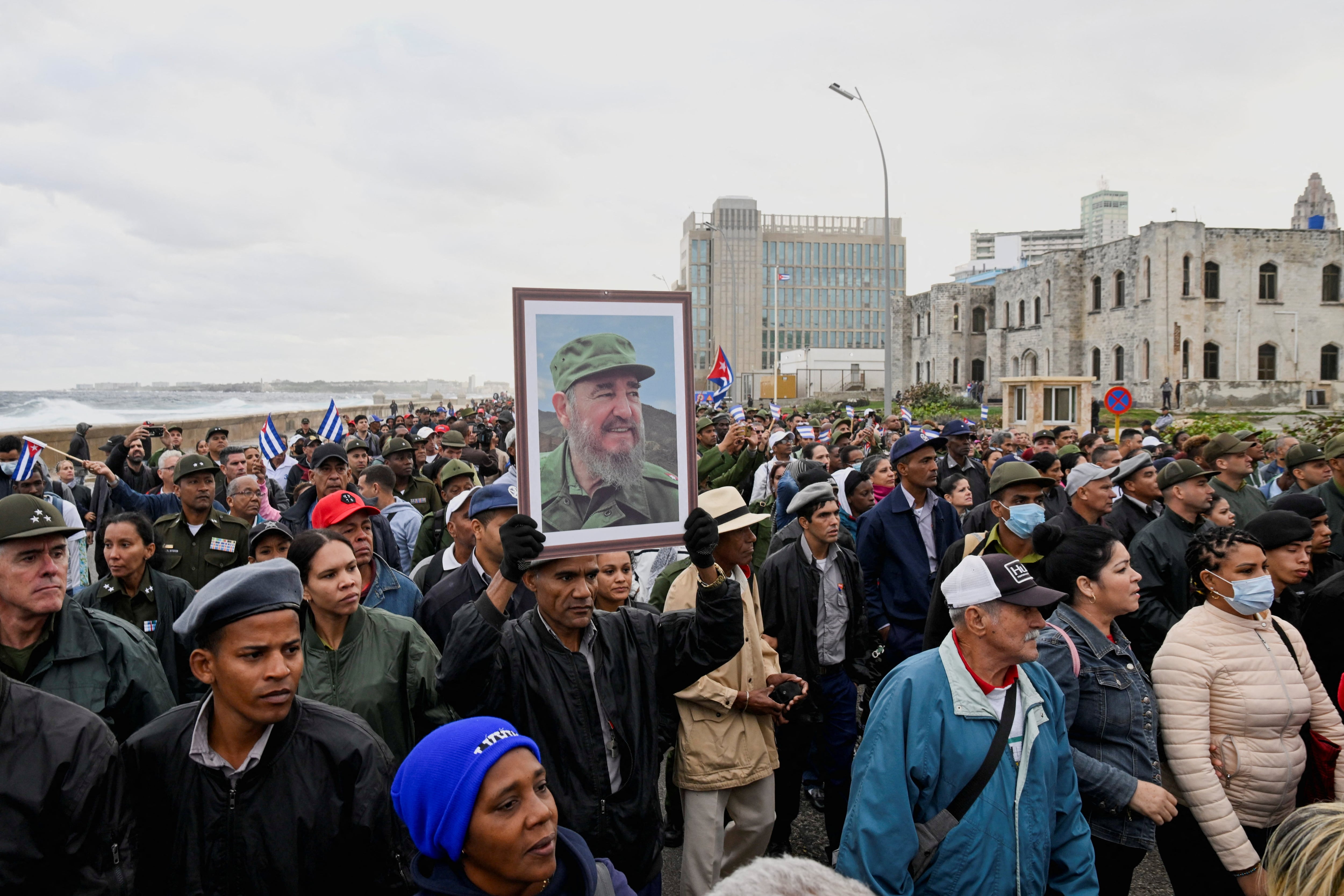
The Caribbean island is dealing with its worst crisis yet, exacerbated by Trump’s latest sanctions on oil supplies
The zero option was mooted by Fidel Castro in the 1990s after the fall of the Soviet Union. Without the support of the Soviets, especially regarding oil shipments, Castroism came up with a survival strategy: strict rationing, suspension of public transportation and temporary closure of schools and universities. The strategy was narrowly avoided. But now, three decades later, the zero option has veered back into view as the country teeters on the edge of its worst crisis in recent history.
Following the U.S. sanctions on fuel suppliers, the Cuban government has implemented measures similar to those planned back in the 1990s. President Miguel Díaz-Canel asked Cubans for “effort” and “creativity,” while acknowledging that he is already in negotiations with Washington. With the threat of military intervention on hold, Donald Trump has dialed up the pressure on a 60-year embargo, which in turn has led to talks and increased uncertainty among the population.
For a month now, expectations have been shifting. If the year began with the fear of a replica of the operation that captured Nicolás Maduro in Caracas, by mid-January it seemed that Washington preferred to sit back and wait for Cuba’s inevitable collapse. Now, negotiations are on the agenda, though the framework remains vague. Early February, Cuban Foreign Minister Carlos Fernández de Cossio acknowledged the “exchange of messages at the highest level.” Without there being any formal negotiations as yet, the Cuban Foreign Ministry has been laying the groundwork for some time, according to the statements of both parties. In a statement that took many by surprise, the Foreign Ministry said on February 1 that “Cuba is willing to reactivate and expand bilateral cooperation with the United States and proposes to renew technical cooperation in areas that include the fight against terrorism, the prevention of money laundering, the fight against drug trafficking, cybersecurity, human trafficking and financial crimes.”
This is not, of course, the first time these two countries have sat down at the negotiating table during their tortuous relationship, nor the first time that Cuba has reached out to the U.S. But for the Cuban historian from the Colegio de México, Rafael Rojas, what is unusual is that Cuba seems “to be adapting to the roadmap laid out by Trump’s National Security Strategy.” At the end of last year, the U.S. president dusted off a 19th century doctrine, known as the Monroe Doctrine, that justified intervention across the American continent, turning international law on its head.
The historian recalls previous negotiations, such as the rafter crisis in 1994, when Bill Clinton’s administration asked Havana to contain the Cuban migratory flow which amounted to more than 35,000 people leaving the island. “But now it’s being talked about in broader terms: Cuba neutralizing the flow from the Greater Caribbean. It is a message that seeks to placate fears of a mass exodus to the United States, one of its greatest historical concerns,” says Rojas. In the last five years, as the deep structural crisis pushing Cubans into misery has worsened, at least one million people have left the island, amounting to 10% of the total population.
Díaz-Canel has insisted on negotiations that exercise “respect for the sovereignty, independence and self-determination of Cuba,” a red line that suggests no sudden departure from the authoritarian political model established in 1959. Trump’s approach to Venezuela, a kind of forced transition, seems unlikely, according to analysts. For Sergio Ángel, the director of the Cuba Program at the Colombian university Sergio Arboleda, “using the same resource would not work.” In Venezuela, he adds, “there were judicial cases against the leaders, previous negotiations and an escalation of force that began with the attacks on the alleged narco-boats.”
The recent announcement by the State Department that it will send $6 million in humanitarian assistance to Cuba indicates Washington is considering very different tactics compared to Venezuela. “The White House is interested in political control and social order in Cuba – both to avoid the much-feared mass exodus, and also to avoid fomenting a wave of repression on the island that would push the U.S. to intervene militarily,” says Sergio Ángel. “At the same time, the State Department’s announcement suggests Cuba’s other suppliers have been displaced to allow the U.S. to become its main supplier in return for a lot [of control].” While the deterrent in Venezuela was force, in Cuba it is linked to the economy.
Some economists in Cuba have been raising their voices calling for reform, especially in the economic sphere. They want to see more openness to international markets and foreign investment, expanding on the initiatives of a decade ago after the thaw of diplomatic relations with the Obama administration. Those initiatives sunk with Trump 1.0 and the pandemic. Now, with the collapse of Cuba’s three main sources of income – tourism, remittances and service exports – Sergio Ángel wonders how long the regime can sustain what is an unbearable situation for the population. “Castroism is an expert in buying time, but time is running out,” he says. Meanwhile, Rojas believes “that the negotiations are going to be slow and moderate. It is possible that they will make some concessions, such as an amnesty for political prisoners, but in a very gradual way.”
While Cuban households try to keep up with the pace of rationing announced by the government, the streets, workplaces and shops are abuzz with frustration. In a market in Havana’s old town, Ramón, a 78-year-old retired engineer, was clearly furious. “We are still in free fall, without an end in sight. How long, gentlemen?” he wonders while the butcher looks on, his expression serious, while fanning the pork exposed on the counter to scare away the flies.
Ramón (a pseudonym) cannot afford to buy pork at1,500 pesos or $3, once a typical ingredient in Cuban cooking. He ends up buying two huge bones that the butcher sells him for 150 pesos. “What can you do? At least with this I can make a broth to warm me up, with the cold as it is,” he says, taking out the last two 100 peso bills from his wallet. Like Ramón, many pensioners are struggling to make ends meet on their dwindling pensions (about 4,000 pesos or around $7 a month), forcing them to look for other ways to survive. With the latest developments and the authorities asking for more effort and creativity, they are eyeing the future with dread.
“I thought we would never have to live through such hardships again after getting through the Special Period [of the 1990s],” says a 72-year-old woman, who had to return to her former job as a schoolteacher to supplement her pension. Her children send her a monthly remittance of $100, “but even so, managing is increasingly difficult with the high prices.” Daily survival involves standing in line for several hours, either at the understocked pharmacy, at the grocery store or at the bank. For this 72-year-old, the government’s contingency measures will bring more chaos to the few services that remain available to the population. “I’m too old and too tired to protest,” she says.
The Cuban government states that not a single shipment of fuel has entered the country since December. With the Venezuela tap turned off, and with Russia and China looking the other way, Mexico is one of the few allies left to the island. President Claudia Sheinbaum has acknowledged that she has suspended fuel shipments, which Cuba depended on last year. But Sheinbaum has indicated that she will begin to send food and humanitarian aid while she examines the possibility of resuming oil shipments without being sanctioned by the U.S.
Mexico is being cautious, as it is also a Trump target, especially in the U.S. administration’s campaign against drug cartels. The bilateral relationship has been marked for decades by an old principle, which still seems to be in force – a kind of tacit agreement between Mexico and the U.S. by which Mexico can take positions contrary to the U.S. as long as it does not pose a serious problem. Mexico’s support of Cuba is an example. By supporting Cuba, the Mexican government could exhibit leftist credentials, without threatening the bilateral relationship.
Sheinbaum is trusting this principle, one that was reinforced by former President Andrés Manuel López Obrador. In 2022, the latter traveled to Havana to be decorated with the José Martí Order, the highest distinction granted by the island’s authorities to a foreign figure. During the event, he denounced the U.S. embargo and sent an ambiguous message: “I want the Revolution to be able to renew itself.” For Sergio Ángel, “it seemed to insinuate that Mexico’s path with the PRI [governing party], and in particular Morena [the political party that emerged from the National Regeneration Movement] could be a benchmark for a democratic transition in Cuba.”
For years, the Castro elite has been analyzing different models – Mexico, China, Vietnam – in the event of a transition that would allow them to hang on to a portion of power. Since López Obrador’s visit, the relationship has been strengthened with more oil shipments in exchange for medical services. Sheinbaum has gone along with it, but with a different discourse. “The President insists on the historical relationship between the two, but with more emphasis on the humanitarian angle. It is a discourse difficult for the Cuban authorities to assimilate, wrapped in the rhetoric of dignity and resistance,” adds Sergio Ángel.
The lack of consistency in the Cuban government’s latest statements are another symptom of the extreme situation in which the island finds itself. Castroism no longer denies poverty and uses terms such as “genocide” to criticize Trump’s policies. According to the analysts consulted, they are policies that aim to “turn the suffering of the population into a spectacle,” thereby attempting to appear legitimate and worthy of international solidarity.
Meanwhile, Cubans continue to face a crisis that seems never-ending – the regime’s worst to date. According to a recent survey by the Sergio Arboleda University, carried out last year, almost 80% of Cubans believe that they are experiencing a more extreme crisis than during the 1990s with the threat of option zero hanging over them.
Sign up for our weekly newsletter to get more English-language news coverage from EL PAÍS USA Edition
¿Quieres añadir otro usuario a tu suscripción?
Si continúas leyendo en este dispositivo, no se podrá leer en el otro.
¿Por qué estás viendo esto?
Si quieres compartir tu cuenta, cambia tu suscripción a la modalidad Premium, así podrás añadir otro usuario. Cada uno accederá con su propia cuenta de email, lo que os permitirá personalizar vuestra experiencia en EL PAÍS.
¿Tienes una suscripción de empresa? Accede aquí para contratar más cuentas.
En el caso de no saber quién está usando tu cuenta, te recomendamos cambiar tu contraseña aquí.
Si decides continuar compartiendo tu cuenta, este mensaje se mostrará en tu dispositivo y en el de la otra persona que está usando tu cuenta de forma indefinida, afectando a tu experiencia de lectura. Puedes consultar aquí los términos y condiciones de la suscripción digital.
Comments
No comments yet.
Log in to leave a comment.