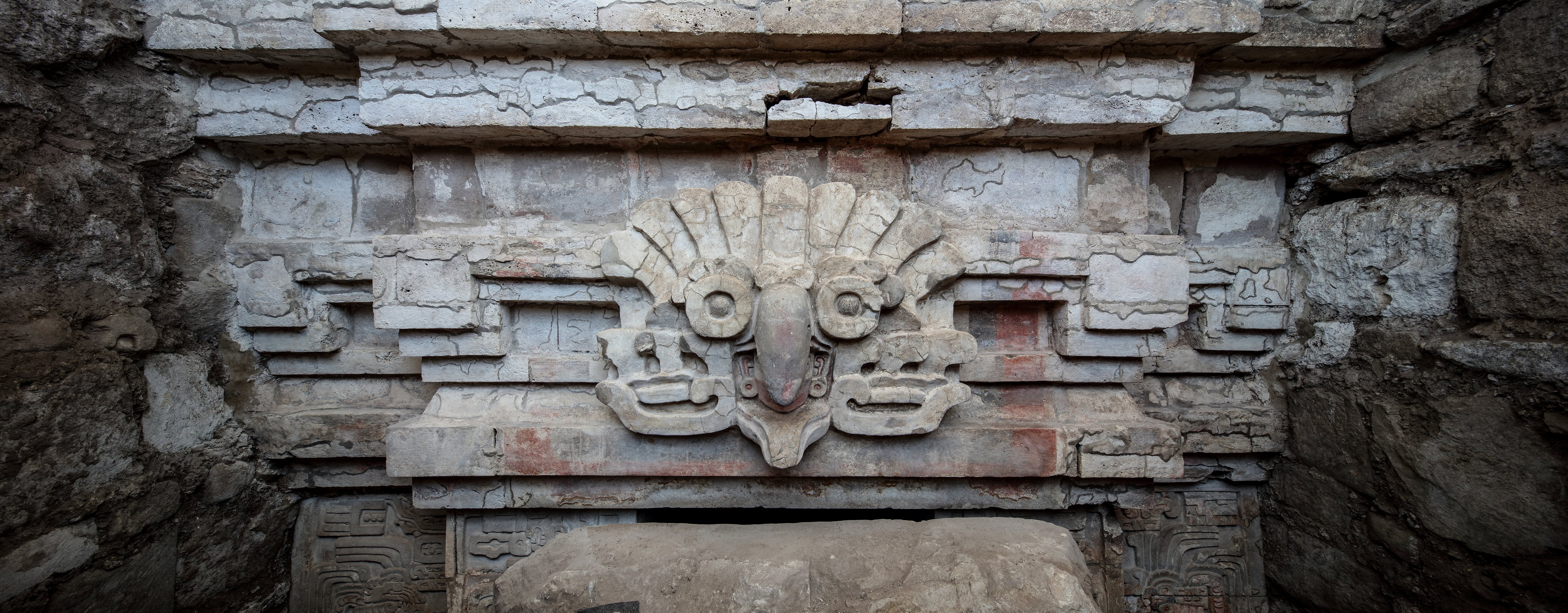
In Huitzo, Oaxaca, two experts explore the intricacies of the Tomb of the Owl, one of the most important discoveries in Mexican archaeology of the last decade
It was 2019. On the hills of La Cantera, in the central valleys of Oaxaca, in southern Mexico, lay a massive stone and stucco tomb, hidden underground. It had stood there for hundreds of years, untouched by progress, the world and its vicissitudes… It coexisted with roots and insects, especially with “tiny winged ants that gnawed through the soft stone,” explains the archaeologist Cira Martínez of the National Institute of Anthropology and History (INAH). Until one day, looters showed up. “They made a hole at the top, pierced the roof, and went inside,” Martínez recounts. Ironically, this was the beginning of the discovery of the Zapotec Tomb of the Owl, one of the most important archaeological findings in Mexico in the last 10 years.
A copal tree marked the spot, but experts only learned that later, when they finally found it: it took them six years to locate the tomb, a journey interrupted by the Covid-19 pandemic. Cerro de la Cantera and its sister hill, Cerro de la Campana, were part of one of the many archaeological zones in the central valleys of Oaxaca, home, a millennium and a half ago, to the great Zapotec civilization, one of the oldest in Mesoamerica, predating the Aztecs and contemporary with some Mayan cities. Since the late 20th century, the INAH had been excavating the “acropolis” of the old city that once stood there, as Martínez explains, “the temples, the ball court,” but hadn’t had time to explore the rest of the ancient city, which covered a total of about six square kilometers.
While they waited, the looters saw an opportunity. It’s unknown what they took or what they did with it. Nor is it known how they found the tomb. Since the INAH received the tip in 2019 — the report only stated that a tomb was being looted in Huitzo, the current name of the town — Martínez and other colleagues set about locating it. It was like finding a needle in a haystack, until one day, years later, the search party, made up of archaeologists, restorers, local residents, and council members, encountered a shepherd. They asked him if he knew anything, and the shepherd pointed to the copal tree. That’s where it was, he said, on the hill. Cira Martínez and other colleagues climbed up and, indeed, found something strange. The earth had been disturbed, mixed with “fragments of pottery, paint, and stucco,” she recalls.
That was in February of last year. After digging for a while, the archaeologists found the tomb, its roof covered with a wooden plank left behind by the looters. When they removed it, they glimpsed for the first time the distant past, as though going through an interdimensional portal typical of science fiction films, their legs in the 21st century and their face in the 7th, all emotion and smiles in a bygone darkness. In just one week, a team of archaeologists, restorers, masons, and architects from the INAH excavated the entire structure. They discovered it was quite large, more than five and a half meters long, between one and a half and almost three meters wide, and with a gradually increasing height, from 1.60 meters to 2.60 meters.
The interior still displayed fragments of mural paintings, undoubtedly depicting the stories of those buried there. But the most impressive find appeared at the entrance. Above the tomb’s doorway, archaeologists discovered a mask in the shape of an owl, superimposed on the face of a human figure. The mask, made of stucco, was remarkably well-preserved. Martínez was reminded of another mask found in Zapotec tombs south of the valleys, in an area known as Lambityeco. Unlike the short time it took to excavate the tomb, a team of more than 10 specialists spent months unearthing the mask, working inch by inch with the care one would give to a newborn.
In one of the fundamental books on the Zapotec people, aptly titled The Zapotec Civilization, Joy Marcus and Kent Flannery note that when lords or royal consorts died, they were often venerated as beings who could intercede on behalf of their people before the great supernatural forces. Indeed, they wrote, it was believed that deceased rulers transformed into clouds, and even today some Zapotec speakers refer to their ancestors as binigulaza, or ‘old people of the clouds.’ To keep them close, families buried their loved ones at home, in a tomb beneath the courtyard, especially the heads of the family, thus ensuring a continuous connection with the divine.
The Tomb of the Owl is thus understood as a space of connection between an old Zapotec family — “likely that of a neighborhood chief,” says Martínez — and the gods and forces of nature. In the central valleys of Oaxaca, the Zapotec people left dozens of examples like this, with their stucco sculptures. Archaeologist Nelly Robes, who directed the Monte Albán Archaeological Zone, the ancient Zapotec capital, points out that “the masks or effigies on the façades of the tombs at Huitzo originated in Monte Albán, where the effigies of Tomb 104 and Tomb 1 of San Pedro Ixtlahuaca are found.”
Robles also highlights the mural paintings found in the Tomb of the Owl, which are still under study. “The mural painting tradition began in the central city from 0 to 200 CE, with a clear Teotihuacan influence,” she says, referring to the great city in the Valley of Mexico, predecessor of the Mexica city of Tenochtitlán and contemporary with Monte Albán. “Both artistic traditions — sculpture on friezes and façades and mural painting in funerary contexts — constitute a Zapotec style that reached its peak in the Late Period, and examples of this can be found at a significant number of sites, including tombs 104 and 105 at Monte Albán, tomb 242 at Atzompa, the tombs at Yagul, and those at Lambityeco, tomb 6, and mounds 190 and 193, to name just a few,” she adds.
The Tomb of the Owl neighborhood was part of old Huitzo, a village within the sphere of influence of a larger settlement, San José El Mogote, both tributaries of Monte Albán. Because of its location, Huitzo was “very important because it closed off the Etla Valley,” says archaeologist Martínez, referring to one of the three central valleys of Oaxaca, the northernmost. “It was on the border between the Zapotec and Mixtec peoples. Its position was strategic,” she adds, referring to another of the region’s rival groups. “The political relationship between Monte Albán and these kingdoms was one of codependency and tribute from the surrounding areas to the city,” Robles explains. “It was a relationship of likely constant demands that, ultimately, fostered the political tensions that contributed to the abandonment of Monte Albán between 850 and 800 CE,” she adds.
It remains unclear what caused the decline of Monte Albán, just as with Teotihuacan in the north, or with some Mayan city-states. Mystery surrounds its fall. The discovery of the Tomb of the Owl, which the INAH calls Tomb 10 Huitzo, and future interpretations of the mural paintings inside could shed some light on the myth. The mask of the owl, an animal associated with the night and with power, thus becomes a must-see for lovers of antiquity, drawing a line from north to south through the valleys, with Monte Albán and Mitla, the Zapotec Vatican, in between.
Sign up for our weekly newsletter to get more English-language news coverage from EL PAÍS USA Edition
¿Quieres añadir otro usuario a tu suscripción?
Si continúas leyendo en este dispositivo, no se podrá leer en el otro.
¿Por qué estás viendo esto?
Si quieres compartir tu cuenta, cambia tu suscripción a la modalidad Premium, así podrás añadir otro usuario. Cada uno accederá con su propia cuenta de email, lo que os permitirá personalizar vuestra experiencia en EL PAÍS.
¿Tienes una suscripción de empresa? Accede aquí para contratar más cuentas.
En el caso de no saber quién está usando tu cuenta, te recomendamos cambiar tu contraseña aquí.
Si decides continuar compartiendo tu cuenta, este mensaje se mostrará en tu dispositivo y en el de la otra persona que está usando tu cuenta de forma indefinida, afectando a tu experiencia de lectura. Puedes consultar aquí los términos y condiciones de la suscripción digital.
Comments
No comments yet.
Log in to leave a comment.