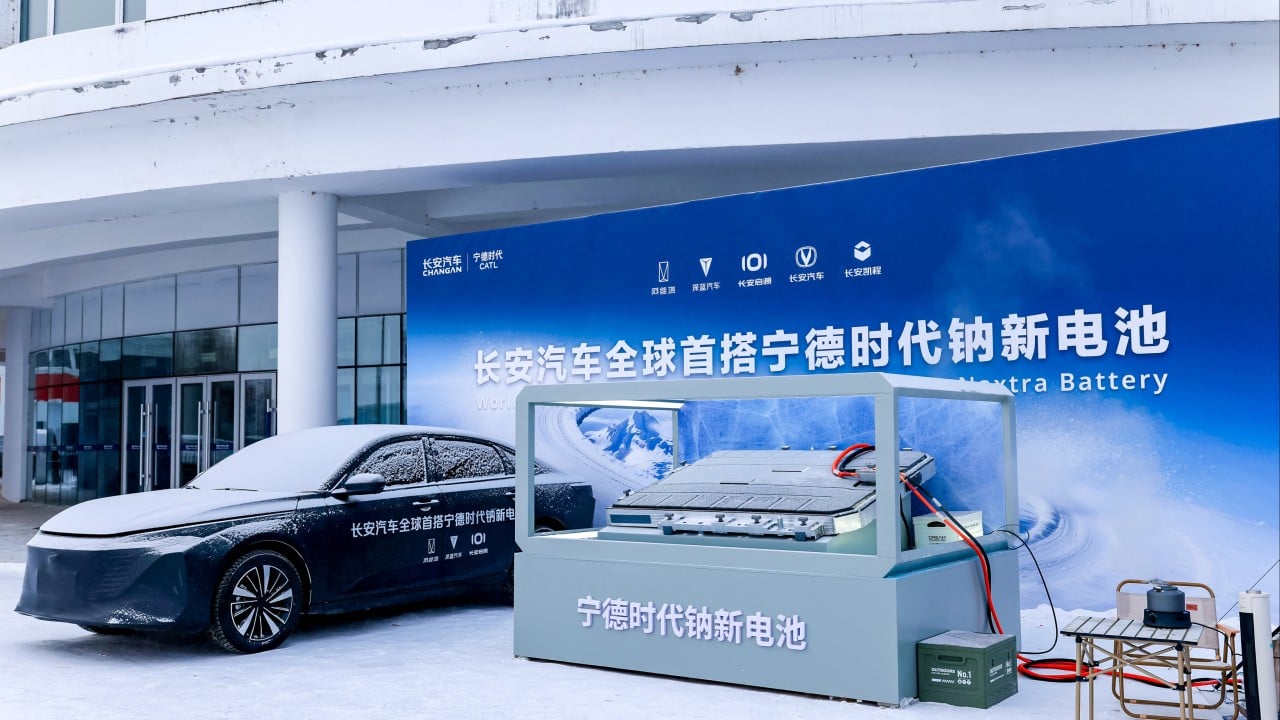
CATL’s Naxtra sodium-ion battery, which will be applied in mass-produced passenger cars for the first time globally this year, is undergoing winter testing in vehicles in chilly Inner Mongolia, the firm and its partner China Changan Automobile Group announced last week.
“The Naxtra batteries are capable of working in extreme cold areas such as Antarctica, with tests done in -50 degrees Celsius (-58 Fahrenheit),” said Ouyang Xiaolong, the leading engineer for passenger car technology at the world’s largest power-battery supplier, in a recent interview with the South China Morning Post.
The tests in extreme conditions come as China’s penetration of EVs in total new car retail sales logged the slowest growth in the past five years in 2025 of 6.3 percentage points, data from the China Passenger Car Association showed.
EV sales in mainland China have concentrated in coastal areas or developed cities, where the temperature is usually mild. Among the top 100 cities in terms of EV sales volume in 2025, only four cities were in Heilongjiang, Xinjiang and Inner Mongolia, where the temperature could be as low as -40 degrees Celsius in winter.
The limitation partly results from dominant lithium-ion batteries, as their performance sharply degrades at temperatures below 0 degrees Celsius.
Sodium-ion batteries were better in low-temperature performance, safety and materials availability, but they were less competitive in energy density and cycle life, according to Ethan Zhang, an analyst at Nomura.
Comments
No comments yet.
Log in to leave a comment.