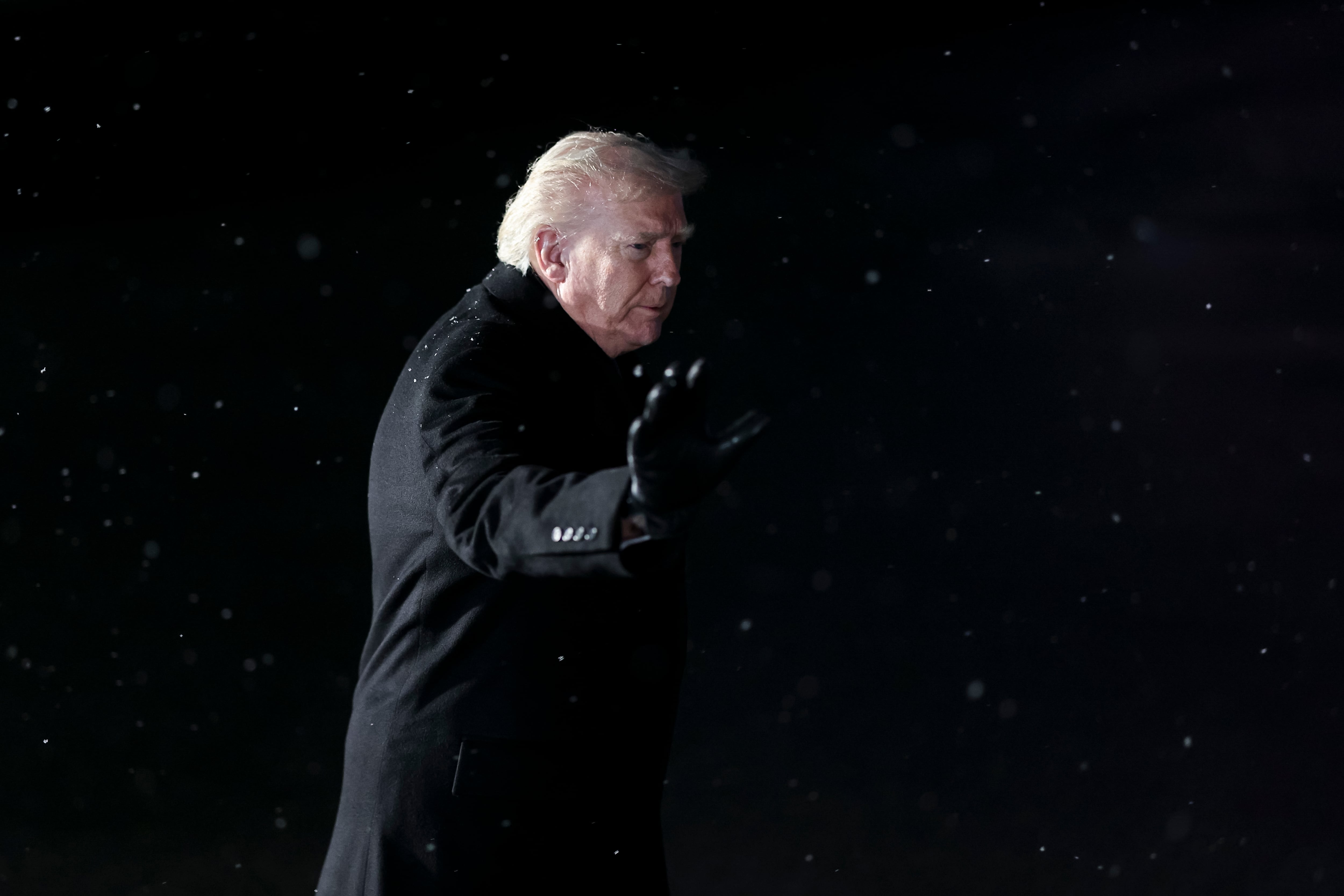
The US president is talking about ‘canceling’ or ‘nationalizing’ an election that appears to be going in the Democrats’ favor. As in 2020, he is already suggesting, without evidence, that it will be fraudulent
Soccer, as the joke goes, is a game where 11 players compete against 11 players and Germany always wins. The U.S. elections, President Donald Trump believes, are a race between two parties, and he always comes out on top. That’s not a joke.
A series of increasingly inflammatory statements by Trump, along with orders and actions by his administration, have sparked fears that the U.S. president intends to interfere in the midterm elections next November as blatantly, or probably more so, than when he unsuccessfully attempted it in the 2020 presidential election.
Polls indicate a decline in his ratings, dragged down by two of the issues that propelled him to the White House in 2024: immigration and the economy. A majority of voters, seven out of ten according to a Pew Research Center poll published this week, believe the economy is on the wrong track. The president’s approval rating is at 41%, down from 47% a year ago, according to data compiled by the Cook Political Report.
If this trend continues unabated, the Republican Party fears a crushing defeat on November 3. It is already considered likely that the Democratic opposition will take control of the House, where the Republican advantage is only four seats out of a total of 435. But, for the first time in the tycoon’s second term, Republicans believe it is possible they could also lose the Senate, where they currently enjoy a 53-47 majority.
“The key is the economy, where the Democrats have won the narrative. And then there’s the cost of healthcare. There, too, the public believes the Democrats can do better than the Republicans. These will be key issues in the outcome of the November election, and right now both benefit the Democrats,” acknowledges Republican polling analyst Frank Luntz in a video call.
Controlling Congress would allow Democrats to almost completely neutralize Trump’s agenda and impose restrictions on a president who, in his first year in office, has faced virtually none. Above all, it would open the door to what the Republican fears most: impeachment proceedings that could lead to his removal from office.
Throughout the first year of his second term, Trump has pressured lawmakers in Republican-controlled states to approve changes to electoral maps that favor his party. He also supports a bill, known as the Save America Act, that would prohibit mail-in voting except in exceptional circumstances and require proof of U.S. citizenship at the time of voting, even though it is already illegal for a foreigner to vote, and such a scenario is highly unlikely.
As polls have raised concerns among Republicans, Trump has also intensified his rhetoric about alleged fraud risks in November and the need to take action. He did the same in 2020, months before his defeat in the presidential election to Democrat Joe Biden.
This past Sunday, he reinforced the message with a post on his Truth Social platform: “America’s Elections are Rigged, Stolen, and a Laughingstock all over the World. We are either going to fix them, or we won’t have a Country any longer.”
Two weeks ago he raised the possibility of “canceling” the elections; this week he spoke of “nationalizing” them. The organization of elections is the responsibility of the states, as stipulated in the Constitution.
“The Republicans should say, ‘We want to take over,’” Trump said. ”We should take over the voting … in at least many, 15 places. The Republicans ought to nationalize the voting. We have states that are so crooked and they’re counting votes,” he maintained, without specifying which “15 places” he had in mind, though it can be inferred that he was referring to states governed by Democrats.
In an interview with NBC on Wednesday, the president—as he did in 2020—indicated that if the election results are unfavorable to him, he might not recognize them.
His statements have been reinforced by those of Steve Bannon, his former political advisor and now influential ideologue of the far right, who, like Trump, claims that undocumented immigrants are flocking to the polls in the United States. Also on Tuesday, the president threatened to deploy Immigration and Customs Enforcement (the dreaded ICE) at polling places.
Furthermore, the Justice Department has been pressuring states since last year to obtain their voter registration lists and has filed lawsuits against approximately half of them to acquire them. At least 11 of the 50 states, all with Republican-led administrations, have complied. In Minnesota, local authorities have reported that the federal government demanded these lists in exchange for withdrawing ICE agents, whose presence has sparked massive protests and whose violence has resulted in the fatal shooting of two U.S. citizens.
However, the move that has most worried the Democratic opposition came last week. While Trump continues to insist, against all odds and despite the data, that he won the 2020 election, the Justice Department has seized ballots in Fulton County, Georgia, to open an investigation into the results. In this unusual operation, in one of the places where Trump has consistently claimed, without evidence, that there was fraud, the Director of National Intelligence, Tulsi Gabbard, was present, stating that she was there on the president’s orders.
“I think we’ve got a president that can’t get over the fact that he lost in 2020 and now in kind of a Nixonian effort is going to try to do everything he can to make sure he doesn’t get another beating in 2026,” Democratic Senator Mark Warner told reporters this week.
In another unusual move, the FBI this week sent invitations to senior election officials from various states to a meeting to discuss preparations for the midterm elections. Representatives from the Departments of Justice and Homeland Security, the Postal Service, and the election commission will also be present, according to Politico.
So far, Republicans have not disavowed their leader’s statements. Speaker of the House Mike Johnson in fact sided with him. Meanwhile, Democrats continue to reap encouraging results. A week ago, their representative Taylor Rehmet won a special election to fill a vacancy in the Texas State Senate, with a 13-point lead over his Republican opponent. What’s striking in this case is that he achieved this in a district that Trump had won in 2014 by 17 percentage points.
That result “is a wake-up call,” acknowledged Republican Senator Don Bacon of Nebraska last week. Trump, he recalled, won the presidential election with a message of strength in the economy and immigration, and the president should refocus on those issues. “If we focused on both of those things, we would be much better off,” he noted.
Sign up for our weekly newsletter to get more English-language news coverage from EL PAÍS USA Edition
¿Quieres añadir otro usuario a tu suscripción?
Si continúas leyendo en este dispositivo, no se podrá leer en el otro.
¿Por qué estás viendo esto?
Si quieres compartir tu cuenta, cambia tu suscripción a la modalidad Premium, así podrás añadir otro usuario. Cada uno accederá con su propia cuenta de email, lo que os permitirá personalizar vuestra experiencia en EL PAÍS.
¿Tienes una suscripción de empresa? Accede aquí para contratar más cuentas.
En el caso de no saber quién está usando tu cuenta, te recomendamos cambiar tu contraseña aquí.
Si decides continuar compartiendo tu cuenta, este mensaje se mostrará en tu dispositivo y en el de la otra persona que está usando tu cuenta de forma indefinida, afectando a tu experiencia de lectura. Puedes consultar aquí los términos y condiciones de la suscripción digital.
Comments
No comments yet.
Log in to leave a comment.