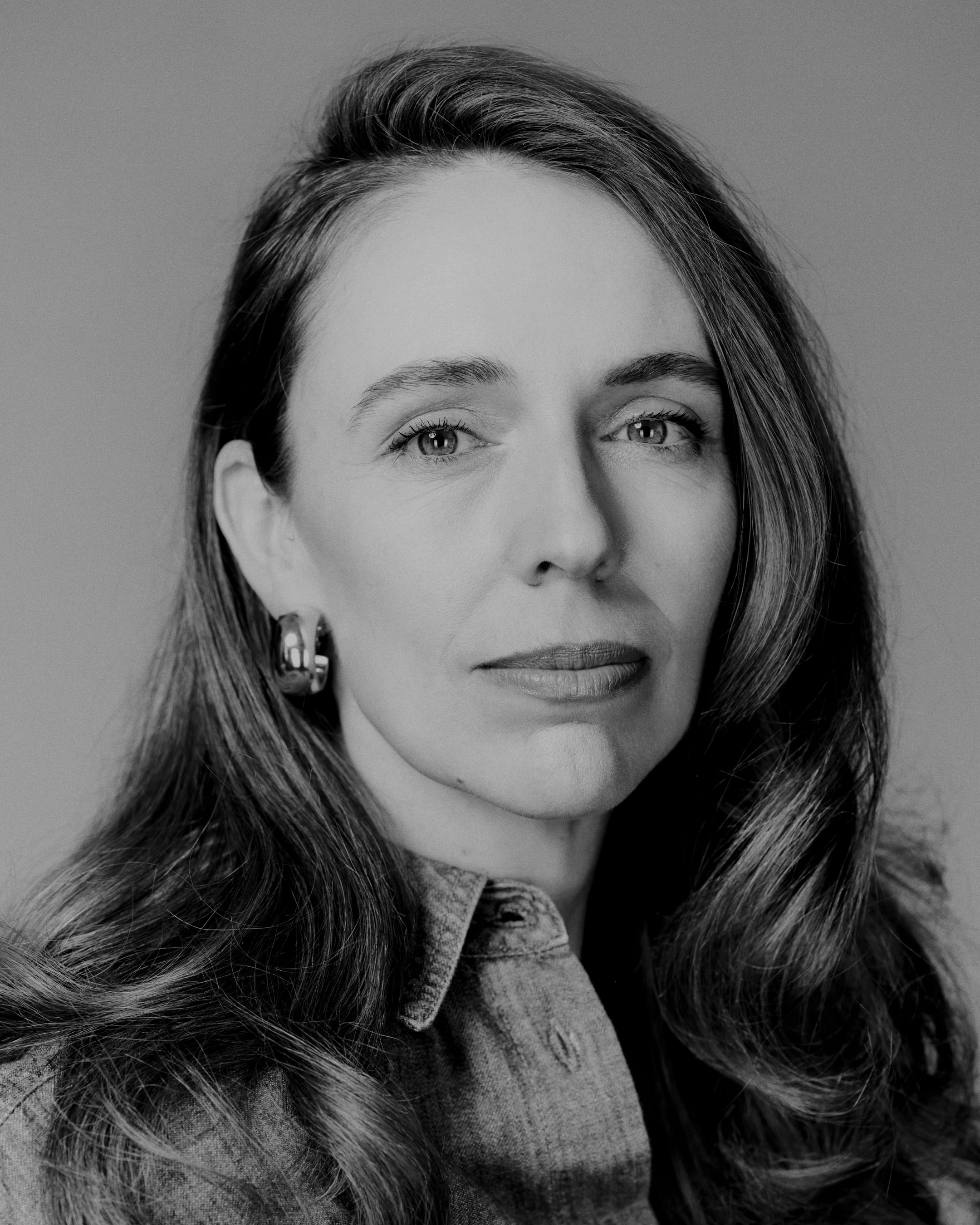
In 2023, she resigned as leader of New Zealand because she no longer had ‘enough in the tank’ to give her best. She had been in office for six years. Her departure marked the culmination of a different approach to power, one that stood in stark contrast to the male-dominated hyper-leadership that continues to dominate the world. Her understanding of politics, based on empathy and transparency, made her an icon. We spoke with her in London
In a time when reality often seems like an improbable dystopia, Jacinda Ardern, 45, gives the impression of arriving from another world. A world that championed the idea that power could be wielded differently. A world where empathy wasn’t a weakness, but a strength. A world that fell in love with the governing style of the young prime minister of a small, remote country, almost invisible on the news map, the antithesis of the hyper-masculine leadership that prevails today. She was different. In every way. Even in the way she left. She resigned in 2023, after serving for six years, because she no longer had “enough in the tank.” She announced her resignation with a trembling voice at a press conference that went viral.
Almost three years later, the former prime minister of New Zealand arrives punctually for the interview wearing a beige trench coat, barely any makeup, her hair pulled back in a ponytail, a gold heart‑shaped pendant, and a coffee in her hands. She looks like just another one of the professionals milling about that morning at one of the Soho House locations in London — the international club where we’ve arranged to meet — where advertising executives mingle with young designers and creatives of all kinds. Ardern shakes hands firmly, with the wide, open and radiant smile that became one of the symbols of the “Jacindamania” that turned her into a global icon.
Since stepping away from active politics, she has devoted herself to academic reflection. After her time at Harvard University, where she shared her experience with students and professors at the John F. Kennedy School of Government, she is now promoting spaces for debate on governance and leadership linked to the University of Oxford. She has published a memoir (A Different Kind of Power) in which she delves into areas rarely explored by political leaders: motherhood, insecurities, doubts, the psychological toll of power, constant pressure, moments of vulnerability… A book more interested in contradictions than in heroic narratives.
Question. Why did you decide to write such a personal book?
Answer. When I left office, I didn’t see myself writing a book. A lot of people asked me about it, but I worried that it might seem defensive, as if I were trying to justify my decisions or impose my version of events. Then I thought it might be helpful to talk about the experience of a being a reluctant leader. But if I was going to do that, I had to write a book that was very open and transparent. I’ve always thought that people deserve to know their politicians.
Q. It’s not common for leaders to show who they really are, beyond the persona they construct.
A. Perhaps that’s part of the problem. We live in a time where public life has become dehumanized. We’re very tough on one other. We can be pretty unforgiving. We can be pretty intolerant of error. That’s why I like to talk about alternative versions of leadership and public service, because I think we need them. Everything is binary now, but life and decision-making is not binary. We’ve simplified everything so much that politics has responded by putting everything in these terms, when so often what we deal with is complex and gray. Unless we’re willing to be open about that complexity, it’s very difficult for the public to understand why we make certain decisions.
Q. Accountability also doesn’t seem to be at its best.
A. This is a difficult period because people’s bandwidths are pretty limited. They don’t have the time or energy for complex issues. But our response shouldn’t be to play into that by oversimplifying everything. That’s just not the way the world is. We need more transparency. For example, you can acknowledge that you don’t have all the answers, which is very different from saying you don’t have a plan. We often make decisions with incomplete information — the pandemic was a clear example — and we should be clear on that. Leadership isn’t saying “we don’t know,” but rather saying: “We don’t know, and here is our plan to take into account the uncertainty of this situation.”
Ardern took office in 2017, at just 37 years old. A few days earlier, during the negotiations that would make her prime minister of New Zealand, she learned she was pregnant in a friend’s bathroom. She describes the scene in detail in her book: “[The] test was sitting on the edge of the sink basin, waiting for its big reveal. I looked down at the timer on my phone. Twenty-five seconds, 23 seconds, 21. I was days away from learning if I would run a country, and now, as I sat in a bathroom in Tawa, New Zealand, I was seconds away from learning if I would do it while having a baby. I closed my eyes and lifted my head to the ceiling. Then I took a deep breath, opened my eyes, and looked down.”
It was a metaphor for what came next: the awareness that life does not stop, even when power tries to freeze everything around it.
The idea of the “reluctant” leader appears often in her memoir. Ardern portrays herself as a woman who questions herself, who fears she may fall short, who doubts her own abilities even — or especially — when others project onto her expectations she sees as excessive. Her memoir is full of small moments that reveal that self-imposed pressure: a woman who comes to power almost by accident and never feels fully prepared; a leader who tries to hide the physical discomfort of pregnancy so as not to appear fragile; who even pretends to be vegetarian to avoid having to explain what she can or cannot eat while expecting; who measures every gesture because she knows any mistake will be amplified.
Q. How much do you think imposter syndrome has marked your political career and your way of being in the world?
A. A lot. Because it brings character traits I hadn’t considered until writing the book. I’d always acknowledged that I had imposter syndrome and thought mostly the consequence was that it had held me back at times. What I didn’t give a lot of thought to was some of the other behaviors it triggers: over-preparation, the desire to listen to others, to fully understand issues. And upon analyzing it, I saw that these were powerful, useful qualities. And I could find evidence of them in the way that I was leading but without necessarily connecting it to the role of imposter syndrome. Now I’m being very honest: I don’t think it’s something you get rid of. But I’m not even sure you should. Humility in leadership is good. Questioning yourself is good. You just don’t want it to paralyze you.
Q. It’s striking that this feeling doesn’t go away in someone who was elected by the public and admired around the world.
A. It’s not consistent. It doesn’t feel the same all the time. It depends on what’s happening. Interestingly, I felt it least during major crises. I wonder if that’s because in part you become so focused on the job at hand that self-doubt feels indulgent. You have no capacity for anything other than the job that you have to do.
Q. In the book, you also explain that your father doubted whether someone as sensitive as you could survive in politics, in an environment of constant — and sometimes brutal — exposure. But a fellow MP told you that it was precisely that sensitivity that made you good at it.
A. When you feel things deeply, you become deeply involved. You give so much of yourself because you’re so committed to what you’re doing. And if you also go through a period full of crises, five years will feel like ten. The current political environment is very unrelenting, highly critical, tumultuous. It is, however, manageable. I would never tell a thin-skinned person don’t go into politics. If you have a strong sense of duty, there is nothing more fulfilling or rewarding than that job. There’s nothing like it. It will not matter what I do for the rest of my life. It will be the greatest privilege of my career.
Jacinda Ardern was sworn into office in 2017, the same year Donald Trump entered the White House for the first time. The same leader who stormed into Venezuela in the dead of night to arrest Nicolás Maduro, who has threatened to take over Greenland “the easy way or the hard way,” and who has plunged the entire planet into uncertainty. A leader who champions strength, a testosterone‑driven style of politics, who rejects empathy and doubt. Like Vladimir Putin. Like Javier Milei. Like so many others today.
Q. The way you describe leadership in your memoir — as a form of public service, with boundaries and processes — is radically different from the grandiose, theatrical gestures that dominate politics today. You left office in 2023, shortly before Donald Trump won an election again. Do you think it is possible to reverse the success of this kind of leadership, so opposed to your own?
A. Yes, I do. That’s why I spend a lot of time talking to, and in some cases working with, politicians. We shouldn’t abandon values like kindness, compassion, curiosity, or courage just because the opposite is in the spotlight now. The absence of these values is one of the biggest problems today. There are politicians who lead in this way and do very well, like Mark Carney [prime minister of Canada], who stood up on election night and talked about kindness. But media incentives are geared toward the more inflammatory style. You don’t usually see headlines that say “a politician builds consensus on such and such an issue,” because that doesn’t generate clicks. It doesn’t grab people’s attention.
Ardern did manage to capture global attention — to the point of becoming a phenomenon — thanks to the “empathetic” leadership style she champions. The image of her holding her baby in her arms at the United Nations General Assembly in 2018 went viral. It was the first time anything like it had happened. In reality, she was simply trying to reconcile an official trip with breastfeeding and the logistics of being a new mother. “I wasn’t giving up on breastfeeding […] Conceding in my mind meant I was somehow failing,” she writes in her memoir. But that gesture ended up becoming a political statement about the possibility of governing without hiding motherhood.
Something similar happened when, after the 2019 attack by a white supremacist on two Christchurch mosques, in which 51 people died, she appeared wearing a hijab and embracing the victims. That image, along with her proclamation “They are us,” became a global symbol of institutional empathy, respect, and humanity.
Q. What do you remember from those days?
A. I remember everything so clearly. Especially the people: the community leaders, the families who lost loved ones, the victims. I find it hard sometimes to be recognized for a response that was first and foremost driven by the Muslim community. I cannot imagine anything more horrific than what happened to them. And yet, they chose to open their arms and allow a whole country to grieve alongside them. It was incredibly humbling.
Q. Are you still in contact with any of the victims?
A. Yes. Before moving overseas, I reconnected with members of the community. Since then, we’ve launched a scholarship for families of victims as a small form of support. It saddens me that even today, people thank me for that response, because it should be the norm: acknowledging what happened, putting the community first, depriving the attacker of what they seek — infamy, a reaction — recognizing the long-term impact on the victims, and trying to address it. That should be a standard response, not something that should be met with gratitude. When someone thanks me for that response, I feel it reflects their day-to-day experience of Islamophobia. And that makes me feel very sad.
In her memoir, Ardern recounts the phone call Donald Trump made to her after the massacre. The U.S. president was interested only in the future of the perpetrator and wanted to know whether the New Zealand government planned to use the term “terrorist” to refer to him. “The man who had done this left a rambling manifesto full of hatred. He’d decorated his guns with the names of white supremacists who’d also killed Muslims,” Ardern recalls. “His intent had been not just to take lives but also to create fear and to intimidate. He’d also hoped that his actions might inspire new waves of violence. If that wasn’t terrorism, then nothing was. ‘Yes,’ I told the president. ‘This was a white man from Australia who deliberately targeted our Muslim community. He is a terrorist.’”
Trump said nothing, she writes, and simply asked whether there was anything the United States could do for them. “My answer was simple,” Ardern recounts. “You can show sympathy and love for all Muslim communities.”
Christchurch was the first major crisis she had to manage during her term, but not the only one. A year later came the pandemic, which confronted political leaders with something unprecedented and complex, with a population terrified by the unknown and watching hundreds of thousands of people die around the world on their television screens. She approached it, as she did everything, in her own way — communicating from home through social media with an informal, approachable tone and offering practical advice based on the information available to her.
Q. How does a political leader deal with something like this?
A. With imperfection and by doing the best you can. For me, the question was: what is the path of least regret? I preferred to try something and make a mistake than not do enough. Because getting it wrong meant people dying.
Q. You made very difficult decisions, such as confining the population or imposing mandatory vaccinations for certain high‑risk professions.
A. During those days I spoke a lot with a good friend who lived in Spain with her two small children. That helped me understand how hard the pandemic was for everyone. In New Zealand, there were prolonged periods of normality for the population, but within the government, it was never possible to relax. We lived with the constant tension that a new case could appear at any moment and we would have to go back into lockdown. That constant anxiety was very hard.
Q. New Zealand was seen as a model of good management, but many criticisms emerged at home. How did you cope with that contradiction?
A. That’s what leadership is: making hard decisions that not everyone will be happy with. Subsequent surveys showed that around 77% rated the management as good or very good. But undoubtedly there are people who didn’t like the response. I would rather be criticized for doing too much than too little.
Managing the pandemic was complicated worldwide, a time of escalating hatred toward politicians making difficult decisions. In her memoir, Ardern describes a 2022 protest that deeply affected her: “I heard the protest speeches, saw the signs. I saw my own image, with a Hitler moustache, monocle, and ‘Dictator of the Year’ emblazoned above my face. I saw the gallows, complete with a noose, which people said had been erected for me. I saw the American flags, the Trump flags, the swastikas.”
She recounts another episode that illustrates just how deeply polarization poisons not only the political climate but also everyday interactions. A woman approached her in an airport bathroom with clear hostility. “I just wanted to thank you. Thanks for ruining the country,” she snapped. Ardern explains that, for the first time, she felt something different — something new. “It was the tenor of the woman’s voice, the way she’d stood so close, the way her seething, nonspecific rage felt not only unpredictable but incongruous to the situation,” she writes. Ardern thought about responding, but didn’t. She dried her hands and walked out. But she was aware that this was not a normal criticism. It was something more personal, more violent, and potentially more dangerous.
Q. How do you build bridges in a world that seems to have gone mad?
A. Leaders today face two very complex tasks. On the one hand, they must listen to legitimate criticism and be accountable. But at the same time, they have to be able to distinguish when some of that criticism is based not on facts but on disinformation campaigns. We saw it with Covid-19, and we see it with climate change. It’s very hard to build consensus when some in those groups not only believe it isn’t real, they are motivated towards violence. That’s why I think we must seriously discuss the role of disinformation and social media platforms, because it’s clear they contribute to people being radicalized. They are not just the postman without responsibility. The level of online violence that people see and experience is enormous. I just don’t think it’s the way we want our kids to grow up.
Q. Faced with the rise of leaders like Trump and the far right, some progressive politicians argue that there is no alternative but to polarize defensively. What is your opinion on this argument?
A. I totally disagree with this idea. The key question is: what do we mean by success in politics? If the only measure is being elected, then sure, it might seem logical to adopt that path, because that approach has brought some leaders to power. But if success also includes the well-being of society, social cohesion, trust, turnout, and belief in institutions, then that leadership model is an abject failure. The data shows that, even though these individuals are being elected, they are being elected at a time where trust is at historic lows, where citizens don’t believe that institutions are serving them, and where there is not only polarization but also a belief that engaging in hostile activity and forms of violence is now acceptable. Unfortunately, the situation we are in is being fed by a complete lack of leadership.
Q. So how do we break that vicious cycle?
A. The first thing to understand is that we should not be simplistic about what people are voting for. After the European elections, for example, Datapraxis found that only about a quarter of those who voted for parties considered far-right did so for ideological reasons. Many others voted that way because they felt poorly served by mainstream politics. Financial insecurity is key: wages that don’t allow people to thrive, a feeling that their children don’t have the prospect of a better future, and insecurity regarding housing, healthcare, and education. If we look at some studies, we find figures showing that nearly 80% of people from lower socioeconomic groups do not believe that politics is serving them.
A. There wasn’t a single reason. These decisions are complex. There’s no simple explanation. I could feel that my energy was depleted. I was starting to be a little less of the leader I wanted to be. I thought: I don’t have another four years in me. And I also felt that I might be generating resistance to causes we had made progress on. What I explained at that press conference was the real reason.
Q. In your memoir, you devote less attention to it than to other episodes of your career.
A. I had to make the decision quickly and I couldn’t dwell on it with many people. So for me, the amount of space I gave it on the page actually was the way I felt.
Q. How much did motherhood influence the decision?
A. I did not choose to leave because I thought that I wasn’t being a good enough mother by doing that job. I don’t want people to believe you can’t be a mother and a leader. You can. On the other hand, guilt is always present when you’re a mother: I felt it as prime minister and I feel it now as well, even though I’m around more now.
Q. In a world designed by men, aren’t some forms of leadership in a way incompatible with personal life?
A. That’s why I didn’t want to create the false narrative that you can do it all on your own. You can’t. We need more flexible work cultures: being able to be with your children, leave if there’s an emergency, not being afraid to ask for understanding. It’s not enough for it to be in the rule book: the key is whether people feel they can actually do it.
Q. You are still very young. Is it possible that you will return to active politics at some point?
A. In my country, it’s not common to return, and I have no intention of doing so. In New Zealand, once you leave, you leave.
Sign up for our weekly newsletter to get more English-language news coverage from EL PAÍS USA Edition
¿Quieres añadir otro usuario a tu suscripción?
Si continúas leyendo en este dispositivo, no se podrá leer en el otro.
¿Por qué estás viendo esto?
Si quieres compartir tu cuenta, cambia tu suscripción a la modalidad Premium, así podrás añadir otro usuario. Cada uno accederá con su propia cuenta de email, lo que os permitirá personalizar vuestra experiencia en EL PAÍS.
¿Tienes una suscripción de empresa? Accede aquí para contratar más cuentas.
En el caso de no saber quién está usando tu cuenta, te recomendamos cambiar tu contraseña aquí.
Si decides continuar compartiendo tu cuenta, este mensaje se mostrará en tu dispositivo y en el de la otra persona que está usando tu cuenta de forma indefinida, afectando a tu experiencia de lectura. Puedes consultar aquí los términos y condiciones de la suscripción digital.
Comments
No comments yet.
Log in to leave a comment.