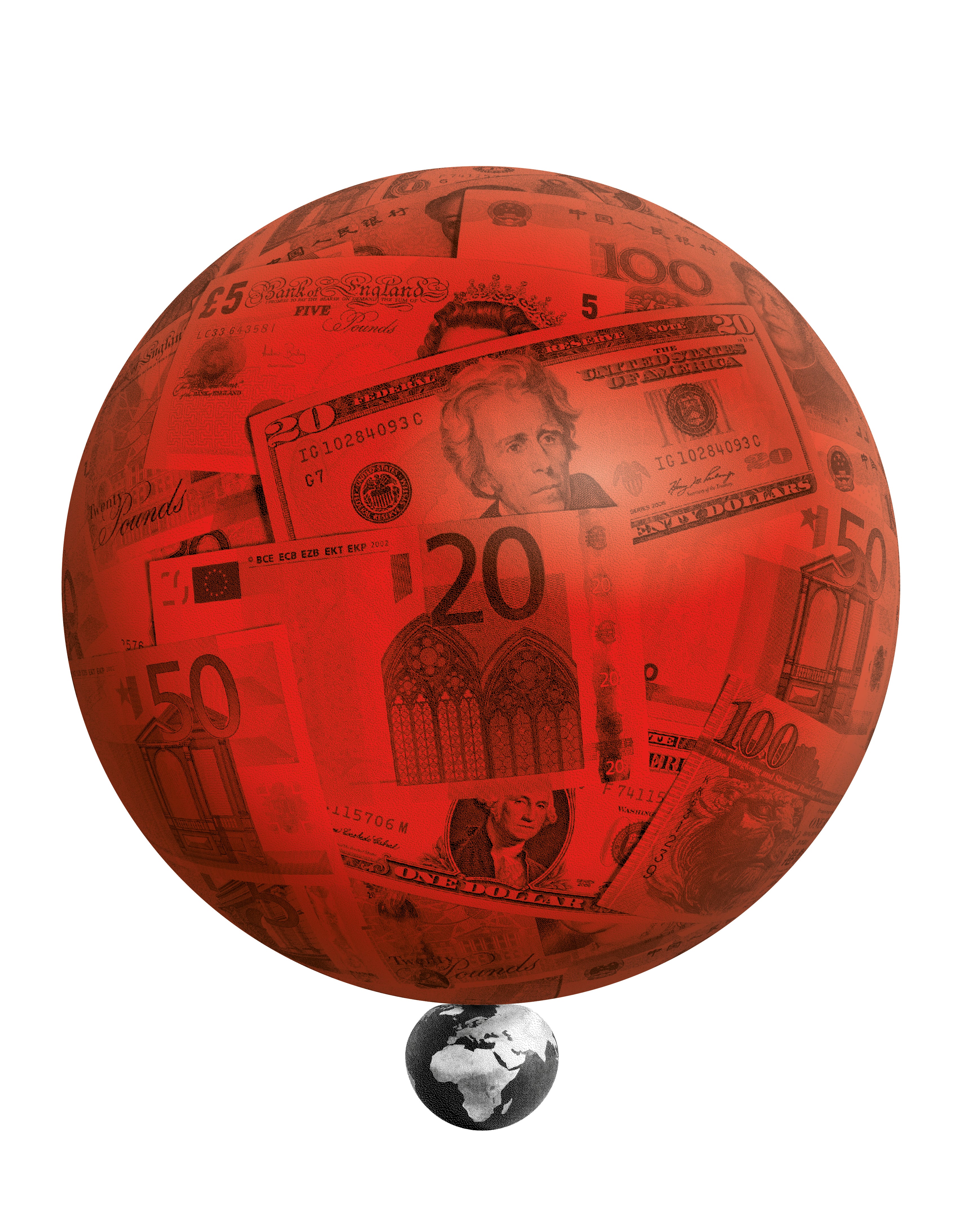
Countries have sharply increased the money they owe to the markets, putting their own spending policies at risk in an increasingly unstable world
We know the world has become more threatening. The people in charge of global finance no longer use reassuring phrases like Mario Draghi’s “whatever it takes” to save the euro in 2012. On the contrary. The head of the International Monetary Fund (IMF) spoke in Davos about how the projected growth for the global economy, 3.3% in 2026, was “beautiful but not enough.” “I want to appeal to all of you: do not fall into complacency. Growth is not strong enough. And that is why the debt weighing on our shoulders, which is approaching 100% of GDP, will be a very heavy burden,” warned Kristalina Georgieva.
So heavy, in fact, that public debt has become one of the structural features of the economy. Globally, it stands at $93 trillion and is expected to soon reach almost $100 trillion. What is worrying, beyond the figure itself, is that while household and corporate debt has been steadily declining since 2015 (now hovering around $151 trillion), governments continue to require more and more resources. According to the OECD, the debt-to-GDP ratio in advanced economies exceeds 110%. Before the Covid-19 pandemic, this level had only been reached during the Napoleonic Wars, as The Economist ironically points out.
Luiz de Mello, director of the organization’s Country Studies Branch, is concerned by the trend. “If we compare the evolution of OECD countries, before the global crisis [of 2008] we had an average public debt of 70% of GDP, and we ended last year with more than 110%. A 40% of GDP increase in less than 20 years is a considerable rise.”
Governments around the world seem unable to balance their budgets. The U.S. deficit reached 6.2% last year, and this year the government forecasts it will be 5.5%, because Donald Trump may announce one of his much-desired tax cuts. The IMF has issued several warnings about how rapidly U.S. debt is growing: it exceeded $36 trillion last year and is reaching levels of around 123% of GDP.
In Europe, the German parliament approved a budget at the end of November that anticipates the second-highest level of borrowing in its history. Of the expenditures, which amount to about €525 billion (roughly $567 billion), nearly €100 billion (about $108 billion) will be financed through loans.
France is walking a tightrope. In the midst of a massive political crisis, early estimates indicate that last year’s deficit reached 5.4% of GDP, after having surged to 5.8% in 2024. The budget in France has just been approved by decree, with a promise that the deficit will not exceed 5% in 2026, but doubts remain. And reforms are stalling: at the end of last year, the pension reform passed three years ago — raising the retirement age to 64, from the current 62 — was suspended. The French know this could make the benefits system unsustainable, but after the 2023 protests, politicians may fear that another attempt would send them packing from parliament.
Alarm bells are ringing in the United Kingdom as well. In 2024, it recorded one of the most negative budget balances on the continent, with a deficit of 5.75%, and its debt continued to balloon in 2025. Inflation has reignited in recent weeks, raising concerns that the central bank may have declared victory over prices too soon, according to an analysis by Muzinich & Co.
Ray Dalio, an investor and an influential voice in the U.S. financial sector, compares debt to the human body’s circulatory system in his new book, How Countries Go Broke: The Big Cycle. He believes that the United States and other advanced economies are heading toward the equivalent of an “economic heart attack.” When debt is used productively, it generates enough income and growth to cover principal and interest payments. But when that income fails to materialize, debt service — the payment of interest — builds up like cholesterol in the financial arteries, eventually constraining spending and, in the worst cases, triggering a crisis. Countries then face painful or even harmful choices for their populations: allowing interest rates to rise — which depresses the economy — devaluing the currency to buy up issued debt — which fuels inflation — or making sharp spending cuts to balance the books — which harms public services and often leads to greater poverty and inequality.
If Dalio is right, what has happened in Japan in recent days could be seen more as angina than a full‑blown heart attack: in late January, 30‑year government bonds saw the highest single‑day sell‑off in their history, with yields surging to 3.85%. The yen plunged against the dollar before recovering amid strong rumors of coordinated action between the Federal Reserve and the Bank of Japan.
What happened? In the autumn, the Japanese government of Sanae Takaichi had announced a major tax‑cut package to spur investment in response to the tariffs. The proposal included lowering the VAT on food to ease pressure on households. But the so‑called “bond‑market watchdogs" were there, ready to twist the government’s arm. And the markets jolted. With €7 trillion ($8.27 trillion) in circulation, Japan’s debt is historically high (around 250% of GDP). Until now, that had not been a major problem as long as creditors saw their repayment expectations met, but a larger deficit driven by higher public spending injected greater uncertainty into the long‑term fiscal outlook.
“With insufficient growth, debt does not shrink on its own. Japan is relevant not because of a classic default risk — its debt is in yen and it has a huge domestic investor base — but because a rapid rise in yields can disrupt global capital flows,’ explains Santiago Lago, professor of applied economics at the University of Santiago de Compostela in Spain. Expectations of higher rates, portfolio shifts by major Japanese investors, and bouts of volatility spilling over into credit markets could cause much more damage, he argues.
Under normal circumstances, 2026 should be a quiet year. Central banks are coming off a cycle of interest rate cuts, global growth is slowing, stock market valuations appear to have peaked, and it’s becoming increasingly difficult for private debt yields to rise. Given this, government bonds should be a good option for investors. But recent events paint a different picture, one in which alarms over fiscal chaos are sounding everywhere at a moment when, paradoxically, defaults seem to be ruled out.
Investors, worried about fiscal excesses, are selling government bonds and dollars and seeking safe-haven assets like gold. “Yes, the central market scenario is favorable,” confirms Lago. “Growth is acceptable, inflation is more under control, and central banks will prudently lower rates. That reduces the urgency. But it’s a fragile balance. In sovereign debt, the big change doesn’t usually come from a ‘default day,’ but from a shift in the narrative: a surprise in growth, a geopolitical shock, a political turn, or a spike in inflation that forces banks to maintain high rates for longer. If that happens, premiums can adjust quickly.”
For Ernesto Campos, an economist and professor at the International University of Valencia in Spain, the absence of recessions in major economies and the existence of institutional safeguards have created this perception of contained risk. “In the case of Spain, for example, the risk premium remains low despite high debt, reflecting short-term confidence,” he explains. “However, fiscal sustainability is not tested in favorable scenarios, but rather in the face of shocks: slowdowns, prolonged interest rate hikes, or structural increases in spending. The risk that markets seem to be undervaluing is not immediate default, but a decade of lower growth, higher interest rates, and increasing tax pressure.” In short, “the market may be calm… but debt is not judged by today’s climate, but by the storm that may be coming.”
An IMF survey presented in Davos speaks of the storms that lie ahead: the economists consulted almost unanimously predict an increase in defense spending (97% in advanced economies and 74% in emerging markets). Investment in digital infrastructure and energy is expected to grow, while only spending on environmental protection is forecast to decrease. Almost half believe there will be a sovereign debt crisis in the coming months. The other half think governments will resort to higher inflation to reduce the burden, and six out of 10 consider tax increases likely in advanced economies.
There are three ways to reduce debt: through economic growth, through fiscal surpluses, and, without doing either of the above, through a magic and dangerous word: inflation. Ernesto Campos explains that growth is the healthiest path: as GDP increases, the relative weight of the debt decreases. “Primary surpluses allow for a more direct reduction, but they tend to be politically costly and difficult to sustain over time,” he explains.
Inflation, by contrast, activates the so‑called “debt liquefaction” mechanism, especially when the debt is issued long‑term and at a fixed rate. As nominal GDP grows, the debt loses relative weight. However, that effect is only beneficial if inflation does not quickly translate into higher interest rates demanded by the markets. When that happens, the initial relief evaporates.
María Jesús Fernández, senior economist at the Spanish think tank Funcas, notes that Greece and Portugal have managed to correct the deficits they generated during the pandemic by doing their homework. Thanks to growth, Spain has gone from a debt level of 125% of GDP in 2021 to the current 103%, and for the first time in two decades expects to post a primary surplus in 2025. But beyond the economic boom, the reduction in debt “has been more a consequence of that liquefaction.” She continues: “The Independent Authority for Fiscal Responsibility [Airef] has already warned that if there are no deficit‑reduction measures, that process could stall or even reverse from 2027 onward. Markets can tolerate it for a while, but when there is an exodus, investors may start looking at Italy or Spain.”
Santiago Lago adds another layer of concern, although he believes the situation is sustainable in the short term. “The main problem is structural. The pressure created by an aging population, defense needs, and the energy transition requires a more ambitious medium‑term budget strategy.”
The new European fiscal framework is meant to serve as a guide that allows each country to adapt its pace of adjustment to local realities, but as Campos notes, “it requires clear commitments and effective monitoring. It leaves behind a punitive approach and puts the emphasis on credibility.” It is no longer about complying or not complying: “It’s not a straitjacket; it’s a GPS. It lets you choose the route, but it requires you to reach it.”
Antonio Sanabria, professor of applied economics at the Complutense University of Madrid, believes that the pandemic bailout protected the economy from greater harm and that debt is now decreasing as a percentage of GDP at a faster rate than anticipated: “But it’s fair to say that more could be done. A more countercyclical stance would give us additional resources for when times get tough.”
Sanabria hits a nerve: politicians tend not to have incentives for prudence and usually leave the problem to those who come after them. In addition, citizens push for a welfare state worthy of the name, for essential public services not to be cut. Sanabria explains: “A politician needs incentives to stabilize the economy without harming growth, because without growth there is no way to pay the debt. It’s logical that they should focus on the most vulnerable.”
What they do not have, he believes, is room to lower taxes: “Talking about it is trying to fool people. [Former Spanish prime minister] Mariano Rajoy, during his campaign, collected signatures to lower VAT, and when he arrived at La Moncloa he raised it. Not because he had some evil plan — he probably believed he could do it — but it was unrealistic.”
The OECD official uses the example of France — facing cuts that citizens neither understand nor accept — to call for reflection on how public debates are presented. “The issue of aging is going to be delicate, and it goes beyond pensions. It has to do with healthcare, care services, and support for the elderly.”
The OECD regularly releases projection studies. “From 2025 to 2060, the budgetary pressure related to population aging will add spending equivalent to 6.5% of GDP in OECD countries. Will debt increase by that amount just to finance this spending?” asks De Mello.
He advocates for medium‑ and long‑term consolidation — well beyond the lifespan of any single government. “It’s important for society to apply pressure. For fiscal councils to constantly underline the importance of credible, lasting adjustments. It’s important to build buffers for periods of crisis. How many have we faced in the last five years? A pandemic, inflation, an energy crisis… the flash flooding in Spain. Without fiscal space, how are we going to face future crises?” Perhaps the IMF’s managing director left Davos asking herself the same question.
“Debt is not a bad word. It is a question of how it is going to be used,” said Muhammad Aurangzeb, Pakistan’s finance minister, at the World Economic Forum in Davos, summarizing the dilemma facing governments worldwide. He recently signed the largest syndicated financing in his country’s history in exchange for allowing a company to build a copper mine. “For us, that’s the start of the discussion. We have to finance future growth. Right now our young IT workers code for $12 an hour. If we improve their skills [using debt], they could start earning $50 dollars.”
Investing public funds to foster growth and boost productivity in the medium and long term is the most sensible course for any government. Yet the emergence of artificial intelligence (AI) complicates that calculation. AI burns through cash the way its servers burn through energy to process data. Amazon, Alphabet, Apple, Microsoft, Meta, Nvidia, and Tesla have announced $365 billion in investments this year. Until now, the so‑called hyperscalers — companies that provide massive cloud‑storage, processing, and data‑center services — financed their investments with profits (current and future). But as they need more and more money, the operations become riskier and the companies’ risk becomes systemic for the economy.
Meta raised $27 billion last year to finance a massive data center in Louisiana in what was described as the largest private debt deal in history. Big tech companies issued $121 billion in U.S. corporate bonds, compared to an average of $28 billion annually between 2020 and 2024, according to a Bank of America report. Another report from Barclays forecasts that U.S. corporate bonds will reach $2.46 trillion this year, with nearly $1 trillion being net new debt driven by AI needs. This comes amid mass layoffs, such as the 16,000 jobs Amazon announced it would cut worldwide this week (its third announcement in just a few months).
Meanwhile, governments are wondering which path to take to avoid falling behind in the technological race, and are also grappling with the question of whether they are digging their own grave. For Jorge Díaz Lanchas, professor of economics at Comillas ICADE University, the big question is what impact all these investments will have on productivity. “Are we facing a bubble? If it bursts and drags down the private sector, which is the one investing, governments will be forced to act.” There is worrying data: in the third quarter of 2025 (the latest available data), productivity in the U.S. grew by 2%, but workers’ share of income fell to a historic low, according to the U.S. Bureau of Labor Statistics.
Tiffany Wilding, an economist at Pimco, addressed the possibility of continued layoffs in a note to investors: “Starting with PCs and software, and now adding automation and AI, technological tools are easily substituting for mid‑skilled and increasingly high‑skilled labor. The falling relative price of software, computers, and components also make capital a relatively cheap substitute for labor.” The outlook for labor share is not good. “Large, relatively capital-intensive firms now have a strong tax incentive to invest in labor-cost-saving technologies. AI remains a relatively affordable and deployable substitute for many tasks that are currently done by humans,” she argued.
For economist David Martínez, the logical approach is to undertake these and other investments with the conviction that they will pay off in terms of strategic autonomy and growth, with more activity and job creation. “In these areas where we depend on the external sector, it’s necessary to build industrial capacity — an innovative ecosystem with greater added value. Because we have less and less room to spend, and spending must have impact.”
If the bet fails, or if one country achieves disruptive breakthroughs that render others’ innovations obsolete, future generations will have to shoulder that heavy burden without receiving anything in return.
Sign up for our weekly newsletter to get more English-language news coverage from EL PAÍS USA Edition
¿Quieres añadir otro usuario a tu suscripción?
Si continúas leyendo en este dispositivo, no se podrá leer en el otro.
¿Por qué estás viendo esto?
Si quieres compartir tu cuenta, cambia tu suscripción a la modalidad Premium, así podrás añadir otro usuario. Cada uno accederá con su propia cuenta de email, lo que os permitirá personalizar vuestra experiencia en EL PAÍS.
¿Tienes una suscripción de empresa? Accede aquí para contratar más cuentas.
En el caso de no saber quién está usando tu cuenta, te recomendamos cambiar tu contraseña aquí.
Si decides continuar compartiendo tu cuenta, este mensaje se mostrará en tu dispositivo y en el de la otra persona que está usando tu cuenta de forma indefinida, afectando a tu experiencia de lectura. Puedes consultar aquí los términos y condiciones de la suscripción digital.
Comments
No comments yet.
Log in to leave a comment.