In his speech at an event held by the Organiser, titled ‘Chhattisgarh@25: Shifting The Lens’, Shah said the Maoist problem should not be linked to either lack of development or a poor law and order situation.
Shah said, “Some thinkers spread the misconception that the Maoist issue is linked to development and that it is an issue of law and order. But it?s not the case.”
Shah said the failure to correctly assess the Maoist problem would amount to injustice to future generations. He mentioned that in the 1980s, the Maoist problem had spread to the bordering districts of what is now Telangana, as well as Maharashtra, Chhattisgarh, Andhra Pradesh and Odisha. He said, “At that time, there were more than 100 districts which were (more) backward than Bastar. If the root cause of the problem is development, then when the problem grew, why did it not grow in those 100 districts that were more underdeveloped than Bastar? Some people call it a law-and-order issue. I do not agree with this either. Before the emergence of the Maoist problem, Bastar?s law and order statistics were much better than those of many districts of Bihar and Uttar Pradesh.”
“I can debate with anyone and prove with facts and evidence that this is an ideology problem. Those who say there is no ideological problem should explain why this movement was named Maoism. Because within this ideology lies the belief that solutions to problems emerge from the barrel of a gun,” the home minister added.
“Left-wing extremism is an ideology-driven challenge. Wherever Communists remained in power, they could not bring development. Communist ideology is an ideology indicative of destruction, and the country needs to get rid of it immediately,” Shah said. The Communist ideology is no longer present in democratic politics, he reiterated. “It does not exist in Tripura and Bengal (both of which had several Communist governments in the past). In Kerala (currently ruled by the CPM-led LDF), it is surviving to an extent; however, people have started the change from Thiruvananthapuram (referring to BJP winning the civic polls in the state capital),” he added.
Shah said he has no hesitation in saying that if Bastar was not affected by the Maoist problem, it would have been the most developed district in the country. “After 10 years, look at Bastar. It is going to become the most developed tribal region,” he asserted.
Accusing the Baghel-led Congress government of sheltering Maoists, Shah said, “I was the Union Home Minister even during Bhupesh Baghel’s tenure. I can say with full responsibility that the Congress government sheltered Maoist terror.”
The Home Minister said 90 per cent of the area dominated by Naxalites had become free and it would get uprooted completely by March 31.
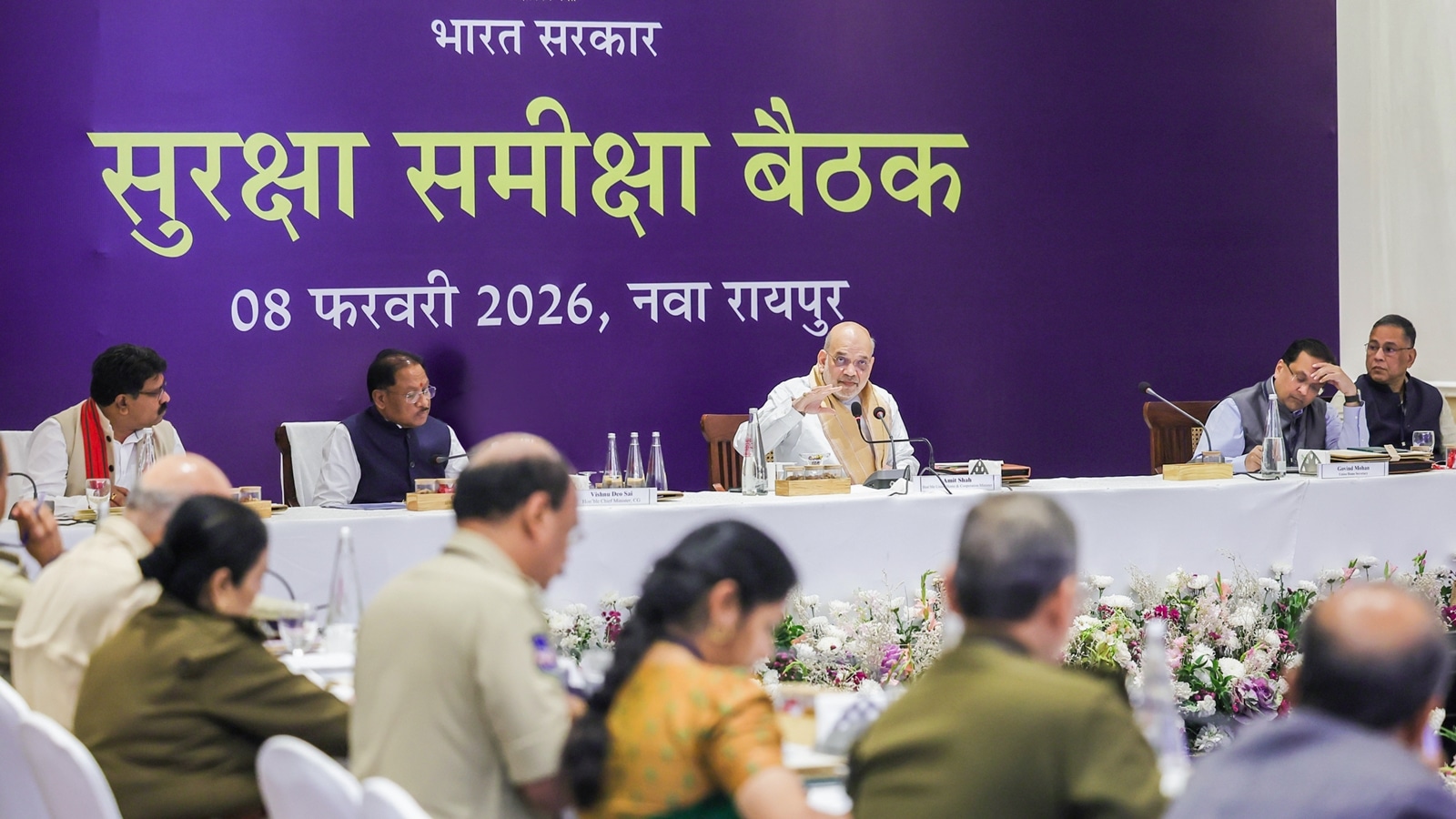
On the second day of his three-day visit to Chhattisgarh, the Union Home Minister chaired a high-level security review meeting on Left Wing Extremism (LWE) in state capital Raipur. He stressed on the need for smooth coordination among agencies, while reiterating the March 2026 deadline set by him for eradication of LWE in India.
Addressing the meeting, Shah stressed that the remaining Naxalites must not be allowed to flee to other states, and the ongoing fight against them must not get fragmented.
After the saffron party won the state elections in 2023 and the consequent Lok Sabha elections in 2024, the number of security forces was increased by thousands in the state and ruthless anti-Naxal operations had begun. In 2024 and 2025, over 500 Naxalites were gunned down including then the general secretary of the banned CPI (Maoist) Basava Raju, military leader Madvi Hidma and several central committee members.
Shah said that the security-centric strategy of the Centre and the Chhattisgarh government, along with infrastructure, strikes on Naxalites? financial networks and the surrender policy, have yielded positive results. He expressed confidence that Naxalism will be completely eliminated before March 31.
Stay updated with the latest - Click here to follow us on Instagram
Firing incidents allegedly linked to the Lawrence Bishnoi gang targeting high-profile individuals in Mumbai have revived memories of the city's underworld past. However, the gang's use of technology and disposable shooters with no criminal records has made it difficult for police to track their activities.
Comments
No comments yet.
Log in to leave a comment.