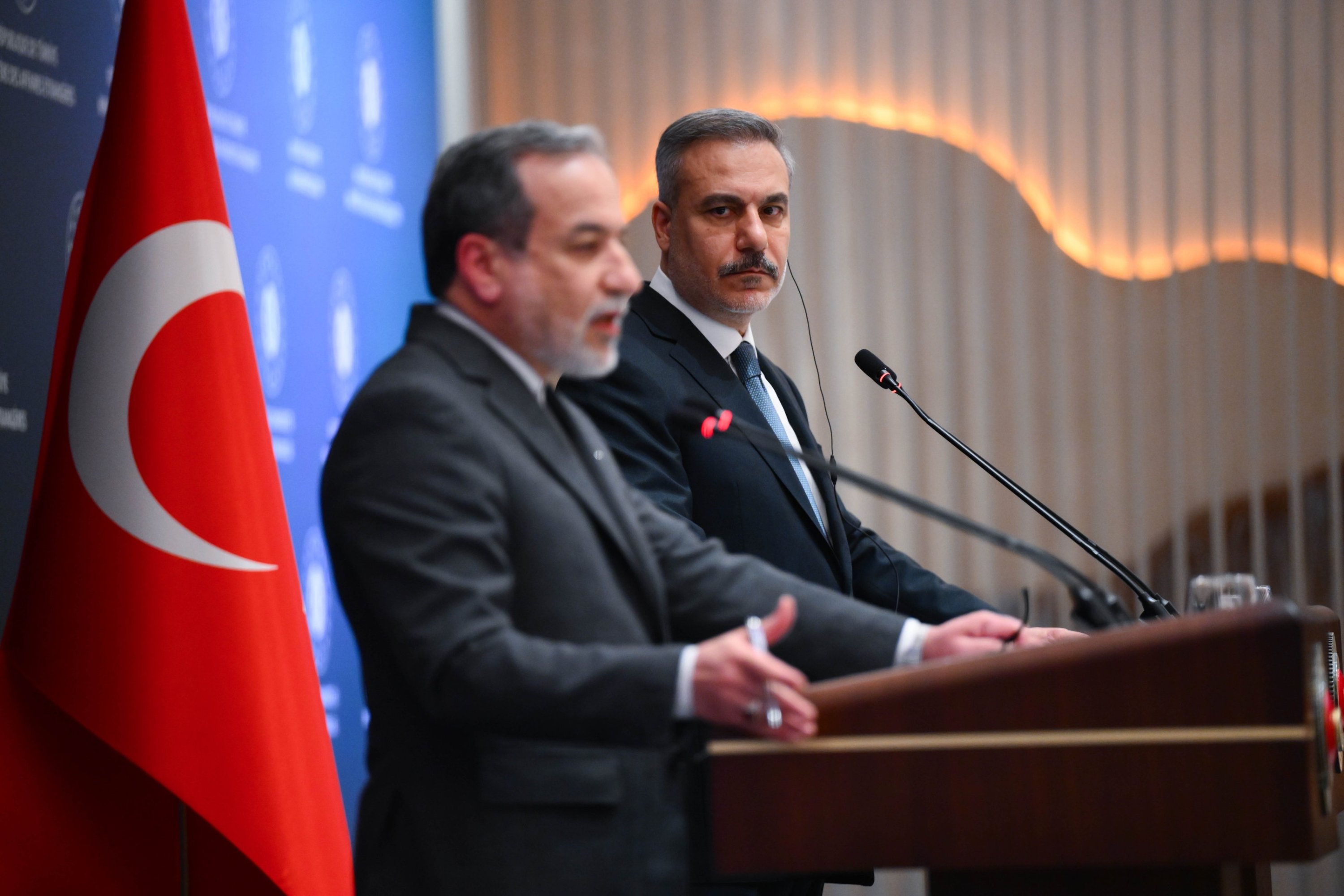
Speaking on a live broadcast, Fidan said the emergence of a positive atmosphere after the first contact in a long while is significant for Ankara. He noted that a creative solution is needed and that both sides appear to show a willingness to work toward resolving the issue. He added that, for now, there does not seem to be an immediate threat of war.
"After the first contact following a long break, the emergence of a positive atmosphere is important for us. We need to find a creative solution, and we see that both sides have the will to resolve the issue. For now, it seems there is at least no immediate threat of war," Fidan said.
The top Turkish diplomat said the Iran issue remains a central focus for Ankara, stressing that the region cannot withstand another war and that President Recep Tayyip Erdoğan is closely following the file.
He noted that Iranian and U.S. officials held rare talks in Oman two days ago, where Iran’s Foreign Minister Abbas Araghchi briefed counterparts on the discussions.
Fidan said that if a solution can be reached on the Iran file, other issues could also be brought to the table, noting that the nuclear dispute is primarily a matter between the U.S. and global security, while other topics are regional and not directly tied to U.S. security.
He said there is a belief that resolving the nuclear issue would make progress on other disputes easier and that Ankara has conveyed this view to both sides in an effort to establish a workable framework. Fidan added that this dynamic should not be seen as a surprise, as parties often prepare alternative scenarios where hostilities exist. He pointed to U.S. displays of pressure – such as deploying major fleets, bombers, and strategic assets – and Iran’s statements about increasing its missile numbers as signs that any potential confrontation would be costly for both. “First, it is about demonstrating strength; second, being prepared,” he said.
In response to a question about whether he thinks regime change could be possible in Iran through U.S. airstrikes, Fidan said regimes do not change through airstrikes.
"I don’t think regime change is possible in Iran," he said.
Fidan dismissed the idea of regime change in Iran as unrealistic, saying such expectations amount to “an empty dream.”
He said a more plausible scenario would be a government weakened by its inability to provide public services, prompting the existing leadership to make radical decisions and adjust course. He noted that discussions take place on two levels – formal talks and more candid exchanges – and argued that the problem lies not in Iran’s system itself but in the decisions and policies it pursues.
Fidan said Iran’s long-standing revolutionary cadre continues to govern the country with an approach shaped by the 1979 revolution rather than a conventional nation-state model, creating structural challenges.
While Iran is not building a bomb, Fidan said, it is developing capabilities close to it, which exposes the country to sanctions. “People misunderstand this,” he said. “They are not producing a bomb, nor is there evidence they intend to, but they are enriching uranium to a level that raises concern. The issue at hand is uranium enrichment.”
Fidan recalled that Iran was struck while negotiations were ongoing and described how, during the 12-day June war, Washington warned Ankara that “anything could happen within hours,” even as talks were scheduled.
“The U.S. was the one talking; Israel was the one striking,” he said, adding that conditions may be different this time and that Türkiye is doing all it can to avert a catastrophe. He noted that Iran has its own decision-making structure, with established rules for negotiations, including location, modality, and participants. Ankara proposed a different method, encouraging Iranian and U.S. officials to meet face-to-face instead of speaking through a mediator in separate rooms, but Iran opted to continue the system used in Oman and that Ankara respects the choice of its neighbor.
Fidan said Iran faces major existential challenges and that Türkiye held extensive consultations in early February with regional partners, including Qatar, Saudi Arabia, Egypt and the United Arab Emirates, all of whom showed strong interest. He added that during discussions on the Palestine issue, Türkiye brought regional countries together around shared ideas and delivered a strong diplomatic effort. “We suggested showing the same kind of solidarity on the Iran issue,” he said, proposing a joint platform to build consensus and present a unified message to the parties. He noted that the United States welcomed this approach, saying it had proven effective in Gaza by fostering regional ownership and coordinated action. “We are moving forward as a strong team,” Fidan said, “but the challenges remain substantial.”
Fidan said the region needs stronger cooperation platforms, stressing that the most urgent requirement is for regional countries to restore mutual confidence.
He noted that this trust deficit must be addressed and added that President Erdoğan’s perspective focuses on institutionalizing regional solidarity in the military, political and economic fields. He continued by saying that ongoing discussions on these ideas are important and that several advanced proposals are now on the table. He added that he expects developments in the near future that will contribute to regional stability.
Fidan said limited progress has been made on preserving the unity and territorial integrity of Syria, but stressed the importance of advancing the process through dialogue rather than bloodshed.
He noted that although more work remains, the withdrawal of the terrorist PKK's Syrian offshoot, YPG, from occupied areas and its repositioning in predominantly YPG/PKK-held regions marks an improvement compared to earlier maps.
Still, he said, additional steps required under existing agreements must be completed, as mistrust persists on both sides. Fidan argued that the YPG must undergo a historic transformation, adopting a more realistic, Syrian-oriented posture that does not threaten the security of Iraq or Türkiye and is not aligned with the goals of the PKK. Such a shift, he added, would create space for legitimate political engagement by Kurdish communities. He said Türkiye has conveyed this message to President Bashar Assad as well and will follow the process closely, emphasizing that equal rights for all Syrian citizens are essential.
Fidan added that Kurdish communities had little opportunity to engage with Damascus due to years under different controlling forces but are now gradually reconnecting. Türkiye, he said, has long taken a sensitive approach toward Syrian Kurds, raising their lack of citizenship and sense of belonging in past meetings with Assad. He noted that toxic narratives have taken root, including PKK-driven claims portraying all Sunni Arabs as Daesh members, and opposing narratives portraying all Kurds as PKK or YPG. These, he said, must be isolated. Fidan praised the stance of Ahmet Şara and his colleagues, saying they did not oppress civilians, and expressed hope that this chapter will close in a way that benefits both Kurds and Arabs, alleviates Türkiye’s security concerns, and helps Syria move toward a more stable future.
Earlier on Monday, Fidan spoke by phone with his Iranian counterpart, discussing ongoing nuclear negotiations, according to Turkish diplomatic sources.
Türkiye was named as one of the potential venues for direct talks between Iran and the U.S., after U.S. President Donald Trump threatened to strike Iran following weeks of deadly protests in Türkiye's eastern neighbor. Iran said last Wednesday that the talks would take place in Oman's Muscat on Friday amid rumors that negotiations may collapse due to disagreements about the format and the venue.
Ankara, which maintains close ties with Iran and the U.S., has advocated dialogue since tensions gradually escalated over the past few weeks. President Recep Tayyip Erdoğan conducted phone diplomacy with both Trump and Iranian President Masoud Pezeshkian during the crisis, while Araghchi met his Turkish counterpart Fidan in Istanbul in January.
Comments
No comments yet.
Log in to leave a comment.