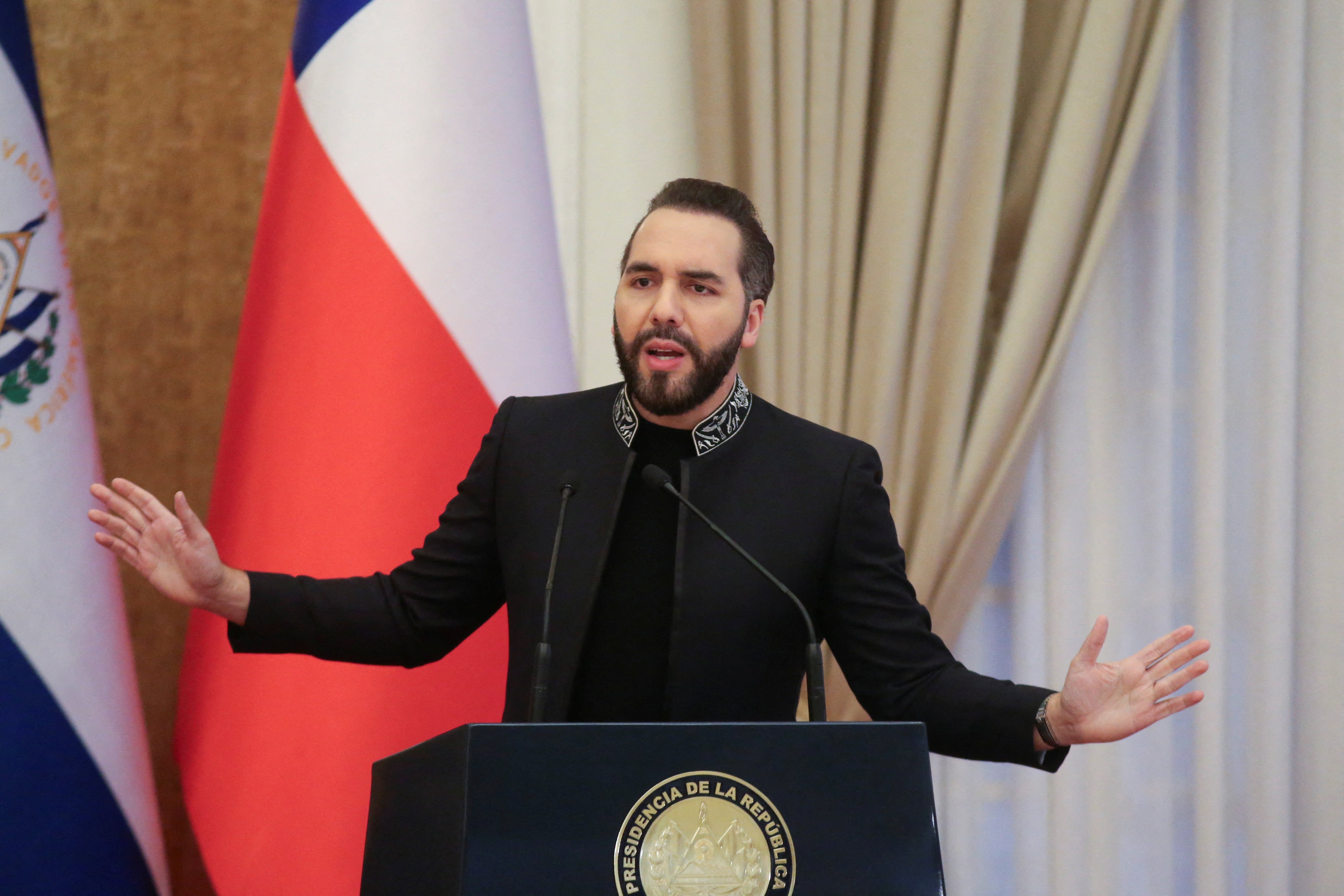
According to the investigation, the president received nearly $3.3 million from companies linked to the Alba Petróleos consortium
El Salvador’s attorney general and trusted ally of President Nayib Bukele, Rodolfo Delgado, has frozen a money‑laundering investigation into Alba Petróleos de El Salvador, a company financed with Venezuelan government funds whose operations extend to bank accounts linked to the president. Documents from the Attorney General’s Office show that Bukele received roughly $3.3 million — both personally and through three companies belonging to his family group — originating from Venezuelan oil money.
Two former prosecutors with direct knowledge of the case say that, as of December, there had been no progress in the investigation. “Not a single sheet of paper has moved in that file since Delgado arrived at the Attorney General’s Office. The outcome of that investigation is not convenient for him or for the president,” one of them said under condition of anonymity.
Venezuela’s attorney general, Tarek William Saab, has also remained silent, declining to comment when contacted by this newspaper. The Attorney General’s Office of El Salvador also did not respond to requests for information. Since Bukele came to power and appointed Delgado to lead the Attorney General’s Office, the money‑laundering investigation that implicates the president has been at a standstill.
The case was opened in 2019 by then–attorney general Raúl Melara, who was investigating Bukele’s administration for alleged corruption and supposed pacts with the MS‑13 and Barrio 18 gangs. Melara was removed from office on May 1, 2021, the same day the ruling party took full control of the Legislative Assembly, preventing the investigation from moving forward to the courts. That day, lawmakers aligned with Bukele also dismissed the justices of the Constitutional Chamber of the Supreme Court and appointed five replacements loyal to the executive branch.
Alba Petróleos de El Salvador is a mixed‑economy company founded in 2006 by a group of municipalities and run by leaders of the Farabundo Martí National Liberation Front (FMLN), the left‑wing party allied with the Venezuelan government in the country. Sixty percent of its shares belong to PDV Caribe S.A., a subsidiary of Petróleos de Venezuela (PDVSA), the Venezuelan state oil company and the project’s main source of funding.
On May 31, 2019, one day before Bukele took office, the Attorney General’s Office under Melara raided the offices of Alba Petróleos El Salvador SEM and 27 other companies linked to the Alba group, including Alba Alimentos S.A., Alba Gas S.A., and Inversiones Valiosas S.A. (Inverval), a firm supposedly dedicated to financing real‑estate projects.
Three months after Bukele took office, in September of that year, the Salvadoran outlet Revista Factum revealed — based on documents seized by the Attorney General’s Office as part of a possible money‑laundering investigation — that in 2013 the now‑president received $1.9 million from Inverval in his own name and another $1.4 million in the name of two of his family‑owned companies: Starlight and Obermet. Bukele responded to the report by saying the money came from the sale of a family‑owned television channel called TVX. “We sold it to a company. That company is now under investigation and it turns out it received money from Alba Petróleos, but honestly, what company didn’t receive money from Alba Petróleos?” Bukele quipped after the revelation.
At the time he received those funds, Bukele was beginning his political career under the banner of the FMLN. He wore red and sang The Internationale at public events. He was mayor of Nuevo Cuscatlán, a municipality of just six square miles — less than five times the size of Central Park in New York — considered one of the country’s strongest generators of revenue and investment. He also owned several companies, including the advertising firm Obermet S.A. de C.V. and Starlight, which operated Channel 23, a free-to-air television channel known as TVX.
Inverval, however, was not a small-time player within the Alba network. According to Factum’s investigation, it was one of the conglomerate’s key companies, and in 2013 — the year it was founded and the same year it issued checks to Bukele and his companies — 70% of its income came from Venezuelan funds.
What’s more, Bukele also did not sell the entire channel, but only a portion of it. After selling 60% of Starlight’s shares to Inverval, TVX came under the direction of trusted figures close to both Bukele and Alba, among them José Luis Merino — a former guerrilla commander, FMLN leader, later investigated in the United States for arms trafficking and money laundering, and one of the main figures behind the Alba conglomerate.
The origins of Alba Petróleos trace back to the Petrocaribe agreement, a cooperation mechanism created to facilitate the supply of Venezuelan oil to countries in Latin America and the Caribbean, including Cuba and Daniel Ortega’s Nicaragua. The project was launched in 2005 by then‑president Hugo Chávez, as part of the Bolivarian Alliance for the Peoples of Our America (ALBA), promoted a year earlier by Cuba and Venezuela.
Oil flowed from Venezuela to Alba Petróleos de El Salvador, which then outsourced profits to companies with no real capacity to repay or funneled them through shell corporations created in tax havens, ultimately returning the funds — now laundered — to individuals linked to the Salvadoran left, according to journalistic investigations.
Attorney General Delgado’s connection to Alba Petróleos and to funds of Venezuelan origin is even more direct. An official document from the Constitutional Chamber, accessed by this newspaper, confirms that Delgado worked as legal representative for Alba Petróleos and attempted to halt the investigation.
The document corresponds to the response to amparo petition 433‑2019, filed by Delgado and two other attorneys in their capacity as legal representatives of Alba Petróleos de El Salvador SEM, in which they requested that the raids carried out in June 2019 be dismissed. Their central argument was that the Attorney General’s Office could have requested the documentation without resorting to judicial searches.
The text was obtained from a massive leak of Supreme Court documents carried out by a group of hackers calling themselves “Ciberinteligencia SV.” Its authenticity was later verified in the institutional repository of the high court.
In the ruling, the Supreme Court addresses attorneys Miguel Ángel Flores Durel, José Luis Orellana Ruano, and Rodolfo Antonio Delgado Montes as legal representatives of Alba. The same document notes that, days earlier, Delgado Montes had submitted his resignation after being appointed attorney general. Flores Durel also resigned after being named a justice of the Constitutional Chamber on the same day. In other words, two lawyers linked to Alba were simultaneously placed in the highest positions of El Salvador’s justice system.
In August 2021, an investigation by Infobae revealed that Delgado received more than $46,000 from Alba Petróleos in 2019 alone. During his time as a private attorney, Delgado also worked with Jorge Manuel Vega Knight, whom the previous Prosecutor’s Office accused of being one of MS‑13’s main collaborators in laundering money and assets.
Sign up for our weekly newsletter to get more English-language news coverage from EL PAÍS USA Edition
¿Quieres añadir otro usuario a tu suscripción?
Si continúas leyendo en este dispositivo, no se podrá leer en el otro.
¿Por qué estás viendo esto?
Si quieres compartir tu cuenta, cambia tu suscripción a la modalidad Premium, así podrás añadir otro usuario. Cada uno accederá con su propia cuenta de email, lo que os permitirá personalizar vuestra experiencia en EL PAÍS.
¿Tienes una suscripción de empresa? Accede aquí para contratar más cuentas.
En el caso de no saber quién está usando tu cuenta, te recomendamos cambiar tu contraseña aquí.
Si decides continuar compartiendo tu cuenta, este mensaje se mostrará en tu dispositivo y en el de la otra persona que está usando tu cuenta de forma indefinida, afectando a tu experiencia de lectura. Puedes consultar aquí los términos y condiciones de la suscripción digital.
Comments
No comments yet.
Log in to leave a comment.