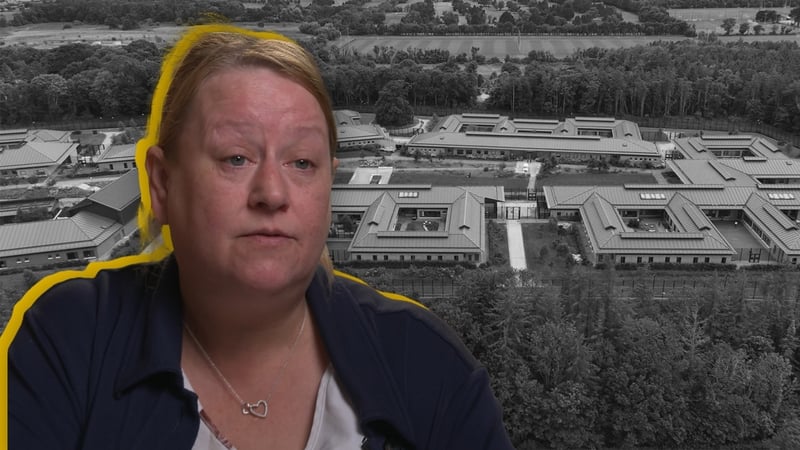
The family of a brain-injured man who spent almost five years locked on his own in small rooms in uninterrupted seclusion - going against all standards in modern psychiatric care - has spoken out about what they describe as the "absolutely dreadful" conditions he lived in.
Stephen Loughnane was first placed in continuous seclusion in Limerick Prison in 2021, before being transferred to the old Central Mental Hospital (CMH) in Dundrum, Co Dublin, and later to the new CMH in Portrane in north County Dublin in November 2022 where he currently resides.
He remained in uninterrupted seclusion across all three settings, and his mother Jacinta Graham says this is because there are no residential settings able to take him.
Speaking to RTÉ Investigates, Ms Graham described the conditions under which her son was living.
"It's like going to visit Hannibal Lecter in the movie 'Silence of the Lambs' - behind a screen with the glass and talking through a speaker. That's the only way I can describe it. And absolutely nothing in the room," Ms Graham said.
"And it plays on my mind thinking about him, all the minutes of every day, walking around in that room with nothing only the four walls. It's coming up to nearly five years he's there now, 24 hours of every day for the last five years nearly," she added.
"It's heartbreaking to think of him like it. Absolutely dreadful."
In recent months, Stephen was moved to a larger isolation unit on a temporary basis after spending years on his own in the small seclusion room stripped of any furniture or effects.
Originally from Roscrea, Co Tipperary, Stephen was the surviving passenger of a fatal road crash at the age 16.
Now 28, he suffered a brain injury in the crash that resulted in psychiatric symptoms including psychosis, hallucinations, and violent outbursts.
Following one episode in 2021, when he attacked his mother, he was remanded to Limerick Prison, where he spent months in permanent isolation before his moves to Dundrum and eventually Portrane.
The use of seclusion is a strictly regulated practice in mental health facilities that is used to prevent a person who is a threat to themselves or others from leaving a room by any means.
In the case of the CMH, it involves being kept in a stripped-down room measuring four metres by three metres with regulated access to an external cage of a similar size.
Contact with staff is maintained through an intercom.
Stephen Loughnane’s detention in prison while waiting for transfer to hospital exposed a serious anomaly within the criminal justice system. Twenty-three hour seclusion is commonly used in Irish jails, often for prisoners who are mentally ill. But prisons are considered outside the remit of the Mental Health Commission.
Dr Charles O'Mahony from University of Galway School of Law said it raised "significant human rights issues" as well as "significant gaps in terms of regulation and oversight."
In a statement to RTÉ Investigates, the HSE said it would not comment on the specific case but said the "use of restrictive practices [such as seclusion] in Irish mental health centres has fallen to a record low following the introduction of new human rights-based rules."
This is true for all mental health institutions in Ireland combined. However, it is not true for the CMH in Portrane where Stephen currently resides.
The use of seclusion or solitary confinement has fallen significantly in recent years across Irish mental health facilities. However, its application in Portrane is actually increasing.
In 2024, there were 82 seclusion incidents in Portrane, compared with 69 the previous year.
The longest seclusion episode continued uninterrupted for 20,880 hours.
A report published by the HSE noted that the single episode began when patients first moved into the state-of-the-art hospital at 11.30am on 13 November, 2022.
However, Stephen's period of uninterrupted seclusion did not begin in Portrane - it pre-dated his transfer to the new hospital.
Seclusion policies at the new CMH were identified as a "critical" risk factor by the Inspector of Mental Health services in his most recent inspection of the new facility. The annual report for 2024 found "a concerning upward trajectory of non-compliance" with regulatory standards.
Mr Loughnane’s case is among a number highlighted in a two-part RTÉ Investigates documentary, The Psychiatric Care Scandal. The second part airs on RTÉ One at 9.35pm tonight.
READ: Surge in actively psychotic patients held in prisons, RTÉ finds
It found that there are 50 beds at the new CMH - including two Intensive Care Rehabilitation units and a Child and Adolescent unit - that remain unused, more than three years after the facility opened.
Meanwhile, there is a waiting list of 38 people who cannot be admitted and are being kept on prison landings instead, where they are unable to access the same type of anti-psychotic healthcare options.
RTÉ Investigates also uncovered major shortcomings in the provision of psychiatric care to high-risk patients in the community.
This includes the case of a man often described in press reports as "Ireland’s most dangerous prisoner."
Leon Wright, from Ballymun, was recently sentenced to more than six years in prison for the latest of his more than 120 convictions that have included assaults on gardaí, prison officers and members of the public.
His sentencing revealed that he has been diagnosed with a serious mental health condition, schizophrenia, and had been progressing well while on medication and in therapy.
However, after he was released from prison in 2019 with a care plan, the HSE’s community mental health team refused to treat him because of the risk he could pose to staff.
In October 2021, Director of the Probation Service Mark Wilson wrote to the then chief executive of the HSE, Paul Reid, and said it was "completely unsatisfactory" that after two years’ "access to appropriate community-based treatment continues to be denied to Mr Wright."
Mr Wilson said he had "grave concerns for Mr Wright's ongoing welfare and … (if his) treatment needs go unattended, this poses significant risks for himself, (probation staff) and the wider community".
Care was not provided, and Mr Wright took an unsuccessful case to the High Court and the Court of Appeal in a bid to compel the HSE to administer anti-psychotic medication in a community setting.
His solicitor, Eileen McCabe, explained that without medication his symptoms spiralled. He was involved in a violent stand-off with armed gardaí last year and was subsequently sentenced.
He is now in isolation on the National Violence Reduction wing at the Midlands Prison.
"He recognises that in order for him to live in the community he will need mental health professionals to provide care for him, to supervise his medication and to assist him," Ms McCabe said.
"When the consultant who was looking after Leon [Wright] in prison wanted to do the handover to the community healthcare team in the area where he lived, they refused to take him on," she added.
"All of these supports were there except for the community and mental health care. The HSE are saying to him, basically, the only place where you're going to get mental health care is in the prison."
If you have been affected by the issues raised in this article, visit Helplines – RTÉ or Supporting People Affected By Mental Ill Health.
RTÉ Investigates: The Psychiatric Care Scandal by reporter Conor Ryan and producer/director Frank Shouldice will broadcast on RTÉ One and RTÉ Player on Monday 9 February and Tuesday 10 February at 9.35pm.
Follow@conor_w_ryan
Jacinta Graham\u0027s son Stephen spent five years locked on his own in uninterrupted seclusion
\u003Cp\u003EStephen Loughnane suffered a brain injury in a car crash at age 16\u003C/p\u003E
\u003Cp\u003ELeon Wright\u0027s solicitor Eileen McCabe said Leon Wright\u0027s symptoms spiralled without medication\u003C/p\u003E
Comments
No comments yet.
Log in to leave a comment.