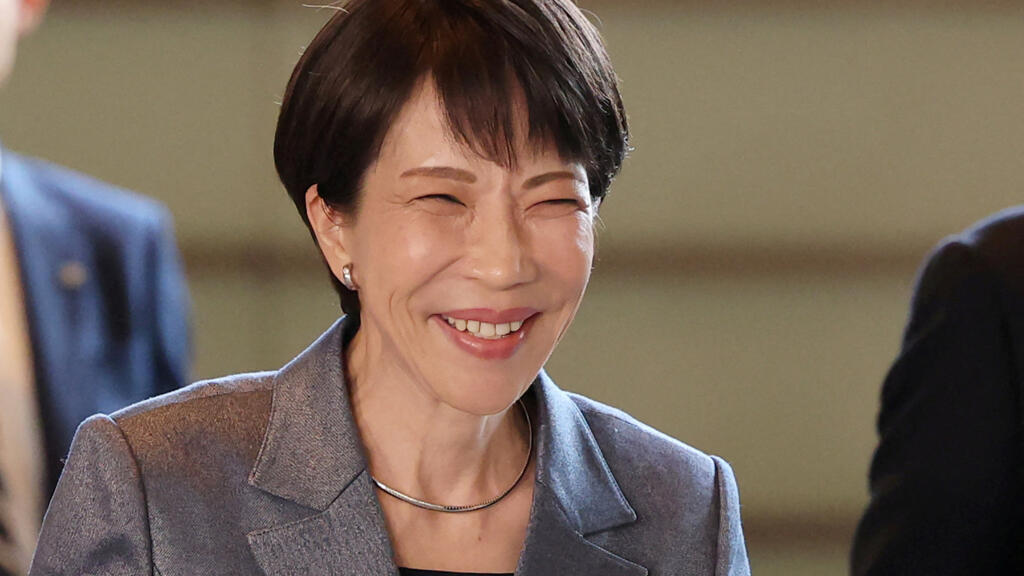
Japanese Prime Minister Sanae Takaichi's passion for heavy metal earned her the moniker "Iron Maiden". She's also called the "Iron Lady", and is perceived as a China hawk. With her party's thumping victory in Sunday's snap election, Takaichi has the parliamentary weight to steer her country, and Japan's neighbours will be monitoring the direction.
Issued on: 09/02/2026 - 21:20Modified: 09/02/2026 - 21:22
By: FRANCE 24 Japan's Prime Minister Sanae Takaichi arrives at a meeting in Tokyo on February 5, 2026. © Kim Kyung-Hoon, Reuters When Japan’s first female prime minister staged a surprise drum session with visiting South Korean President Lee Jae-myung last month, it created ripples across the Sea of Japan, marking a new rhythm in Tokyo’s diplomacy.
Wearing matching blue shirts, Japanese Prime Minister Sanae Takaichi and Lee banged out K-pop hits as the cameras caught Japan’s 64-year-old leader bobbing her head to the beat with a face-splitting smile. As the video clip went viral in both countries, international news outlets gushed about a new “drumstick diplomacy” turning into a “cymbal of unity”.
Before becoming prime minister in October, Takaichi was a regular visitor to Japan’s Yasukuni Shrine, which honours convicted war criminals along with 2.5 million war dead and is viewed as a potent symbol of the country’s militarist past.
More than a decade ago, when Takaichi’s political mentor, then prime minister Shinzo Abe, visited the shrine, it sparked furious reactions from China and South Korea, where memories of Japanese colonialism and Tokyo’s refusal to acknowledge the atrocities of the early 20th century have left festering wounds.
Takaichi’s rise to the pinnacle of power in a deeply patriarchal country may have been enabled by Abe, Japan’s longest-serving prime minister who was assassinated in 2022. But in style, if not substance, Takaichi as prime minister has taken things more cautiously. Since taking office, she has avoided a visit to the Yasukuni Shrine.
That was before she led her party to a thumping supermajority victory in Sunday’s snap poll. With her conservative Liberal Democratic Paty (LDP) sweeping more than two-thirds of parliamentary seats in the lower house, Takaichi now has the ability to give her hawkish instincts a free rein.
Read moreJapan's Takaichi clinches supermajority with thumping election victory
During an interview with Fuji Television on Sunday, Takaichi said she wanted to create an environment to allow a Yasukuni visit that can be understood by neighbouring countries.
But China, Japan’s largest trading partner, is unlikely to be understanding. Barely two weeks after taking office in October, Takaichi ignited a diplomatic storm when she was asked in parliament about her position if China used military force against Taiwan. That would constitute a “survival-threatening situation” for Japan, Takaichi replied, breaking a tradition for Tokyo, which is typically more circumspect on Taiwan issues.
Her reply, which suggested that Japan could intervene militarily if China sought to seize the self-ruled island, sparked a war of words and massive Chinese military exercises in December that were aimed to showcase Beijing's ability to cut off Taiwan from outside support.
Takaichi is known to be a China hawk, which has alarmed some of Japan’s doves. The results of Sunday’s vote, however, show that the majority of Japanese voters are ready for a more muscular foreign policy to contain Beijing’s territorial ambitions.
In Japan, Takaichi has a formidable reputation with monikers to match. An admirer of Margaret Thatcher, Takaichi is also famous for having carried several drum sticks during her heavy-metal days, as she would break them during intense performances. When she became Japan’s first female prime minister, headlines proclaimed the “Iron Maiden” had risen to “Iron Lady”.
It was an unlikely rise for the daughter of working-class parents in the ancient imperial capital of Nara.
Born in Nara on March 7, 1961, Takaichi was raised by conservative parents who taught her prewar moral values. Her mother was a police officer and her father worked at a machinery maker.
As a child, she enjoyed listening to her parents recite an 1890 imperial document praising paternalistic family values and loyalty to the government, Takaichi said in 2012.
After graduating from high school, she was accepted by a number of prestigious Tokyo universities, but she wasn’t allowed to enroll in any of the schools in the capital. Her parents made her attend Kobe University while living at home, which was normal in those days for unmarried daughters of conservative families.
In 1987, she won a sponsorship that enabled her to go to the US to work as congressional fellow for then Democratic congresswoman Pat Schroeder. Takaichi returned to Japan two years later with lessons learned by observing Schroeder, who was the first female representative elected from Colorado.
After returning to Japan from the US, a young Takaichi worked as a television personality, an author and a critic.
“She has a very unique upbringing for a politician in the sense that she comes from a working-class family,” said Kristi Govella from the Nissan Institute of Japanese Studies in an interview with FRANCE 24. “She was a heavy metal drummer. She's an avid motorcyclist and she’s just not in the mold of the typical LDP politician that many voters have become quite tired of in recent years. She has come onto the scene despite possible doubts about her ability to lead because she wasn’t a huge figure on the national scene. And she's really made a splash.”
To display this content from YouTube, you must enable advertisement tracking and audience measurement.
One of your browser extensions seems to be blocking the video player from loading. To watch this content, you may need to disable it on this site.
“In those days, women who were not considered old enough were unwelcome,” she said. She also faced groundless allegations of being a mistress of a senior politician, and criticism – often from women – for wearing heels, flashy jewellery and short skirts.
“I am who I am,” Takaichi said. “The only way to prove myself is with the work I do.”
Her work ethic has sometimes been at odds with the national mood. Takaichi’s vow, before she took office in October, that she would “work, work, work, work, and work” drew criticism from mental health workers and several ordinary Japanese in a country notorious for its long working hours. Lawyers representing people who died from overwork described her comments as unhelpful, and reports of her calling meetings at 3am raised alarm bells about her health in some quarters.
Responding to the criticisms, Takaichi said her comments had been misinterpreted. “I had no intention of encouraging people to overwork or suggesting that working long hours is a virtue,” she said, adding she was simply trying to communicate her determination to be an effective leader.
With her short, cropped hair and her passion for heavy metal and motorcycles, it’s easy to view Takaichi as a daring non-conformist. But that would be a misjudgment, according to Japan experts.
Takaichi supports the imperial family’s male-only succession and opposes same-sex marriage as well as amending the 19th-century law requiring married couples to have the same surname, under which most women are pressured into abandoning theirs.
“She tends to have quite socially conservative views,” said Govella. But the prime minister also has a political nose for issues that resonate with the electorate. “The interesting thing is that we haven't heard a lot of emphasis on that social conservatism. Since she's come to be prime minister, she seems to be trying to weigh the different concerns of voters across issues, and she seems to be accurately gauging that what voters really want to see is a response on the economic side, more than her pushing forward on any specific social issues.”
Watch moreJapan's Iron Lady: What will Takaichi do with her landslide win?
Takaichi may look up to Thatcher, but economic policies do not mirror those of the fiscally conservative former British leader. As an Abe protégé, Japan’s prime minister advocates boosting government spending while also promoting a sales tax cut.
This alarms conservative economists, who warn that Japan must trim its national debt.
But when it comes to defence spending, Takaichi has an ally in US President Donald Trump, who welcomed her pledge to push Japan’s annual defense budget to double 2022 levels – to 2 percent of its gross domestic product – by March.
Takaichi is set to visit Washington to meet with Trump at the White House on March 19. The US president announced the trip on social media as he endorsed the prime minister ahead of Sunday’s election.
(FRANCE 24 with AFP and AP)
Japan's Takaichi vows 'major policy shift' after resounding election victory Asia / Pacific Nikkei index breaks record after Prime Minister Sanae Takaichi's election victory Business Today's top stories
Comments
No comments yet.
Log in to leave a comment.