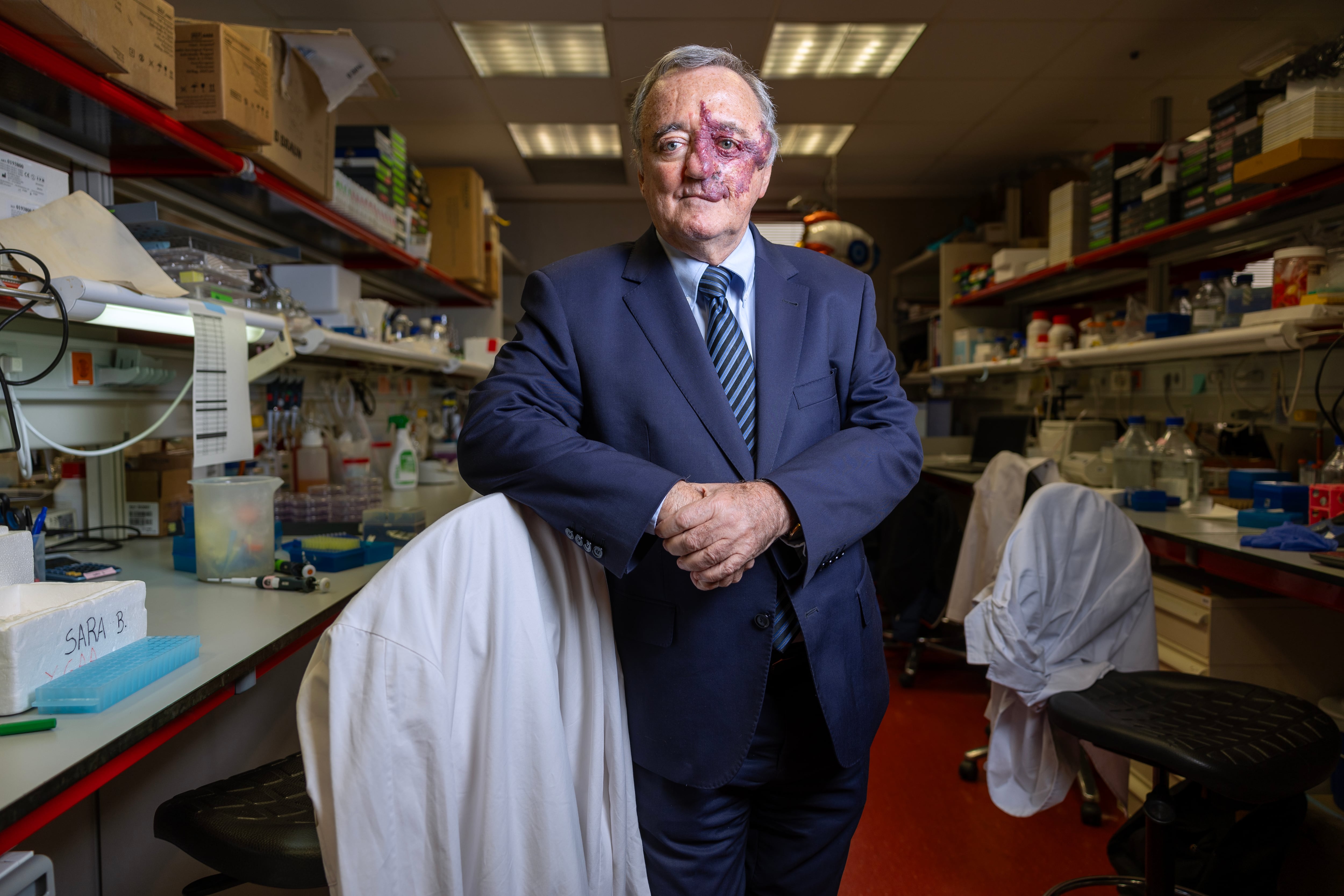
The biochemist’s company, Vega Oncotargets, has toned down its message after the false expectations generated by the announcement of a promising experiment with 45 ‘cured’ mice
More than a hundred people with pancreatic cancer have written to the Spanish National Cancer Research Center (CNIO) seeking help from scientist Mariano Barbacid, who on January 27 convened a press conference to present the promising results of an experiment with 45 mice that he claimed were “cured.” Four employees of the center have confirmed this flood of desperate messages, adding that some patients even showed up at the door of the research institution in Madrid in the hopes of being able to speak personally with Barbacid.
The biochemist revealed his results on February 2 on Spain’s most-watched television program, El Hormiguero. The host, Pablo Motos, proclaimed: “It’s a miracle.”
Colleagues at his own center criticize Barbacid for not better explaining his conflict of interest. He and his colleagues Carmen Guerra and Vasiliki Liaki have applied for a patent for the commercial exploitation of their experimental therapy, should it ever become a reality. The three of them, along with other partners, founded a company, Vega Oncotargets, in April 2024 to develop the treatment in animals. The company prominently displayed on its website—until this past Friday—that they had achieved “the first effective therapy against pancreatic cancer,” but the slogan falls short of the truth.
After being rejected by the prestigious journal Nature, they published their study on December 2 in PNAS, the journal of the U.S. National Academy of Sciences. Because Barbacid is an academic, he has the right to publish his work through an expedited process, with a slightly less stringent peer review. That study with 45 “cured” mice went unnoticed for almost two months, until the scientist organized a massive news conference on January 27 in collaboration with the private CRIS Cancer Foundation. Then it became world news. One of the most widely read newspapers on the planet, The Times of India, ran the headline: “Spanish scientist finds cure for pancreatic cancer in major medical breakthrough.”
Barbacid had already announced in 2011, when he was director of the CNIO, that his team had discovered a mechanism “that prevents the onset and development of lung cancer,” as a press release headlined. In the same statement, he accused the Spanish Ministry of Science of hindering his research by blocking private funding. In a harsh response, the ministry, then led by the biologist Cristina Garmendia, lamented “the false expectations” generated by Barbacid, “which play on the pain and fear that this disease produces in the population.” The ministry, in an unprecedented clash, warned: “Basic findings made in mice should not be announced as if the step to a cure in humans were immediate.”
The new study by Barbacid’s group presents the results of a “triple therapy” that attacks the KRAS protein—a kind of switch that triggers cell division—from three different angles. Certain alterations in this molecule—caused by smoking, for example—cause cells to run rampant, multiply uncontrollably, and generate a tumor. The “triple therapy” consists of three experimental drugs: daraxonrasib, from the U.S. company Revolution Medicines; afatinib, from the German company Boehringer Ingelheim; and SD-36, developed by chemist Shaomeng Wang at the University of Michigan.
The three products belong to other laboratories, but Barbacid’s team has created the company Vega Oncotargets to try to invent and patent alternatives similar to SD-36 and afatinib, which is highly toxic to the skin. The “triple therapy” has achieved complete and lasting regression of the cancer in 45 mice, both rodents with their own tumors induced through genetic engineering and specimens with grafted human tumor cells, but it has not been tested on metastases. This newspaper has tried to contact Barbacid since Thursday, without success.
EL PAÍS sought the opinion of four independent experts in the United States regarding the study. Biologist Pawel Mazur, from the MD Anderson Cancer Center at the University of Texas, emphasizes that “Barbacid is an undisputed leader in pancreatic cancer research” and that his latest study is “one of the most compelling and encouraging preclinical advances [in animals]” in this field. However, Mazur is highly critical of the way the research was publicly communicated. “The way these findings have been presented—with references to a ‘cure’ and a ‘first effective therapy’—goes well beyond what the current evidence supports and risks giving desperate patients unrealistic expectations,” the biologist laments. “It would be more responsible to frame this work as a very promising early step that may help design future clinical trials [in humans], rather than as a near‑term solution for people currently living with pancreatic cancer.”
Ben Stanger’s team reported in August 2025 that they had achieved complete responses in mice with pancreatic cancer using a combination of drugs and immunotherapy, without creating the kind of global hype seen in the case of Barbacid. “When the findings of a research study are shared with the public, it is the responsibility of both the scientists and the journalists to put the findings in proper context, neither downplaying nor inflating their direct or indirect implications,” says Stanger, from the University of Pennsylvania. “While the findings in the PNAS paper [published by Barbacid’s team] were represented in a fair and accurate manner, I’m not sure the same can be said about the press release and subsequent coverage,” he adds.
Biochemist Laura Attardi, from Stanford University, believes Barbacid’s research is “groundbreaking.” Alterations in the KRAS protein underlie nearly 90% of pancreatic cancer cases. For decades, this complex molecule was considered an impossible target for drug treatment. However, in 2021, the American pharmaceutical company Amgen obtained approval for sotorasib, a drug effective against lung cancer in people with a specific mutation. The problem is that tumors develop resistance to these early KRAS inhibitors. “Barbacid’s study, with its triple therapy, circumvents this problem and presents an exciting new clinical approach,” Attardi says. “It looks very promising. I am sure there is more optimization to be done, but I think it’s a historic milestone,” the Stanford researcher concludes.
Biomedical scientist Luisa Escobar-Hoyos, from Yale University, also applauds Barbacid’s “promising results,” but remains grounded. “It’s important to emphasize that only 10% of clinical trials in patients with pancreatic cancer have resulted in a change in medical practice, despite successful tests in mice,” she points out. “Therefore, from a scientific perspective, these results are excellent news. From a clinical perspective, and for patients, it’s important to be cautiously optimistic,” Escobar-Hoyos concludes.
The Vega Oncotargets website lists Mariano Barbacid and Carmen Guerra as co-founders. A third co-founder, the astronaut and biotechnologist Sara García, was also listed, but her name disappeared on February 5. García, who works in the same group at the CNIO, confirmed by phone that it was a mistake and that she is not affiliated with the company. The sole administrator is Gerardo Gutiérrez, the successful chemist who in 1991 founded Gadea Grupo Farmacéutico—a corticosteroid manufacturing empire—and sold it for $174 million in 2015 to a U.S. multinational.
Gutiérrez provided details of the shareholding structure at the request of EL PAÍS. He and his two sons, through the company 3-Gutinver, own 25%. The investment company of the Castile and León regional government, Sodical, holds another 25%. A lawyer from Salamanca owns 10%. The Hermanos Álvarez Quirós Foundation owns 7.5%. The CRIS Cancer Foundation owns 5.2%. The CNIO owns 5%. And almost a quarter belongs to the scientists involved in the research.
Vega Oncotargets doesn’t yet have any employees, Gutiérrez acknowledges. “We outsource everything,” he explains. The entrepreneur highlights the collaboration with FTherapeutics, a consultancy founded by chemist Rafael Ferritto to help turn ideas into real drugs. Barbacid’s group at the CNIO is divided into two teams: one, led by astronaut Sara García, is trying to find its own molecule for triple therapy; the other, headed by Carmen Guerra, is searching for another drug for a second approach. The third drug would be daraxonrasib, from the American company Revolution Medicines.
Gutiérrez realistically describes the current situation: they haven’t even proven that their own products work in mice yet, but they are optimistic. “We have a couple of molecules that are showing great promise, but we need to continue refining them and measuring their toxicity. The probability of this working out well isn’t high, to say the least, but if things go well, we estimate that in two or three years we could begin trials in human volunteers,” he says. Gutiérrez acknowledges that it was a mistake for Vega Oncotargets’ website to announce “the first effective therapy against pancreatic cancer,” without any certainty that such a treatment will ever exist. “We have very promising initial results, but it’s very important not to give false hope,” he admits. The company changed its slogan this past Friday. It is now: “We research to cure pancreatic cancer.”
Pharmacologist Carmen Guerra says she has received about 40 messages from patients in her inbox. Barbacid’s inbox is “completely overwhelmed,” she confirms. “We didn’t expect this reaction; we’ve tried to make it clear that this is in mice,” she laments. On the PubPeer website, where scientists comment on studies by other colleagues, molecular biologist Sholto David has pointed out that the article published in PNAS contains the same image twice, illustrating two different experiments. David, a well-known science sleuth, has also noted what appear to be two images of the same tumor, presented as if they were two different tumors. Guerra regrets the errors but emphasizes that they are minimal and do not affect the conclusions at all.
The president of the CRIS Cancer Foundation, Lola Manterola, believes that the communication campaign carried out by her organization has been “impeccable, making it clear at all times that the study is in mice.” Manterola herself has appeared in several interviews with Barbacid. After El Hormiguero host Pablo Motos said that “it’s a miracle” and after receiving two standing ovations, the biochemist clarified: “At least in experimental tumors. It must be made very clear that we still have at least two or three years to go before we can reach patients.” On the program’s YouTube channel, with 750,000 subscribers, the interview video is presented with a title card added later: “The cure for pancreatic cancer. A historic breakthrough!”
The CRIS Cancer Foundation, founded by Manterola herself after overcoming multiple myeloma, has raised €64 million in its 15 years of existence to invest in cancer research at public institutions, according to its own figures. The non-profit organization has a commitment of another €150 million for the next five years. The Barbacid group has received almost €11 million in public funding, both national and European, since 2018, according to the CNIO. Nearly 66% of its funding is public. CRIS Cancer Foundation has provided it with approximately €2 million since 2020.
“Of course, all governments need to invest more, but civil society, if it wants things to change, has to get involved,” Manterola urges in a telephone conversation. The president explains that, seeing various online initiatives raising money for Barbacid, her foundation decided to launch a fundraising campaign on January 31. In just nine days, they have already raised €3 million, with a goal of €3.5 million. In his first press conference, the biochemist estimated that €30 million would be needed to reach the first human trials and determine whether it would be worthwhile to continue.
The campaign’s message centers on Barbacid: “He has managed to cure pancreatic cancer in mice and now needs our support to cure it in humans.” The video is more ambiguous. The biochemist, dressed in a white coat, proclaims: “I am Mariano Barbacid, and as you have seen in all the news reports, my team and I have achieved the complete and lasting regression of experimental pancreatic cancers; but this is not our goal. Our ultimate goal is to be able to cure pancreatic cancer in patients. And the sooner, the better. That’s why I need your help.”
Sign up for our weekly newsletter to get more English-language news coverage from EL PAÍS USA Edition
¿Quieres añadir otro usuario a tu suscripción?
Si continúas leyendo en este dispositivo, no se podrá leer en el otro.
¿Por qué estás viendo esto?
Si quieres compartir tu cuenta, cambia tu suscripción a la modalidad Premium, así podrás añadir otro usuario. Cada uno accederá con su propia cuenta de email, lo que os permitirá personalizar vuestra experiencia en EL PAÍS.
¿Tienes una suscripción de empresa? Accede aquí para contratar más cuentas.
En el caso de no saber quién está usando tu cuenta, te recomendamos cambiar tu contraseña aquí.
Si decides continuar compartiendo tu cuenta, este mensaje se mostrará en tu dispositivo y en el de la otra persona que está usando tu cuenta de forma indefinida, afectando a tu experiencia de lectura. Puedes consultar aquí los términos y condiciones de la suscripción digital.
Comments
No comments yet.
Log in to leave a comment.