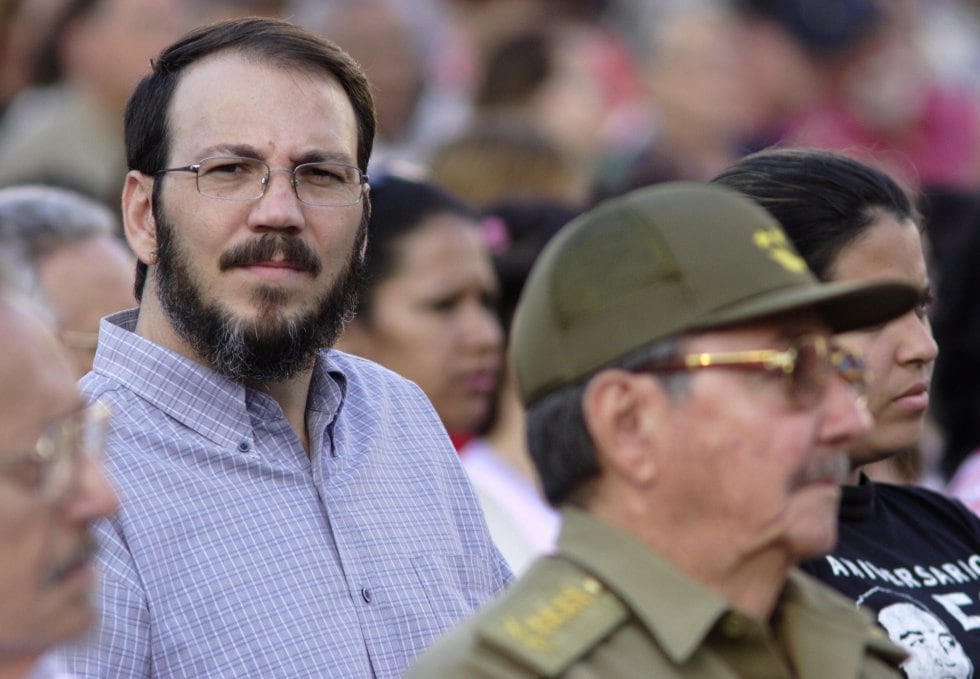
The enigmatic figure of Raúl Castro’s son re‑emerges in Cuba amid U.S. actions in Venezuela and Trump’s renewed pressure on the island
On October 14, 2024, during a march in Havana against the Israeli occupation of Gaza, television cameras showed Alejandro Castro Espín for the first time in almost seven years. For many Cubans, it was like seeing a ghost. Castro Espín seemed to be in disguise. He wasn’t wearing his classic military uniform, with the rank insignia of colonel emblazoned on the shoulders, but rather sunglasses, ordinary trousers, a black T-shirt, and a small Palestinian flag in his hand.
Until that moment, people said he had been put “on pajama plan,” a Cuban euphemism used when a member of the Castro elite is removed from their posts and forced to stay at home — something like a secret early retirement. Raúl Castro’s only son had been attributed contradictory responsibilities: first helping to bring about, and then helping to destroy, the normalization of relations between Cuba and the United States. That day, Alejandro appeared in the second row of the event, just behind the new wave of supposed technocrats who, with Miguel Díaz‑Canel at the helm, at least formally took power on the island in 2018, when Raúl Castro stepped aside and his son was pushed aside with him. But now, two years after that brief and surprising appearance, rumors are circulating in Cuba that he is back.
The events in Venezuela since the U.S. capture of Nicolás Maduro on January 3 and the recent measures adopted by U.S. President Donald Trump to deliver the final blow to the Cuban regime by cutting off its fuel supplies have pushed Havana to put the possibility of a dialogue with Washington back on the table. But, contrary to what Trump has said, the Cuban government denies that such talks are taking place. Even so, in the streets of Cuba and in several media outlets, comments have been pointing in another direction for days. If true, the Castro leadership may have dusted off its prince to negotiate and save it.
As with almost every member of the hermetic Castro family, what is known about the life of Alejandro Castro Espín comes more from rumor than from verifiable facts. But there are some certainties. It is known, for example, that he was born in 1965 and studied refrigeration engineering on the island before going to the USSR for military training, making him the only direct descendant of the Castro brothers to pursue a career in the Armed Forces. He later joined the Cuban troops operating in the Angolan war, and although there is no evidence of his participation on the front lines, the famous anecdote persists that during military exercises he suffered an accident that injured one of his eyes, leaving him partially blind. That is why Cubans — especially the dissidents — call him “El Tuerto,” the One‑Eyed Man.
In 2008, when Raúl Castro succeeded his brother, Colonel Alejandro Castro quietly stepped into public life and showed he was not just any military officer. In a way, he could be described as an organic intellectual of the regime, but in uniform: he wrote articles for official media, presented himself as a political scientist and a master’s graduate in International Relations, and authored books on international politics (such as Empire of Terror and United States: The Price of Power), focused on the history of imperialist predation by U.S. elites. He also gave interviews to outlets like RT and Al Mayadeen and presented his books in Russia, Greece, and several Arab countries, always with his characteristic lisp and an eloquence greater than his father’s, though far below that of his uncle.
The start of his golden era, however, did not arrive until late 2014, when Barack Obama and Raúl Castro announced the normalization of relations between Cuba and the United States. Shortly after the announcement, Alejandro Castro revealed himself to be more than a nepobaby with intellectual aspirations: he had not only been the architect of the rapprochement with Washington and the handler of the secret talks that led to the so‑called “thaw,” but he also became his father’s adviser, a member of the National Security Commission, and the director of intelligence and counterintelligence for State Security. Publicly, his discourse was aligned with the official line: “Cuba has always expressed its willingness to talk [with the United States] on equal terms, but the historical moment made it possible now,” he said in a 2015 interview. And also: “Cuba will not return to capitalism.” Even so, his reputation as a behind‑the‑scenes power broker and skilled negotiator grew among Cubans, especially after he invited John Brennan, then CIA director, to Havana in 2015. It was not unreasonable to think he would become a key figure in the post‑Castro era — someone less rigid and more pragmatic than his elders. But that rise was followed by a spectacular fall.
The restoration of relations with the United States was in danger from the start, and there was much speculation about the existence of a hard‑line core of Castro officials who preferred to maintain the rhetoric of confrontation. Who belonged to that group and how they acted are things still not fully known, but what is clear is that the reforms Cuba had promised were far slower than expected. To make matters worse, in 2017 Obama was replaced in the Oval Office by Trump, and nothing guaranteed that the Republican would preserve the Democrat’s legacy. And it was then, at the worst possible moment, that the Havana Syndrome scandal erupted — a series of alleged “sonic attacks” against U.S. and Canadian diplomats on the island.
According to an investigation by journalists Adam Entousy and Jon Lee Anderson published in The New Yorker, and another conducted jointly by The Insider, Der Spiegel, and 60 Minutes (CBS), the Kremlin’s intelligence services were behind the attacks. In Havana, however, as the Castro regime blamed Alejandro Castro. While some speculate that he was punished for negligence (almost nothing happens in Cuba without State Security knowing about it), others believe he was complicit. It is difficult to imagine the latter, since it would be contradictory for him to intentionally destroy something he had helped build carefully and in secret. Even so, the colonel’s closeness to Putin’s Russia is well known; he traveled there at least twice between 2014 and 2017 to finalize cooperation agreements on intelligence and security.
Nearly eight years later, there is still no official version of events, yet there are those who believe that Alejandro Castro, “El Tuerto,” should trade his “pajamas” for his uniform and return to the negotiating arena — if he isn’t already doing so.
Sign up for our weekly newsletter to get more English-language news coverage from EL PAÍS USA Edition
¿Quieres añadir otro usuario a tu suscripción?
Si continúas leyendo en este dispositivo, no se podrá leer en el otro.
¿Por qué estás viendo esto?
Si quieres compartir tu cuenta, cambia tu suscripción a la modalidad Premium, así podrás añadir otro usuario. Cada uno accederá con su propia cuenta de email, lo que os permitirá personalizar vuestra experiencia en EL PAÍS.
¿Tienes una suscripción de empresa? Accede aquí para contratar más cuentas.
En el caso de no saber quién está usando tu cuenta, te recomendamos cambiar tu contraseña aquí.
Si decides continuar compartiendo tu cuenta, este mensaje se mostrará en tu dispositivo y en el de la otra persona que está usando tu cuenta de forma indefinida, afectando a tu experiencia de lectura. Puedes consultar aquí los términos y condiciones de la suscripción digital.
Comments
No comments yet.
Log in to leave a comment.