Azhar Merchant Azhar Merchant
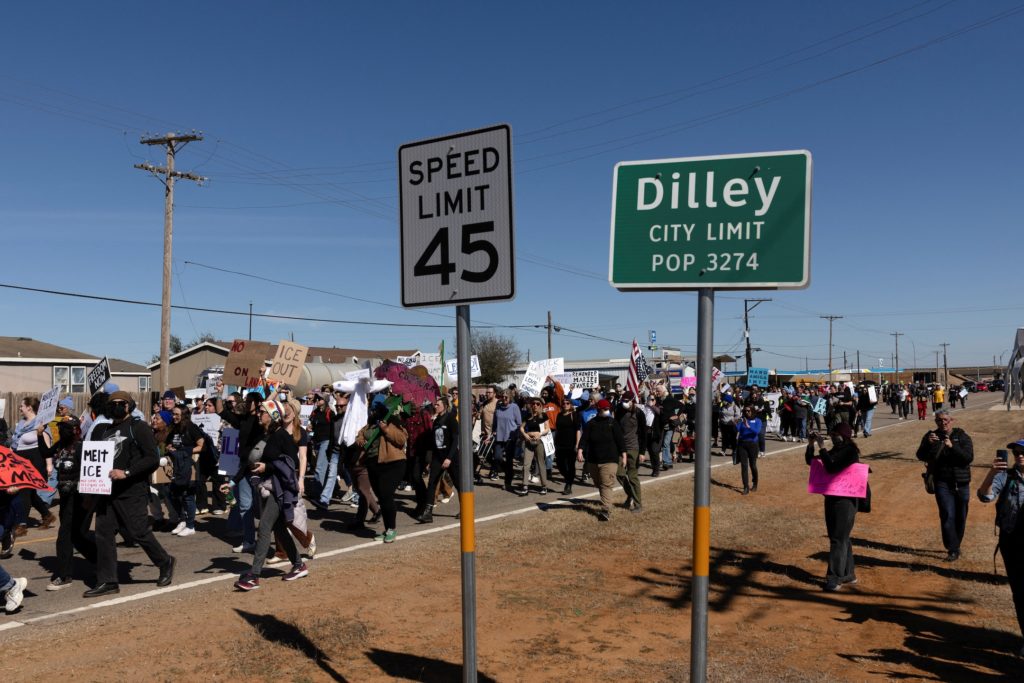
Since it reopened in March 2025, the ICE family detention center in Dilley, Texas, has held around 3,500 people, with more than half of them being children. As reports of contaminated food and the spread of measles have made national headlines, ProPublica spoke with two dozen detainees about the treatment of minors inside. Amna Nawaz discussed more with Mica Rosenberg of ProPublica.
Notice: Transcripts are machine and human generated and lightly edited for accuracy. They may contain errors.
Since it reopened in March of 2025, the ICE family detention center in Dilley, Texas, has held around 3,500 people, more than half of them children. The center was first opened in the Obama administration, shuttered by President Biden in 2021, then reopened under President Trump last year.
As reports of contaminated food and the spread of measles have made national headlines, ProPublica went inside the facility, and through phone calls, letters and e-mails, spoke to two dozen detainees about the treatment of minors inside.
Mica Rosenberg of ProPublica joins me now.
Mica, welcome to the "News Hour." Thanks for joining us.
Mica Rosenberg, ProPublica:
Thank you so much for having me.
So, as you have been speaking with these detainees for weeks now, half of them kids, we should just point out these are some of the kids you have been talking to, 18-month-old Amalia and her family. She's blowing kisses to the screen here -- 13-year-old Gustavo.
I know they're sharing their experiences with you. Just tell us about what some of the common threads are, some of the common stories you have heard from them.
Well, I think one thing that really stands out in what's happening in Dilley now is that, as you mentioned, this facility opened up during the Obama administration and families were housed there, but they were mainly families who were coming across the border and were there supposedly for a short period of time and hoping to be released into the United States or to come here for the first time.
But what's happening now is, many of the children that I spoke to are actually kids who've been living in the United States for -- some for years, and their families were picked up by ICE arrests in the interior, some of them at regular check-ins.
And so a lot of the kids that I talked to had really, in some cases, established U.S. lives. Some of them spoke perfect English. Some of them were in the middle of their high school years when they were detained. And so that's one thing that was quite different than in the past.
And we mentioned those reports about measles cases and some inedible food. Did you hear some of that from the kids inside?
Yes, we heard -- one of the things that we were trying to do with this reporting was really to get the kids to talk about their experiences in their own words.
And so one of the things that they did is, some kids about what they were going through drew pictures about their experiences, and they talked about the repetitive food, some of them saying that they were sick constantly or getting sick, they maybe believed, from the water.
But some of the more vivid descriptions about the conditions really came from their mothers, who I spoke to over the phone or who e-mailed me. And they would talk to me about food that the kids could see or they believed was contaminated and that it was giving their children sickness.
And the administration says that these conditions are not what they're described as. But this is from the firsthand experience of the detainees inside. One thing that we did -- found is that there were over 300 kids who had been there longer than the average of 20 days, which is what under a longstanding legal settlement is supposed to be the standard of how long kids should be detained for and no longer.
We know officials from the administration have said the families are getting top-notch care inside Dilley. They say they get medical care and good food and learning services, special caregivers.
You spoke with Alexander Perez, 15-year-old from the Dominican Republic who talked to you specifically about school. What did he tell you?
Well, he said that school is -- for the kids inside is really only an hour a day. There's -- the classes are capped at 12 kids per class.
And they said that it really only consisted of kind of worksheets, handouts, and that because the different age groups are mixed together -- and so a lot of the kids, as I mentioned, who were sort of in the middle of their school year were really missing their education. They were worried about falling behind.
Is it just a matter, Mica, repetitive food and inadequate learning or is there something more serious in terms of the emotional or mental toll that you saw?
I think their parents were very worried that they were experiencing more serious distress. Mothers told me about some kids who were self-harming, who had cut themselves, other kids who had spoken of suicide, kids who were very much older than they should have been starting to wet their bed, not being able to sleep well at night.
So these are more things that the mothers told me about and the kids would talk more generally. So I think it's hard to say what the long-term impact will be, but I think it was -- it's been difficult on them.
And I know you were able to speak with some parents and kids after some of them were released. What did they tell you? Were they able to go back to their lives as normal?
Well, a lot of it happened relatively recently. After I spoke to them, they were released.
I did speak to one girl, Ariana, who was 14, and she was able to go back to her high school, where she was welcomed by the principal and her teachers, who said that they had really missed her. She had worried about her grades and falling behind, but they said that they would try and support her.
But she -- when she and her mother were detained, they left behind two U.S. citizen siblings, a 2-year-old and a 5-year-old. They were detained in their regular check-in and just didn't come home that day. So her siblings were really sort of traumatized by that. And her little brother said that he was afraid to go to school because he was worried that they wouldn't be there when he came back.
So I think it's a combination of how the kids in detention are being impacted, but also the ones who are left outside.
That is Mica Rosenberg of ProPublica joining us tonight.
Mica, thank you so much your time and your reporting.
Thank you so much for having me.
Watch the Full Episode
By John Hanna, Associated Press
By John Hanna, Associated Press
By Robert Yoon, Associated Press
Amna Nawaz Amna Nawaz
Amna Nawaz serves as co-anchor and co-managing editor of PBS News Hour.
Azhar Merchant Azhar Merchant
Azhar Merchant is Associate Producer for National Affairs.
Subscribe to Here's the Deal, our politics newsletter for analysis you won't find anywhere else.
Thank you. Please check your inbox to confirm.
© 1996 - 2026 NewsHour Productions LLC. All Rights Reserved.
PBS is a 501(c)(3) not-for-profit organization.
Subscribe to Here's the Deal with Lisa Desjardins
Thank you. Please check your inbox to confirm.
Support for News Hour Provided By
Comments
No comments yet.
Log in to leave a comment.