The father of one of them says he was in Pangaon, Maharashtra, having left the village just 10 days earlier for some contract labour work, when the phone call came on January 29, informing him of what had happened.
Surrounded by others in the village, he says he was told his 11-year-old daughter had been found dead in the fields along with her friends.
The news would reach the Haspura Police Station only on February 1, two days later — that five girls had “consumed poison” in the Dalit village, and that only one had survived and was receiving treatment.
According to the Aurangabad police, when the Haspura Station House Officer and Sub-Divisional Police Officer, Daudnagar, reached the village to investigate, they were told the four deceased girls had been cremated on January 29 itself by the families.
As the news spread, the Aurangabad police issued a press note on February 2 saying they were trying to record the statements of the parents, and that this was proving difficult as they were not in the village. “Continuous questioning of villagers and others is underway, evidence is being collected, and an FIR has been registered. Further investigation into the cause of deaths is ongoing,” police said.
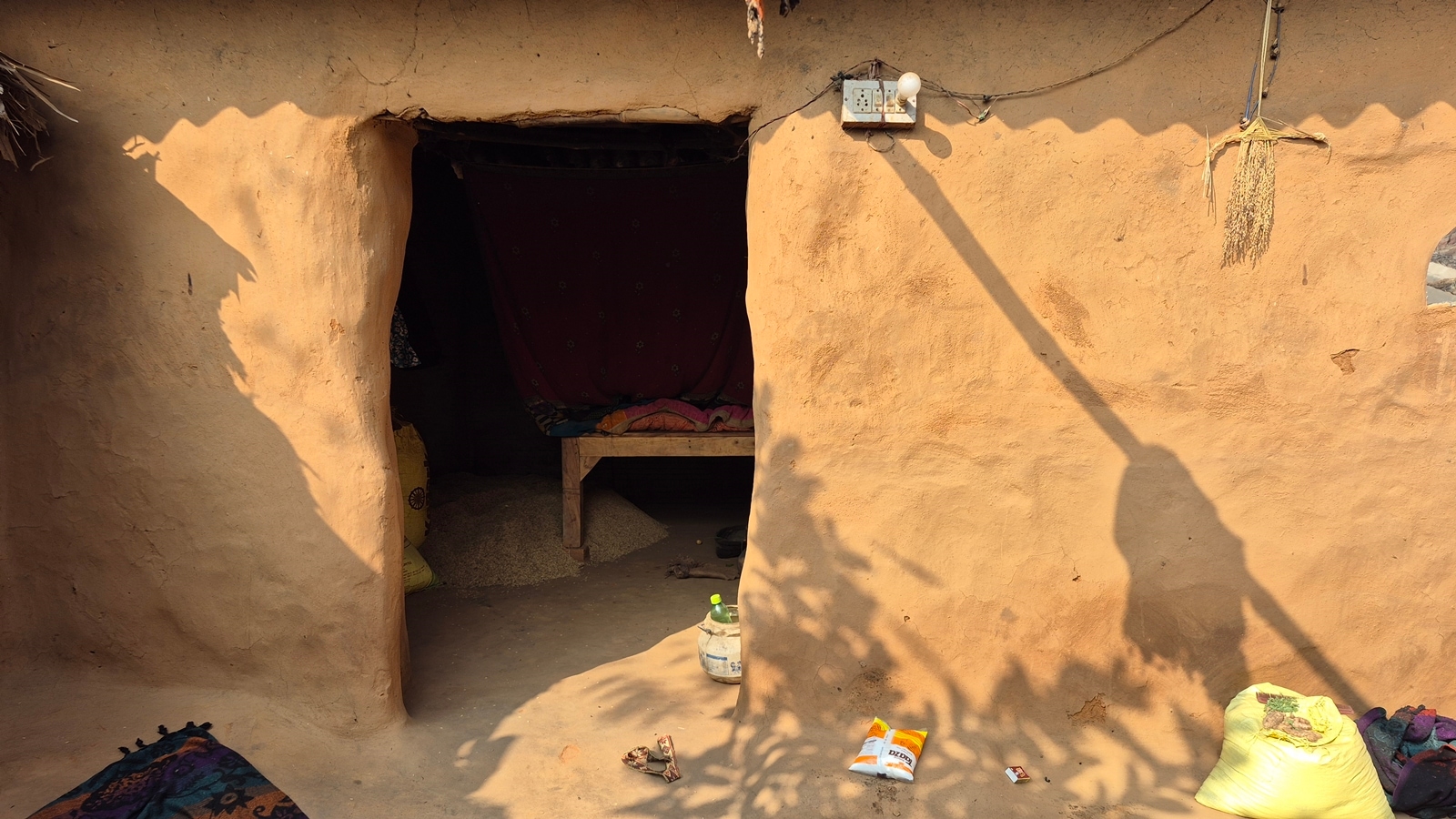
The Dalit village where the girls lived is a small cluster of 25 to 30 houses, only a few of them pucca structures, criss-crossed by clogged drains with stagnant dirty water. Unpaved, potholed roads are the village’s only access to nearby towns.
None of the homes has a toilet. Villagers say that the four-five common toilets have been unusable for the past couple of years, forcing them to relieve themselves in the fields.
There is no piped water supply either. “Most households depend on hand pumps,” says a villager.
Almost all men are employed as farm hands or daily labourers, with work available only 10-15 days a month, fetching Rs 3,000-5,000 per person. “A family produces about 8-10 quintals per crop cycle, which we store for our consumption. We may sell 1-2 quintals to buy vegetables and essentials,” a villager says.
“Men leave early in the morning to look for work, and women, after finishing household work, go out to collect grains or to tend to cattle,” a woman says.
The children, like the five girls, says another woman, are largely left to their own devices. “Those five were always together. Wherever they went, they went as a group. They spent the whole day roaming around the village and nearby areas, or playing.”
While they were earlier enrolled in school, all had dropped out after Class 5 as the government school in the village is only till that level. “They would help their families with chores,” a villager says.
The houses of the five girls, located next to each other, are mostly similar mud structures, with a clay stove in the courtyard, rooms stacked with grains and scattered utensils.
The 11-year-old, whose father is now home from Maharashtra, lived in a two-room mud house with a low roof made of khaprail (burnt clay) tiles, bamboo sticks, and leaves. One has to bend to get in. The room occupied by the girl, the youngest in a family of five (including her brother’s newborn), has a plant growing through the roof.
The father says that the offer of work in Maharashtra was promising, with the contractor who took him and others promising Rs 18,000 each for the construction of a tower. The man says he has a debt of Rs 50,000 to pay off.
“If the government gave us even road construction work or anything that is regular, we would not leave our homes. But you see the state of our roads,” he says, adding that his daughter never complained about anything, including the fact that she had to drop out of school due to their financial situation.
The mother says that she last saw the 11-year-old when she along with the four others came home sometime during the day to deposit some paddy. “We don’t know what happened, or how it happened. Some boys later found them dead in the fields.”
Another girl who died that day, 13, was the daughter of a relative, who had also gone to Pangaon for work. He says he is as clueless as his uncle’s family. “By the time we reached the village, the last rites had already been performed. We were very far away.”
The mother of the 13-year-old recalls her leaving home after breakfast, between 9 and 11 am. “She said she was going to the fields to cut grass,” says the mother.
She didn’t think anything amiss till about 3 pm, when some boys came running and told them the girls were lying in a field. “That’s when we all came to know. If they consumed anything, we don’t know.”
At the third deceased girl’s home, the father says he too was not in the village. “I had gone to Aurangabad for some labour work, and stayed overnight.” He says the talk that the girls were “scolded” or “pressured” was wrong. “They just went out to play. They were of that age.”
The home of another of the deceased girls comprises just an unplastered hall-like room. Her mother sits outside, holding an infant and looking numb. The deceased was her only daughter and the eldest of four siblings.
“We don’t know what happened. I was at home, my husband had gone early in the morning to work at a brick kiln,” she says. “Only the one who survived can tell.”
But the surviving girl’s house is locked. Villagers say she, her two brothers, and parents are currently not in the village. When contacted for comment on the investigation in the case, Aurangabad SP Ambrish Rahul referred The Indian Express to SDPO (Daudnagar) Ashok Kumar Das for further details; however, calls and messages to the SDPO remained unanswered.
A villager says their suspicion is that the girls consumed a fertilizer or some chemical stocked in the fields, mistaking it for black salt. “They were very young, perhaps they made a mistake,” he says.
Questions regarding the hasty cremation are also pushed away. A villager says it was a collective decision, and not because there was anything to hide. “Parents raise their children with love. Why would anyone kill them?” he says.
The father of the 11-year-old says that the village also thought better than to spend too much on the cremation. “The families didn’t have enough money for separate funerals or to buy wood. The girls were so small. So they were all burnt in the same pyre, with whatever wood we could gather from the nearby trees and bushes.”
Himanshu Harsh is a Correspondent with The Indian Express, currently leading on-the-ground coverage in Bihar. With a reporting career rooted in the complexities of the National Capital Region (NCR), Himanshu specializes in the critical intersection of law, crime, and civic governance. Professional Expertise & Credentials An alumnus of the prestigious Indian Institute of Mass Communication (IIMC), Delhi, Himanshu brings a rigorous academic foundation to his investigative work. His expertise is characterized by a "ground-up" reporting style, most notably demonstrated during his extensive coverage of the 2024 Lok Sabha elections, where he analyzed shifting political landscapes and grassroots sentiment. Specialized Beats Himanshu’s portfolio reflects versatility, allowing him to navigate diverse industries and social issues: Civic & Legal Affairs: Extensive experience covering the Delhi reporting beat, focusing on policy implementation and judicial impact. Automotive Industry: A technical background in reporting on India’s evolving transport and automotive sectors. Social Fabric & Human Interest: Beyond hard news, he is known for exploring the changing social dynamics of India’s urban and rural heartlands, bringing a human-centric lens to systemic issues. Personal Interests & Digital Literacy Outside the newsroom, Himanshu’s deep engagement with technology and gaming informs his understanding of digital trends and the modern information economy. A trained DJ with a passion for music, his diverse personal interests contribute to a well-rounded perspective that resonates across both traditional and digital media platforms. … Read More
Stay updated with the latest - Click here to follow us on Instagram
Five young girls from a poor Dalit village in Bihar were found dead in a field, with one survivor who cannot speak. The police are investigating, but the mystery is fading. The village lacks basic amenities and the families are struggling. The girls were close friends, but dropped out of school due to financial issues. The families cremated the girls together.
Comments
No comments yet.
Log in to leave a comment.