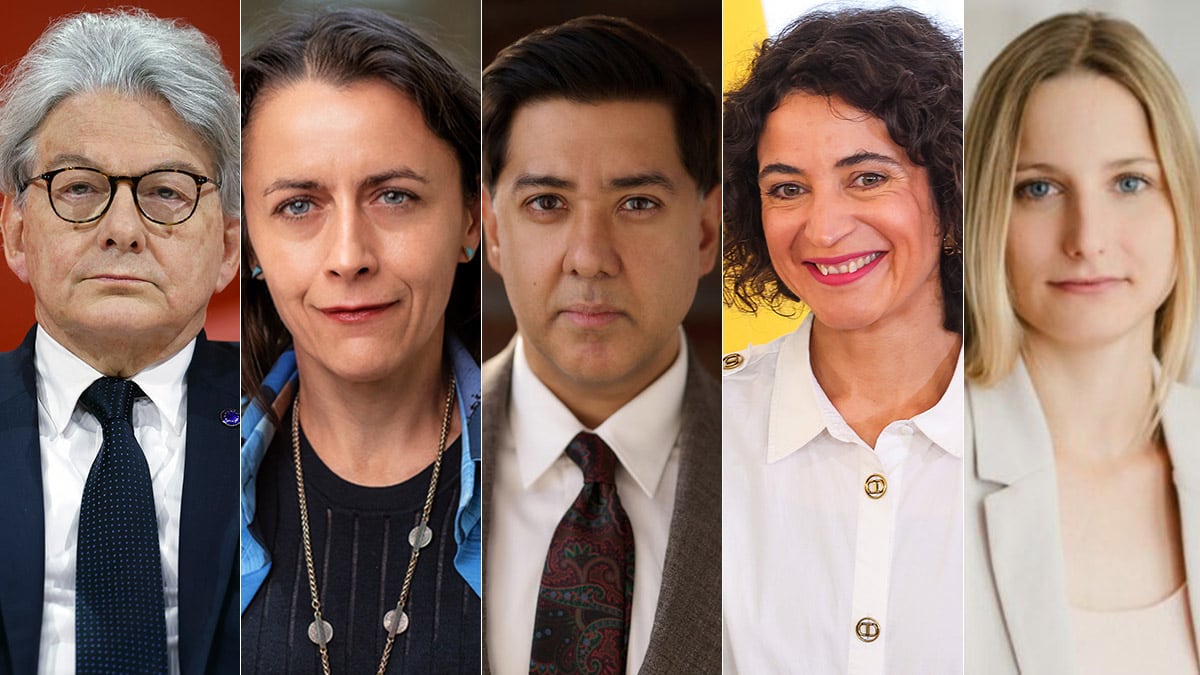
The White House considers them ‘radical activists,’ but all they do is push platforms to follow the law, curb disinformation, and stop hate speech. EL PAÍS speaks with them about being targeted by Trump
On December 23, 52-year-old Clare Melford received an email in which it was communicated that the status of her visa to enter the United States, where the United Kingdom resident had planned to travel in January for work, had gone from “approved” to “pending.” Minutes later, her cell phone began to receive messages from family members and colleagues. The U.S. Under Secretary of State Sarah B. Rogers had cited her in a message on X as one of the five foreigners that the U.S. has banned from entering the country. “She leads Global Disinformation Index (GDI), a U.K.-based organization that monitors websites for ‘hate speech’ and ‘disinformation’. […] This NGO used State Department taxpayer money to exhort censorship and blacklisting of American speech and press,” stated Rogers.
“It was a shock. It’s never nice to be singled out like that, especially hours before Christmas Eve, when all you want to do is wrap presents and peel vegetables,” Melford told EL PAÍS via email. On December 24, she received an email from the ESTA program, the system that manages U.S. visas. Her trip had not been authorized. “They didn’t give me any explanation, nor have they at any point,” she says. She still has not decided whether or not she will take legal action against the decision.
Former European Commissioner for Internal Markets, Thierry Breton, the best known of the five European citizens who were banned from the United States, has turned to the courts. In his case, he was accused of being “a mastermind of the Digital Services Act [DSA],” the European Union regulation designed to oversee large tech companies, and which demands of them transparency and that they take responsibility for the content circulated on their platforms.
The Trump administration has not tried to hide its decision to deny visas to five people in direct response to the EU’s supposed “censorship” of social media platforms, like X, which is property of Elon Musk (former star adviser to Donald Trump and principal donor to his electoral campaign), and Meta’s Instagram and Facebook. According to U.S. Secretary of State Marco Rubio, they’ve been banned because they “have led organized efforts to coerce American platforms to censor, demonetize, and suppress American viewpoints they oppose.”
The White House sanctioned five individuals it labeled as “radical activists,” a group that includes Melford, Breton, and three other nonprofit leaders who work to ensure social‑media platforms follow the law, curb disinformation, and limit hate speech — what Rubio calls “censorship.” Breton is the big‑game target, the only political figure among those hit by the ban; the others have, in one way or another, helped enable the EU to apply corrective measures against major tech companies, such as forcing them to remove fake news or imposing fines for violating regulations.
Un vent de maccarthysme souffle-t-il à nouveau ? 🧹Pour rappel : 90 % du Parlement européen — démocratiquement élu — et les 27 États membres à l’unanimité ont voté le DSA 🇪🇺À nos amis américains : « La censure n’est pas là où vous le pensez. »
“Are the winds of McCarthyism blowing again?” Breton shared in a message on X upon hearing of the ban. “Ninety percent of the European Parliament and the 27 member-states voted unanimously for the DSA,” continued the French statesman. McCarthyism is not an unreasonable term. The European Parliament came to a similar conclusion when (after taking a month to do so), it responded at the end of January with a statement on the withdrawal of Breton’s visa. “This is an unacceptable personalization of EU policy, a dangerous precedent for the independence of the European Institutions and an attack on the EU’s regulatory sovereignty,” reads the statement.
“This is about Big Tech. We know that Elon Musk doesn’t like us — he sued us two years ago, and we won the case. This time, he preferred to push the nuclear button. He’s called his friends in the White House and asked them to get us out of the way,” Imran Ahmed, director of the Center for Countering Digital Hate (CCDH), says by video call from Washington.
The 47-year-old political scientist born in Manchester leads an institution that has documented the rise in racist, antisemitic and extreme-right content that has flooded Twitter since Musk bought the platform, and renamed it X. The $120-million fine that the European Commission imposed on X in December (the first to be levied under the DSA) for lack of transparency in advertising and for the misleading design of the blue check, which now appears on accounts that pay for the designation, relied on information from CCDH reports.
Ahmed’s organization recently published an investigation in collaboration with The New York Times that counted three million sexualized images generated in just 11 days by Grok, Musk’s artificial intelligence tool. The project contributed to the European Commission’s decision to launch an investigation against Grok and X related to the creation of sexualized images of minors (of which the CCDH report identified “at least” 23,000).
Ahmed also found out through a message on X that his name was on the blacklist. But his situation is different — he’s the only one of the five banned Europeans who lives in the United States. He moved to Washington five years ago, and now lives there with his wife and daughter, both of whom are U.S. citizens. He has good reason to be nervous. “They want ICE agents to knock down my door, arrest me and send me to a state like Louisiana, where they have more favorable jurisdictions than in Washington DC and New York.”
On principle, and because he has a life in the country, Ahmed has taken the legal route. “You can’t remove someone with permanent legal residency without going through the courts. And there, facts matter. I am confident that the logic through which they want to deport me is fundamentally unconstitutional. Freedom of speech is explicitly protected by the First Amendment,” he says.
Weeks before Rubio announced the ban on the five Europeans, Ahmed saw an article in which anonymous sources said that the Trump administration was going to take action against him due to his activism. “That gave us time to prepare and get together a great group of lawyers,” he says. On December 24, the day after his name appeared on the list, his legal team asked a federal judge in New York for a temporary restraining order to halt the process and prevent his possible detention. The court granted it and has blocked any arrest or deportation of Ahmed until March 2026.
“The last few weeks have been very stressful, from a professional as well as personal viewpoint,” says 44-year-old German Anna-Lena von Hodenberg, co-director of HateAid, a non-profit organization based in Berlin that provides psychological help and legal aid to people who have been affected by online hate speech such as death or rape threats. HateAid’s reports are read closely in Brussels, and have been used in making decisions related to the application of the DSA.
That is likely the reason why Von Hodenberg and her colleague Josephine Ballon, 35, also ended up on the State Department’s blacklist. Although their work is focused on Europe, they probably came onto the White House’s radar after Ballon gave an interview last March to CBS’s 60 Minutes. “That triggered a massive wave of criticism and trolling from U.S. users,” von Hodenberg recalls. Three hours before Rubio announced the sanctions, Ballon — who had a trip to the United States planned — received an email revoking her ESTA authorization.
The decision has already had consequences, says von Hodenber: “Two important financial partners have withdrawn their support in the last month. That has forced us to make internal changes to protect ourselves. We are preparing in case we receive even harsher sanctions,” says the co-director, who is trained in journalism. They are still deciding whether they will take legal action against the State Department’s decision.
“This is not about us. The U.S. government is defying European sovereignty and is trying to obstruct the application of regulations, specifically the DSA, to U.S. companies,” says von Hodenberg. Her organization defends people from online attacks. The CCDH puts together reports that are important to the application of the DSA. The GDI, the organization run by Melford, monitors press coverage in search of misinformation and discourses that generate hate, and then share that information with advertisers to aid in decisions regarding ad placement. “We do not censor. We do not boycott. We only investigate and share our data with interested parties. And the fact that they have banned me will only make us work harder,” she says.
“The big social media platforms don’t want to implement the regulation of countries in Europe, where they earn billions of euros. The U.S. government is supporting them by threatening to enact tariffs and reduce its involvement in NAITO,” says von Hodenberg. “The sanctions imposed on us and the other three Europeans are a new step in this escalation. In our opinion, the debate on censorship is an excuse to defend the economic interests of the companies they protect.”
“They are trying to silence our research,” says the CCDH’s Ahmed. “I think that strengthens the resolve, of both myself and the other four European citizens banned by the United States, to keep working, because if we are bothering [the White House], that means we are doing something right.” He is ready for a fight, and wants to continue to live in the country where he has made a family. “Governments often behave badly. It is up to us, the citizens, to not let them get away with it. If we don’t fight, if we accept the situation, we lose everything.”
Sign up for our weekly newsletter to get more English-language news coverage from EL PAÍS USA Edition
¿Quieres añadir otro usuario a tu suscripción?
Si continúas leyendo en este dispositivo, no se podrá leer en el otro.
¿Por qué estás viendo esto?
Si quieres compartir tu cuenta, cambia tu suscripción a la modalidad Premium, así podrás añadir otro usuario. Cada uno accederá con su propia cuenta de email, lo que os permitirá personalizar vuestra experiencia en EL PAÍS.
¿Tienes una suscripción de empresa? Accede aquí para contratar más cuentas.
En el caso de no saber quién está usando tu cuenta, te recomendamos cambiar tu contraseña aquí.
Si decides continuar compartiendo tu cuenta, este mensaje se mostrará en tu dispositivo y en el de la otra persona que está usando tu cuenta de forma indefinida, afectando a tu experiencia de lectura. Puedes consultar aquí los términos y condiciones de la suscripción digital.
Comments
No comments yet.
Log in to leave a comment.