Kayan Taraporevala Kayan Taraporevala
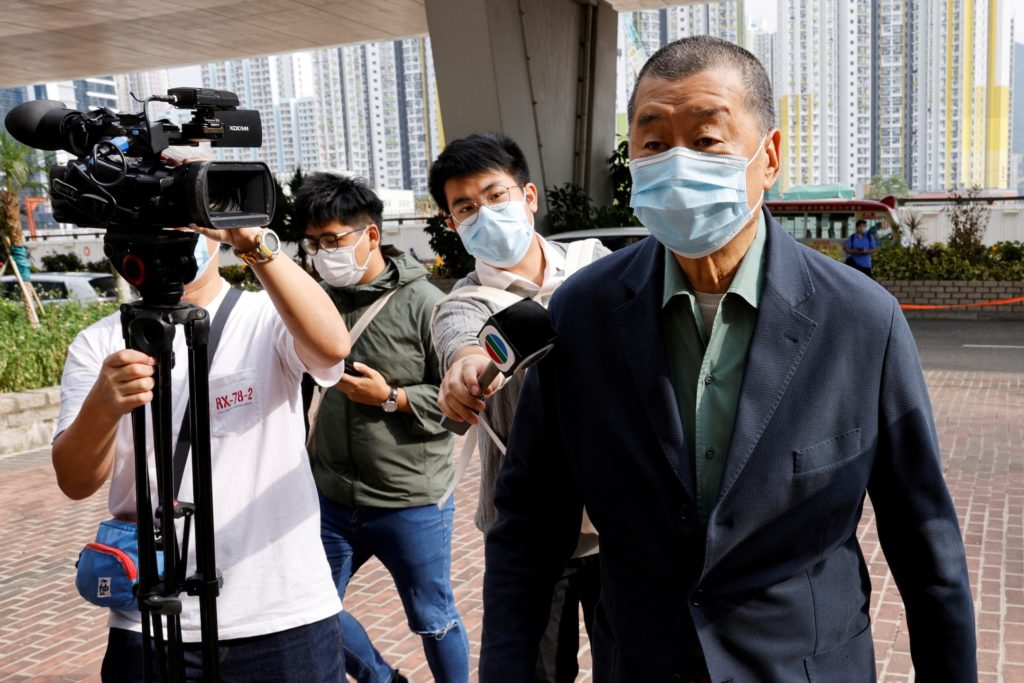
Hong Kong democracy advocate and former media tycoon Jimmy Lai, who is 78, has been sentenced to 20 years in prison by a Beijing-backed court. It is the longest sentence handed down under China’s national security law that has effectively silenced dissent. Nick Schifrin discussed more with former Ambassador Nicholas Burns.
Notice: Transcripts are machine and human generated and lightly edited for accuracy. They may contain errors.
Hong Kong democracy advocate and former media tycoon Jimmy Lai, who is 78 years old, has been sentenced to 20 years in prison by a Beijing-backed court.
It is the longest sentenced handed down under China's national security law, legislation that has effectively silenced dissent in a city that for decades operated under British rule of law.
The U.S. called the sentence by the China-backed court and Lai's earlier conviction for so-called collusion with foreign forces unjust. Lai's children called it a death sentence.
Nick Schifrin has more.
Inside a Hong Kong court that once proudly protected Western liberties, authorities took an icon of democracy away and confirmed that criticism in this city will be crushed with Chinese characteristics.
For decades, Jimmy Lai struggled for Hong Kong's freedoms, an ever-present force fighting to preserve the city's rule of law. He arrived in Hong Kong at the age of 12, escaping communist China by stowing away on a fishing boat. He worked his way up to become a media tycoon, one of the city's most successful and powerful businessmen.
But in the summer of 2020, Lai became the most prominent person arrested under Beijing's sweeping national security law, which allowed Beijing-backed authorities to punish people for -- quote -- "provoking the hatred of Beijing" or receiving any support from a foreign country.
That was Lai's conviction for -- quote -- "conspiring to collude with foreign forces" and for publishing -- quote -- "seditious articles," sentiments echoed today by China's Foreign Ministry.
Lin Jian, Chinese Foreign Ministry Spokesperson (through interpreter):
His actions have gravely endangered national security and severely harmed Hong Kong's prosperity, stability, and the well-being of its residents. And, therefore, he deserved to be severely punished in accordance with the law.
And that makes Lai's detention and sentence about more than the man; 30 years ago, he founded Apple Daily, a tabloid willing to criticize the Hong Kong and Beijing governments. Today, six of its former employees were also sentenced, further extinguishing Hong Kong's press freedom, says Edward Li, another former employee who's now in exile in Taiwan.
Edward Li, Former Employee, Apple Daily (through interpreter):
A former Apple Daily colleague said to me: "You didn't have much hope to begin with, and now you don't even have the slightest bit left."
That criminalizes the exercise of freedom of association and expression.
Today, the sentencing condemned by the United Nations, other governments and Secretary of State Marco Rubio, who called it a -- quote -- "unjust and tragic conclusion to this case."
It is especially tragic for Lai's children. Lai's daughter Claire called the sentence heartbreakingly cruel, saying, if it's carried out, he will die a martyr behind bars. His son Sebastien today called it a death sentence.
I interviewed Sebastien last fall.
As you know, I interviewed your father in August 2020, and this is my last question to him.
Are you resigned on a personal level to being found guilty and spending a long time, even perhaps the rest of your life, in prison?
Jimmy Lai, Founder, Next Digital:
I don't think about this because I don't want to put the psychological burden on myself until the time comes. I'm not worried just because my life is about myself. It will be meaningless. Only when I detach from myself and thinking of my life is about something bigger and not about myself that my life becomes meaningful. And that makes me going every day.
What's your response to watching that?
Sebastien Lai, Son of Jimmy Lai: It's -- yes, it's obviously very emotional. And he knew that despite obviously the danger, to his life that he had something mattered more. And so he stayed and defended his principles and defended his colleagues. And I'm so proud to call this man my father.
And, today, Sebastien Lai appealed to President Trump to once again push for Jimmy Lai's release during an April trip to Beijing.
For perspective on all this, we turn to longtime career diplomat and former U.S. Ambassador to China during the Biden administration Nicholas Burns. He's now professor of the practice of diplomacy and international relations at Harvard University.
Nick Burns, thanks very much. Welcome back to the "News Hour."
We have talked for years about the erosion of democracy, freedom of the media and press in Hong Kong, and that rule of law in the city looks like rule of law in mainland China. And so what makes this 20-year sentence so significant?
Nicholas Burns, Former U.S. Ambassador to China: Nick, this is a travesty of justice. Jimmy Lai is a great man. He is the strongest voice for freedom, democracy, press rights, individual rights in either Hong Kong or China today.
And he was not judged by a jury of his peers, but by a kangaroo court of judges appointed and beholden to Beijing. And so that's why this is important. There's a climate of fear in China today. There's increased repression in this authoritarian dictatorship.
And he is the most prominent case. And I think it's very positive that Secretary Rubio issued the statement today, positive that President Trump raised the case of Jimmy Lai with President Xi Jinping when they met last autumn. And I hope very much that the Chinese are now going to come under a lot of pressure, the government of Beijing, to issue a humanitarian release of Jimmy Lai to live in his remaining years wherever he wants.
I think that's what the United States should be pushing for.
Lai's children have said that he is of ill health.
But remind us, what did Beijing promise when the United Kingdom handed over Hong Kong back in 1997?
I remember very distinctly, Nick. I was with our secretary of state, Madeleine Albright, in Hong Kong on June 30, 1997, when the United Kingdom handed over control and rule in Hong Kong to the People's Republic of China.
And the Chinese leadership told us privately and they told the world publicly that there would be 50 years of autonomy for the people of Hong Kong, that their individual rights, like freedom of speech and freedom of the press, would be guaranteed. And so of course, this sentencing and the national security law that has taken place in Hong Kong has made the Chinese renege on all of their promises to the people of Hong Kong.
And it's a very, very bitter result. So they have gone back on their word, as many people suspected that they would. And that's a warning. That's a warning to the people of Taiwan. When the government of Beijing blithely says, we will let you have the same freedoms that you enjoy now, that won't be the case if the Chinese succeed in taking over Taiwan.
The Hong Kong office of China's Foreign Ministry today issued a statement, saying that foreign media should -- quote -- "respect the independents of Hong Kong's judicial process."
Is there any doubt that Hong Kong's judicial process is beholden to Beijing?
None whatsoever. In fact, Hong Kong today is a fully owned subsidiary of the People's Republic of China.
I was there in 2024 while I was in China as ambassador. I went to Hong Kong, in fact, during the week when this odious national security law was strengthened, and saw the fact that freedom of speech had largely disappeared then and that businesspeople had been cowed, both Western, as well as Hong Kong business people.
And there was very little, if any, freedom of the press. And I think today's sentencing has really put the lid on what was once a great, great role that the Hong Kong citizens had in living in a free society next to mainland China.
As you mentioned and as Sebastien Lai mentioned today, President Trump did bring Jimmy Lai up to Xi Jinping late last year. President Trump, of course, is going to visit Beijing in April. Do you think there is any leverage that the U.S. could push for Beijing to release Jimmy Lai?
I think that there's a strong outcry by the democratic world and the United Kingdom, certainly, and the United States and elsewhere that this is unjust, that Jimmy Lai should be free.
He's already lived, Nick, five years in solitary confinement, and he's not well. And so I think, if the outcry is strong enough, and if our government and the British government push strongly enough, there is a chance that the government in Beijing will decide that a humanitarian parole may be is in their best interest because this really shines a light on the fact that the government of Xi Jinping is increasingly oppressive, increasingly autocratic.
You see the number of businesspeople, the number of military people who've disappeared, brought up on charges of corruption. And so the climate in China is very, very severe right now, much more so than 10 to 20 years ago.
Well, as you say, it's not only Jimmy Lai.It's not only Hong Kong or democracy or press freedom. Business leaders, Communist Party members, Christian Uyghurs, I mean, they have all been targeted by Xi Jinping's China.
And now we have, as you just alluded to, the equivalent of the chairman of the Joint Chiefs of Staff basically. You see him there, General Zhang Youxia, essentially disappeared or he's been fired all of a sudden. What do you make of this?
This is the most important purge of a military leadership in China since 1971, when Lin Biao, who was the successor to Mao Zedong, failed in a coup attempt and died in a plane crash. There's been nothing like it in China since.
General Zhang was a close friend and associate of President Xi. And the fact that he's been purged and that nearly the entire military leadership of the country has been brought up on corruption charges, these are really uncharted waters for President Xi. And it indicates that he obviously wants full and absolute control of his government.
Maybe there's a sense of paranoia here, that he feels that he can't allow other people to have any degree of power. He has not named a successor. And, in 2027, next year, he will very likely decide to try to have a fourth five-year term in office. And that means probably he will be president for life.
So this is a very significant development, both the sentencing today, but also the purge of the military. And on top of that, Nick, the Chinese in November and December launched a major arrest of religious leaders, Christian leaders in China.
Nick Burns, former ambassador to Beijing, thank you very much.
Watch the Full Episode
By Kanis Leung, Associated Press
By Kanis Leung, Associated Press
By Kanis Leung, Associated Press
By Kanis Leung, Associated Press
Nick Schifrin Nick Schifrin
Nick Schifrin is PBS News Hour’s Foreign Affairs and Defense Correspondent and serves as the host of Compass Points from PBS News.
Kayan Taraporevala Kayan Taraporevala
Kayan Taraporevala is an Associate Producer for PBS News Hour.
Subscribe to Here's the Deal, our politics newsletter for analysis you won't find anywhere else.
Thank you. Please check your inbox to confirm.
© 1996 - 2026 NewsHour Productions LLC. All Rights Reserved.
PBS is a 501(c)(3) not-for-profit organization.
Subscribe to Here's the Deal with Lisa Desjardins
Thank you. Please check your inbox to confirm.
Support for News Hour Provided By
Comments
No comments yet.
Log in to leave a comment.