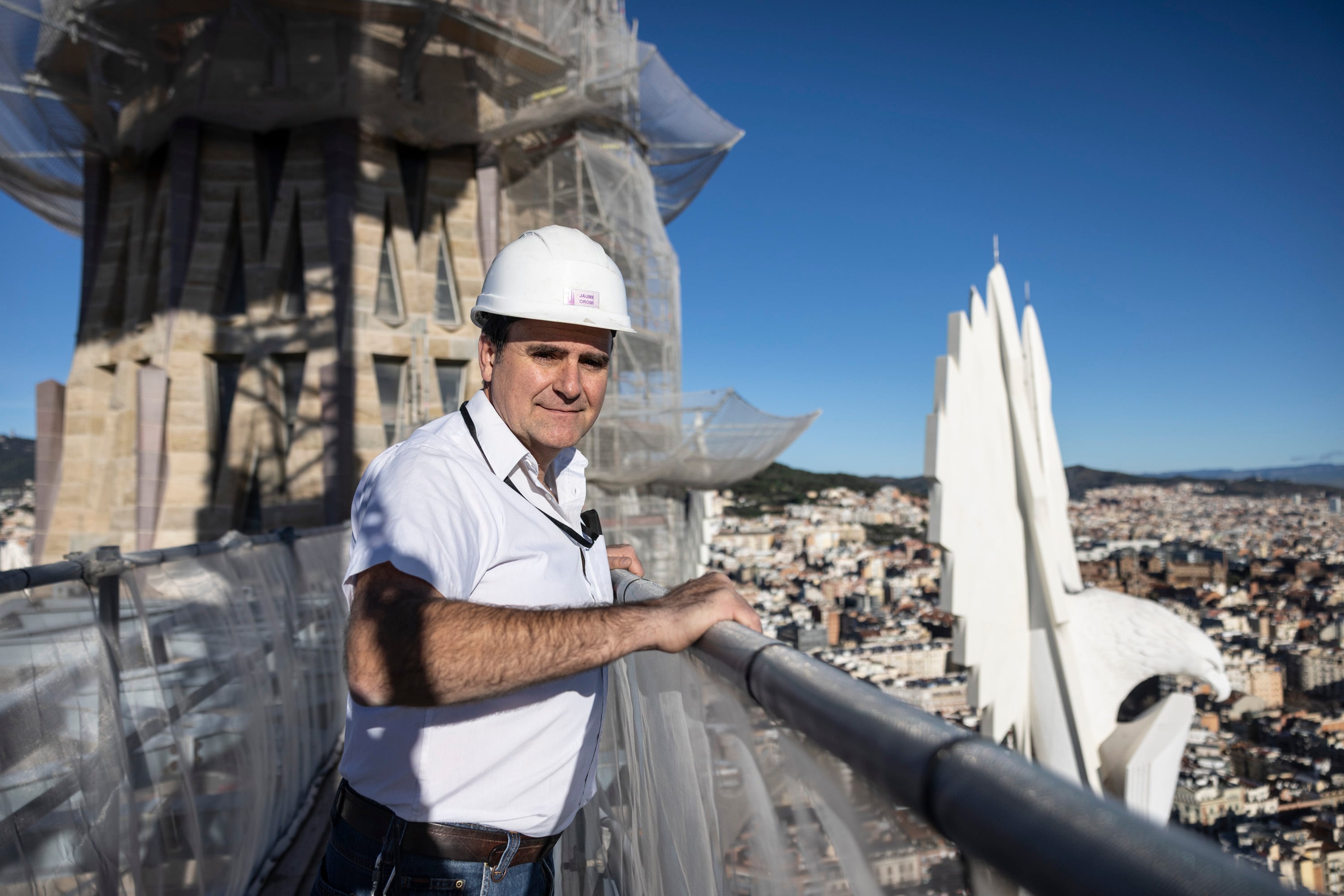
General foreman Jaume Oromí discusses the work at the temple, which is set to rise to 172.5 meters: ‘We always have the visitors below us’
Since last November, Barcelona’s Sagrada Família has been the tallest church in the world. A few months earlier, in August, it had become the tallest building in the city. But Spanish architect Antoni Gaudí did not want a human work to surpass a creation of nature — “a work of God,” he said. And so the project approaches its maximum height without exceeding Montjuïc mountain, which stands at 173 meters.
At 85 meters up, David, a French stonemason, is giving the final touches to a piece that will form part of the bridge linking the Tower of Jesus with that of the evangelist Luke. The stone hangs from the crane operated by José Encina, who works from a cabin at 140 meters. The general foreman of the temple’s construction is Jaume Oromí, the conductor of an orchestra of about 150 workers, who likes to describe himself as a “master builder.” Wearing a hard hat, work jeans, and a short‑sleeved shirt on a Tuesday in February, he walks the site every day — from the materials yard at street level to the crane access bridge at 131 meters — moving through elevators, hoists, stairways, openings that will become stained‑glass windows, interior and exterior scaffolding, and walkways. He ensures everything is in order and safe. All this take place while dealing with the unusual reality of building a monument that is open to the public: “We always have the visitors below us.”
The completion date for the Tower of Jesus — the central and tallest tower of the temple envisioned by Gaudí, rising to 172.5 meters — is drawing near. It will be finished in a matter of weeks. After that, the scaffolding surrounding it — a custom‑built structure designed to withstand strong winds — will have to be removed. The tower will be inaugurated on June 10, the centenary of the architect’s death, a commemoration for which the Construction Board has invited Pope Leo XIV. In 2024, the most recent year for which data has been published, the Sagrada Família received 4.8 million visitors. It generated around €134 million ($160 million) in revenue, all from private sources, and 52% of that amount was allocated to construction work.
Unlike most buildings, over more than 140 years of construction the Sagrada Família has not risen continuously upward, but has been built in phases. Before his death, Gaudí had advanced the Nativity façade considerably and completed the Tower of Barnabas, so that part of the temple could be shown and donations would continue to flow. A century later, the complex is now almost fully completed in height: the basilica, the Nativity and Passion façades (with sculptures by Josep Maria Subirachs), the towers to the apostles, the towers to the four evangelists, the Tower of Virgin Mary (inaugurated in 2021), and — nearly finished — the Tower of Jesus.
What will remain is finishing the interior of this tower — which will be open to visitors in the future — the Chapel of the Assumption, the roofs where two of the three cranes currently stand, a sacristy, and also the Glory façade (with its chapels). The latter is the subject of public and political controversy, because the Construction Board is determined to build an access staircase that would require demolishing residential buildings. The mayor of Barcelona, Jaume Collboni, argues that if residents must be relocated, the Board should bear the cost.
At the site, 54 meters up, at the base of the crane that reaches 200 meters when its arms are fully extended, several workers are focused on the upper piece of the cross atop the Tower of Jesus. They are installing interior marble or glass in one of its openings. In total, the cross is made up of 15,000 ceramic pieces, produced from 500 different molds and seven shades of white. At the very top, there is a lightning rod and a beacon light for signaling. Much higher, at 131 meters, the crane is connected by a bridge to a giant metal ring — a brace that anchors it to the inside of the central tower. Vertigo is not your friend at this height. The crane operator, José Encina, waves from behind the cabin’s glass.
On this site, Oromí notes, the three cranes are essential construction elements for lifting materials, auxiliary structures, and architectural pieces, with stone, concrete, and steel being the main materials used. The central crane, a latest‑generation model from the German manufacturer Liebherr, never stops. Its monitoring system (it even has a black box) has recorded movement for seven and a half hours out of the eight‑hour workday.
At the Sagrada Família, the operations that allow the work to move forward are crucial. In fact, when Jaume Oromí is asked about difficult or delicate moments, he immediately recalls the assembly of the base of the super‑crane: they had to lift a 25‑meter piece, suspended horizontally, threading it between the already‑built towers. They spent days calculating the maneuver to anticipate any unforeseen issue. “These are moments that never make the news,” he says, but they require dozens of professionals, including climbers. The general foreman also remembers Storm Gloria in 2020, when fierce winds made the scaffolding whistle.
Oromí takes pride in mastering the trade “in the broadest sense.” He likes to say he was an altar boy before becoming a friar. At 14, he helped his father as a laborer, at 17 he was working as a bricklayer, later he became a builder, and at 36 he studied architecture. “My children say this is the cherry on the cake. And it’s true that the Sagrada Família is a unique project, given its significance, but I like to think they all are, because we are entrusted with the confidence of those who commission them,” he says early in the morning in the materials yard.
His days begin with “a sweep through the entire site, checking that everything is in order” and that all safety measures are being followed. The temple employs its own staff as well as workers from companies hired for specific tasks. Logistics are key in such a complex project, with only two yards available to store materials — whether sculptures, stone, gas heaters for the basilica, or umbrellas to shelter tourists. And no matter how much planning is done, a windy or rainy day can force a change of plans.
“Another important thing is making sure everything happens with as little conflict as possible. Managing human relationships so that things run smoothly and with minimal friction is essential, even if it doesn’t show up in reports,” he emphasizes, with the calm demeanor of someone who seems unlikely to ever lose his temper. This Tuesday, in the materials yard, he checks that the team is ready to receive a large metal structure being transported by a truck whose arrival will require stopping traffic for a few minutes. He can recognize workers just by seeing their backs as they walk away.
Oromí, the man in charge of coordinating all the teams, is the kind who, even while speaking with someone, never loses track of what’s happening around him: who’s walking by, what’s going up, what’s coming down, what’s moving. “That was just a pencil falling,” he explains when a small thud is heard. The Sagrada Família also has the particularity of being under construction while up to 1,500 people visit it at the same time. “It makes us extremely aware of safety: the visitors, the fact that there are so many people around,” and even of what happens outside the fences, with cranes moving hundreds of tons. In addition to the paying visitors, about 18 million tourists come each year just to see it from the outside — 50,000 a day, according to the Barcelona City Council.
Oromí is 54, and estimates from the Construction Board point to at least another decade of work. He would already be old enough to retire, but he doesn’t consider it in the strict sense. He insists on the “seriousness, rigor, and utmost responsibility” with which the project is carried out — “a team effort, where you need trust in the crews and perspective, the ability to see the whole tree.” In the future, and “for fun,” he plans to pursue “a doctorate in structures.”
Sign up for our weekly newsletter to get more English-language news coverage from EL PAÍS USA Edition
¿Quieres añadir otro usuario a tu suscripción?
Si continúas leyendo en este dispositivo, no se podrá leer en el otro.
¿Por qué estás viendo esto?
Si quieres compartir tu cuenta, cambia tu suscripción a la modalidad Premium, así podrás añadir otro usuario. Cada uno accederá con su propia cuenta de email, lo que os permitirá personalizar vuestra experiencia en EL PAÍS.
¿Tienes una suscripción de empresa? Accede aquí para contratar más cuentas.
En el caso de no saber quién está usando tu cuenta, te recomendamos cambiar tu contraseña aquí.
Si decides continuar compartiendo tu cuenta, este mensaje se mostrará en tu dispositivo y en el de la otra persona que está usando tu cuenta de forma indefinida, afectando a tu experiencia de lectura. Puedes consultar aquí los términos y condiciones de la suscripción digital.
Comments
No comments yet.
Log in to leave a comment.